🧪 Homebrew Water Calculator
Build your perfect brewing water profile — add mineral salts & hit your target ion levels
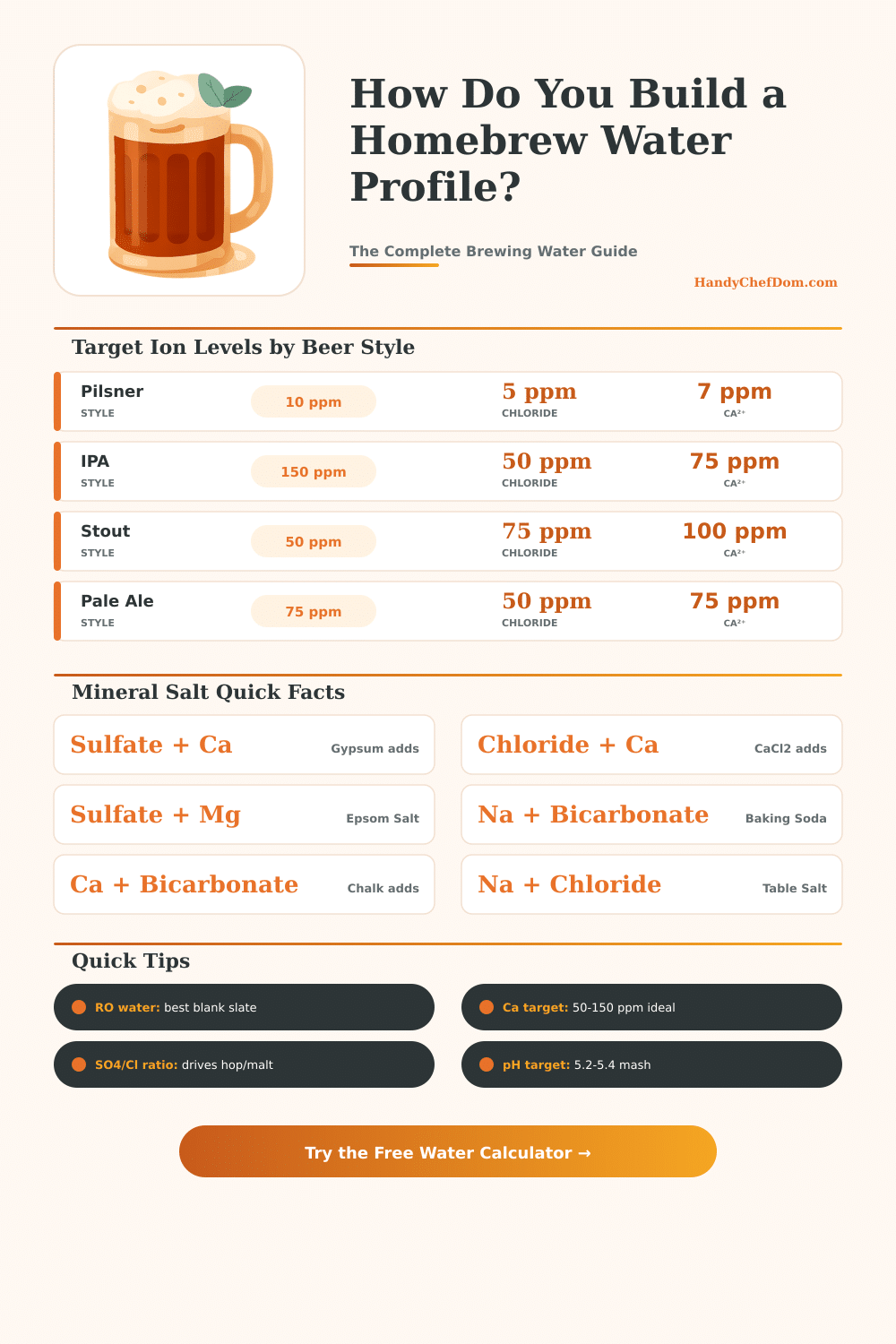
| Style | Ca²⁺ (ppm) | Mg²⁺ (ppm) | Na⁺ (ppm) | SO₄²⁻ (ppm) | Cl⁻ (ppm) | HCO₃⁻ (ppm) |
|---|---|---|---|---|---|---|
| Pilsner / Lager | 7–50 | 0–10 | 0–10 | 5–30 | 0–20 | 0–50 |
| West Coast IPA | 75–150 | 5–15 | 0–25 | 100–300 | 30–75 | 0–50 |
| NEIPA / Hazy IPA | 75–150 | 5–15 | 0–25 | 25–75 | 75–150 | 0–50 |
| Pale Ale / APA | 50–100 | 5–15 | 0–25 | 50–150 | 25–75 | 0–75 |
| Stout / Porter | 50–150 | 5–20 | 0–50 | 25–100 | 50–150 | 50–200 |
| Amber / Red Ale | 50–100 | 5–15 | 0–25 | 25–75 | 25–75 | 25–100 |
| Hefeweizen | 25–75 | 5–15 | 0–15 | 10–30 | 15–50 | 50–150 |
| Belgian Ale | 25–75 | 5–15 | 0–20 | 10–50 | 15–50 | 25–100 |
| Saison / Farmhouse | 50–100 | 5–15 | 0–20 | 25–75 | 15–50 | 25–75 |
| Salt | Formula | Ca²⁺ ppm | Mg²⁺ ppm | Na⁺ ppm | SO₄²⁻ ppm | Cl⁻ ppm | HCO₃⁻ ppm |
|---|---|---|---|---|---|---|---|
| Gypsum | CaSO₄·2H₂O | 61.5 | 0 | 0 | 147.4 | 0 | 0 |
| Calcium Chloride | CaCl₂·2H₂O | 72.0 | 0 | 0 | 0 | 127.5 | 0 |
| Epsom Salt | MgSO₄·7H₂O | 0 | 26.1 | 0 | 103.7 | 0 | 0 |
| Table Salt | NaCl | 0 | 0 | 104.0 | 0 | 160.3 | 0 |
| Baking Soda | NaHCO₃ | 0 | 0 | 72.3 | 0 | 0 | 192.9 |
| Chalk | CaCO₃ | 105.9 | 0 | 0 | 0 | 0 | 158.3 |
| Ratio (SO₄:Cl) | Flavor Character | Best For |
|---|---|---|
| 0.5 : 1 (or less) | Very Malty / Soft / Round | Stouts, NEIPA, Sweet Porters |
| 0.5–1 : 1 | Malt-forward, Balanced | Amber, Hefeweizen, Belgian |
| 1 : 1 | Balanced / Neutral | Pale Ales, All-rounders |
| 1–2 : 1 | Hop-forward / Crisp | Pale Ales, Session IPAs |
| 2–4 : 1 | Dry / Bitter / Assertive Hops | West Coast IPA, Pilsner |
| 4+ : 1 | Very Dry / Harsh (use sparingly) | Burton Ales only |
| Beer Style | Target Mash pH | Notes |
|---|---|---|
| Pale Lager / Pilsner | 5.2 – 5.4 | Lower pH enhances crispness |
| Pale Ale / IPA | 5.2 – 5.5 | Sweet spot for hop character |
| NEIPA / Hazy | 5.3 – 5.5 | Slightly higher preserves softness |
| Amber / Red Ale | 5.3 – 5.5 | Darker malts help lower pH |
| Stout / Porter | 5.3 – 5.6 | Roasted malts naturally acidify |
| Hefeweizen | 5.3 – 5.5 | Wheat malt raises pH slightly |
| Belgian Ales | 5.2 – 5.5 | Depends heavily on grain bill |
One of those elements, that does not seem that heavy, as it should, but that actually affects almost everything about your beer, the flavor, the nuance, the aroma, even the feeling in the mouth. The chemicals of the homebrew water can get really complex, even so. The best starting point is that if you learn the basics well, you can control what ultimately appears in your glass.
Your homebrew water comes from one of two sources. There are surface waters, pools, rivers, streams, and also groundwater, that is pumped from underground reservoirs. Groundwater usually carries more minerals, but fewer organic pollutants like algae.
Simple Homebrew Water Tips
The old idea of “hard water” simply pointed to how hard it was to make soap bubble in the water. That is not exactly what you need to know, when you prepare beer.
If your homebrew water has drinkable taste, probably it will work for brewing. One single Campden tablet can neutralize chlorine and chloramine, one tablet for around 75 liters. Use filtered water or pass it through a carbon filter are otehr modes.
Even small amounts of chlorine can bring weird taste, that upsets every brew, that you do, regardless of the kind. The water changes dramatically according to the place, where you live. Some regions have almost no dissolved stuff in it, while others are full of minerals.
Reverse osmosis (RO) water is liked, because it stays stable from one brew to the next. Even so, RO water bought in store sometimes has too few minerals, so that the fermentation really works, so you maybe will have to add a bit of minerals.
You can modify your water all along by adding salts. Calcium chloride and gypsum are the typical culprits. The rule “less is more” works best, avoid overdoing it, that results in heavy, mineral beer after all those efforts.
If 200 ppm of calcium seems too heavy, mix with distilled water or lower the pH with acids, to avoid overloading of salts.
A simple dropper allows you too add acid directly in the water or the mash, to set the pH. A pH meter helps to keep everything honest. Programs like BeerSmith, ProMash and BrewFather have built-in tools for counting how salt corrections alter your water.
The website of BrewFather combines recipes with water profiles in one place. Here the water calculators convert salt amounts into regular spoons.
Do a test of your local water in a lab, then use those values to set everything. Here is what separates average beer from something really great. The bitterness comes from hops, minerals in the homebrew water and the grains, so correcting all three all along doeseverything smoother.
Baking soda, Epsom salt, gypsum, calcium carbonate and acids are all tools to reach your wanted profile.