🍺 Homebrew Priming Sugar Calculator
Calculate the exact amount of priming sugar for perfectly carbonated beer
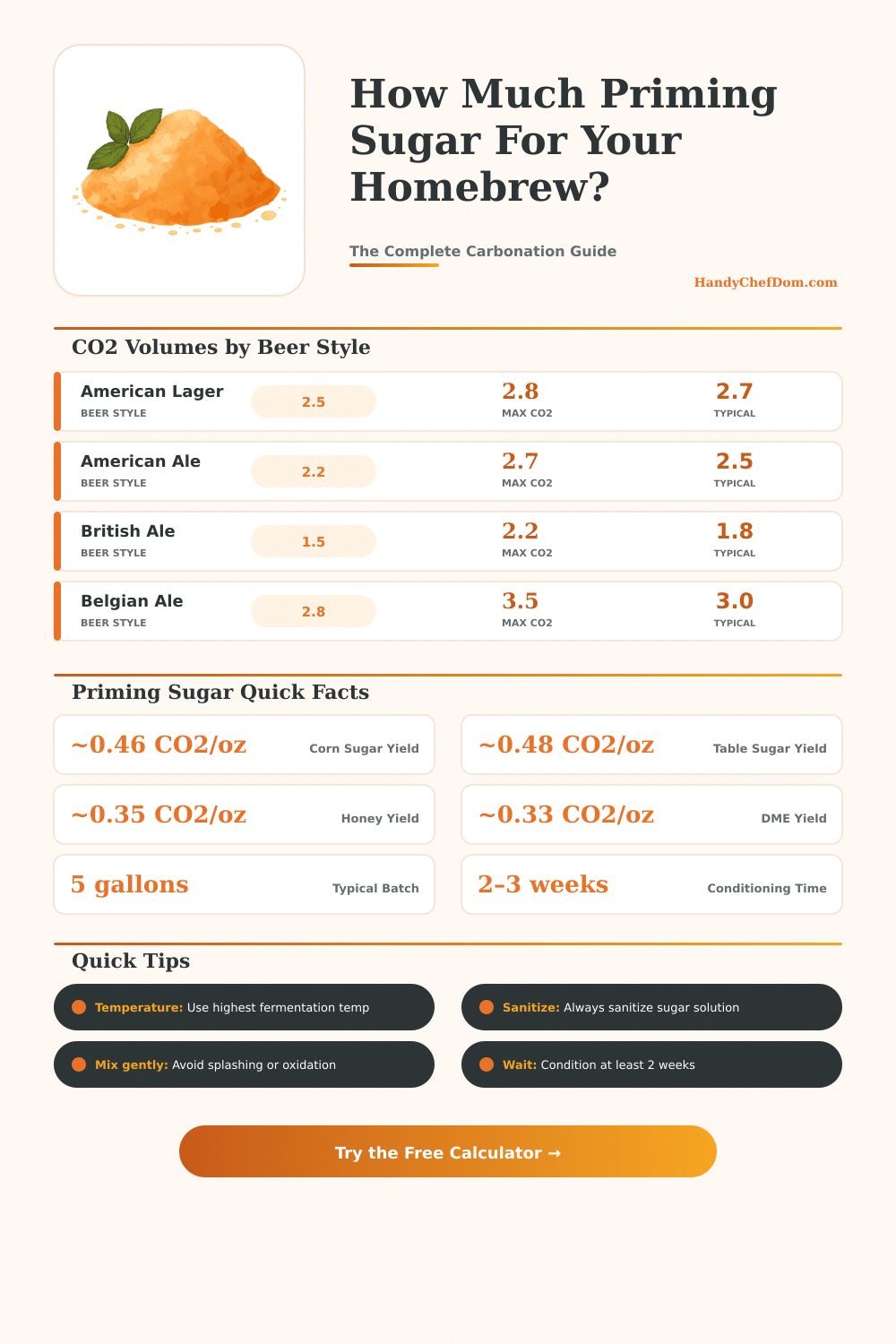
| Beer Style | Min CO₂ | Max CO₂ | Typical | Notes |
|---|---|---|---|---|
| American Lager / Light | 2.5 | 2.8 | 2.65 | Crisp, fizzy finish |
| American IPA / Pale Ale | 2.2 | 2.7 | 2.5 | Classic US ale range |
| British Bitter / Mild | 1.5 | 2.2 | 1.8 | Low carb, cask style |
| Hefeweizen / Wheat Beer | 3.3 | 4.5 | 3.7 | Very highly carbonated |
| Belgian Tripel / Strong | 2.8 | 3.5 | 3.0 | High, fruity |
| Saison / Farmhouse | 3.0 | 4.0 | 3.5 | Spritzy, effervescent |
| Dry Stout / Stout | 1.7 | 2.3 | 2.0 | Low, creamy |
| Robust Porter | 1.8 | 2.5 | 2.2 | Moderate body |
| Barleywine / Imp. Stout | 1.5 | 2.2 | 1.9 | Low carb suits big beer |
| Czech / German Pilsner | 2.3 | 2.6 | 2.4 | Crisp lager |
| Lambic / Gueuze | 2.4 | 4.5 | 3.5 | Wild ferment, high |
| Hard Cider / Mead | 2.5 | 3.5 | 3.0 | Like champagne style |
| Sugar Type | Fermentability | oz per 5 gal* | g per 20 L* | Notes |
|---|---|---|---|---|
| Corn Sugar (Dextrose) | ~100% | 4.0–5.0 | 113–142 | Most predictable, go-to |
| Table Sugar (Sucrose) | ~100% | 3.8–4.8 | 108–136 | Slightly less by weight |
| Turbinado / Raw Sugar | ~98% | 3.9–4.9 | 110–139 | Similar to table sugar |
| Dry Malt Extract (DME) | ~75% | 5.3–6.5 | 150–184 | Adds malty flavor |
| Honey (avg. grade) | ~95% | 5.0–6.0 | 142–170 | Varies by source |
| Maple Syrup (Grade A) | ~90% | 5.5–6.5 | 156–184 | Adds subtle maple |
*Approximate for 2.5 volumes CO₂ target at 68°F / 20°C
| Temp °F | Temp °C | Residual CO₂ (vols) | Typical Style |
|---|---|---|---|
| 32°F | 0°C | 1.73 | Cold-crashed lager |
| 40°F | 4°C | 1.46 | Lagered & cold |
| 50°F | 10°C | 1.16 | Cold fermented ale |
| 60°F | 15.5°C | 0.92 | Cellar temp ale |
| 65°F | 18°C | 0.82 | Ale ferment low |
| 68°F | 20°C | 0.76 | Common ale temp |
| 72°F | 22°C | 0.70 | Warm ale / saison |
| 75°F | 24°C | 0.65 | Belgian strong |
| 80°F | 27°C | 0.58 | High temp saison |
Before one bottles the beer, the homebrew of beer lay priming sugar for help to second fermenting stage in the bottles. Later everything becomes very easy: the leftover fermentation gets new food and start to produce carbon dioxide. Because the bottle closes tight all those CO2 stay inside and build up, so like this is born the fizz.
The most many homebrew choose dextrose, that one commonly calls corn sugar, when comes the moment for the process. That sugar stays neutral and do not alter the taste of your beer or cider during the process of fizz. From viewpoint of fermentation, glucose is exactly that, what the fermentation likes most and processes most quickly, hence one considers it the best standard.
How to Use Sugar to Make Your Beer Fizzy
Corn sugar became the usual option for many homebrew, because it is easy and the fermnetation uses it up fairly soon.
But here the main spot: corn sugar is not the only option. Between the most used replacements are table sugar and dry malt extract. The brewers became creative during years, applying everything from malt extract to honey for process his beer in bottles.
Brown sugar acts gram after gram likewise as corn sugar. Honey adds soft flowery hints, if you want something fresh, although it costs more money. Table sugar works well also, and I noticed, that some sets improved, when makers changed from corn sugar to it.
The key is, that every kind of priming sugar acts differently about the amount, that you require, and the speed, by which fermentation it process, so there is not one universal recipe.
One interesting detail to note is, that corn sugar tends to give more creamy foam with nice bubbles. Cane sugar, on the other hand, generate bigger bubbles and do not help too nice foam. Dry malt extract works well, although the carbonation process lasts a bit more long with it.
The most used way is the old process. One dissolves the sugar in almost two cups of boiled water and mix that in the bottling bucket before pouring the beer. The common beer naturally mixes with the sugar water.
After that, a bit of gentle stirring help spread it more evenly. If you skip the stirring step, you risk problems, half of your bottles could end almost without fizz.
Most many kits for five gallons of homebrew come with bag of five units of corn sugar. That gives around 2.7 volumes of CO2. The problem is, that use the whole amount commonly cause too much fizz and much lost beer, that foams out. Around 3.9 units for five gallons usually work more well in the whole range.
Weigh the sugar is safer than measuring it, because loose space messes up the rating. Volume ratings simply are not that precise, especially if you prepare beer for contest.
Carbonation tablets are another way, they are simply big sugar tablets. You lay one in 12-ounce bottle or two in 22-ounce. Those tablets offer ease for little sets andremove much his effort.