🍖 Meat Temperature Calculator
Set pull temps, carryover, and rest windows for beef, pork, poultry, lamb, and brisket with confidence.
Poultry and ground meat automatically clamp to USDA-safe minimums. Whole cuts and brisket still use the doneness target you choose, then subtract carryover for the pull temp.
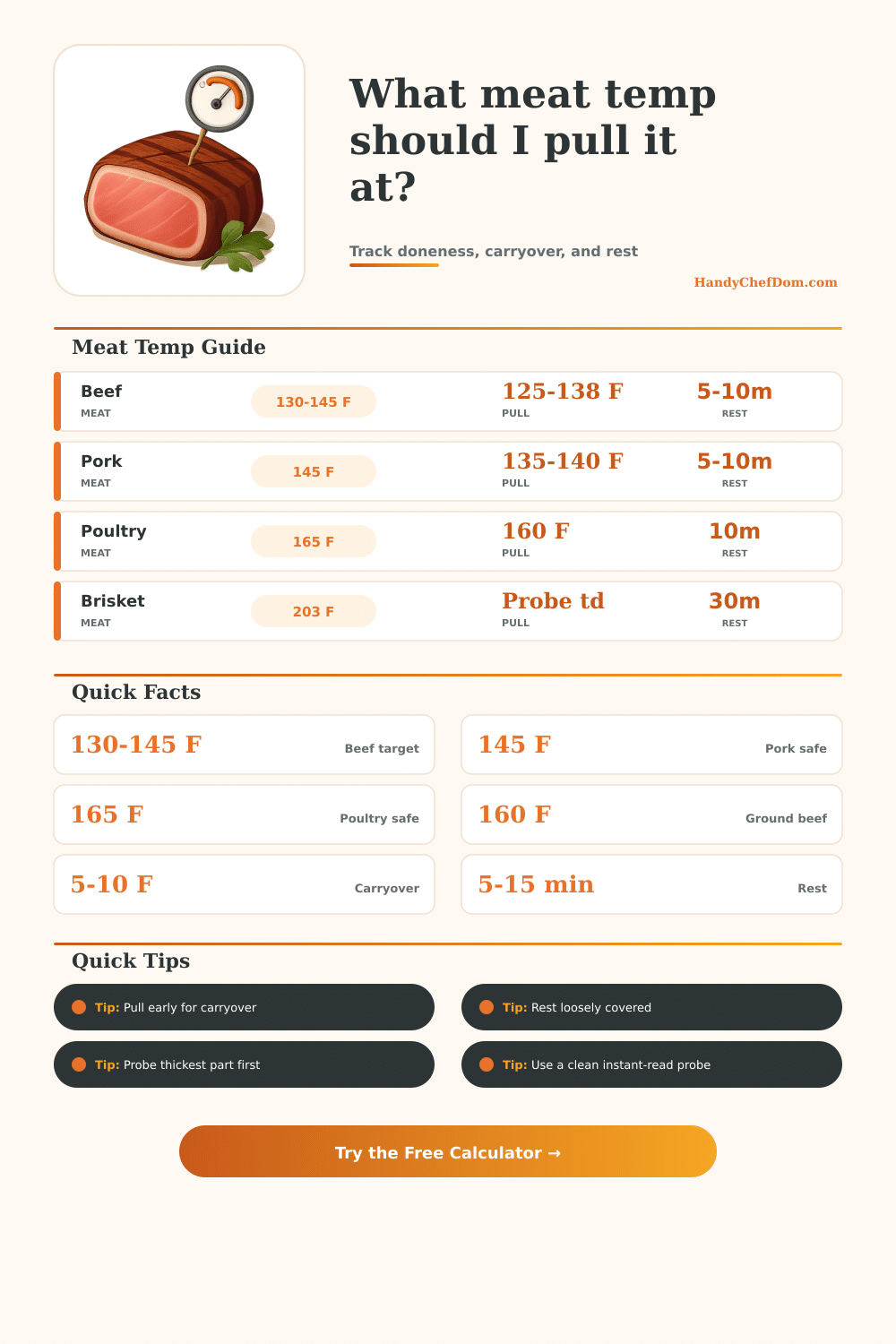
| Cut | Rare / Medium | Safe | Note |
|---|---|---|---|
| Beef steak | 125-145 F | 145 F | Best seared fast |
| Pork chop | 135-145 F | 145 F | Juicy at 145 F |
| Chicken breast | 160-165 F | 165 F | Always fully cooked |
| Turkey breast | 160-165 F | 165 F | Rest before slicing |
| Lamb chop | 130-145 F | 145 F | Works medium rare |
| Brisket | 195-205 F | 203 F | Probe tender finish |
| Method | Factor | Heat | Note |
|---|---|---|---|
| Grill | 0.88 | Hot | Fast sear |
| Roast | 1.00 | Even | Steady cook |
| Pan sear | 0.78 | Direct | Thin cuts |
| Smoker | 1.28 | Low | Slow bark |
| Sous vide | 0.60 | Water | Precise edge |
| Broil | 0.82 | Top heat | Watch closely |
| Carryover | Rest | Finish | Use |
|---|---|---|---|
| 4-5 F | 5 min | Thin chops | Quick sear |
| 6-8 F | 10 min | Steaks | Counter rest |
| 8-10 F | 15 min | Roasts | Foil tent |
| 10-12 F | 20 min | Turkey | Slice later |
| 12-15 F | 30 min | Brisket | Long hold |
| 4 F | 0 min | Sous vide | Minimal rise |
| Serving | Weight | Plate | Note |
|---|---|---|---|
| Steak | 0.75 lb | 1 | Hearty cut |
| Pork chop | 0.50 lb | 1 | Lean plate |
| Chicken breast | 0.40 lb | 1 | Family meal |
| Turkey | 0.45 lb | 1 | Holiday slice |
| Lamb chop | 0.60 lb | 1 | Special dinner |
| Ground beef | 0.33 lb | 1 | Burger patty |
Cooking meats requires an understanding of the concepts of temperature and carryover cook. Carryover cooking is the term used to describe the process by which the temperature of meat continue to rise after the meat has been removed from a heat source. This occurs because the heat from the outer portions of the meat transfer to the center of the meat.
If cooks dont account for carryover cooking when preparing meat, the meat can be overcook. If cooks do not allow the meat to rest after cooking, the juices from the meat will escape when the cook slice the meat. Measurements of temperature is important in the cooking of meat because the temperature of meat will indicate when the proteins in the muscle fiber begin to tighten and when the fats in the meat will render.
Why meat keeps cooking after you take it off the heat
Different meats requires different temperatures to ensure that the meat is safe to eat and tastes good when consumed. Beef is one meat product that can be cooked to a range of temperatures. Beef can be cooked to rare temperatures or medium temperature.
Pork can be cooked to 145 degree Fahrenheit, which is the temperature at which the pork will be safe to eat and juicy. Poultry must be cooked to 165 degrees Fahrenheit as it contains more bacteria than other meats. Brisket is one of the meats that require the highest cooking temperature, where the meat should reach 203 degrees Fahrenheit to become tender.
The thickness of the meat will impact the cooking of the meat. Thin piece of meat will heat up quick and will experience less carryover cooking than thick pieces of meat. Thick cuts of meat will take longer to heat up to the desired internal temperature but will experience more carryover cooking.
The weight of the meat will also impact the cooking time. Large pieces of meat will take longer to cook than smaller piece. Lastly, the temperature to which the grill or oven is set will also impact the cooking of the meat.
The higher the temperature of the grill, the more faster the surface of the meat will cook. A meat thermometer will help cooks to identify the pull temperature for the meat that is being prepared. Accounting for carryover cooking mean removing the meat from the heat source before it reach the target temperature of the cook.
For instance, cooks can remove steak from the grill that is eight degrees below the desired internal temperature of the steak. This allows for the carryover cooking to occur. All meats need to be allowed to rest after cooking so that the juices will remain inside the meat.
Thin cuts of meat should rest for five minutes after cooking while large cuts of meat, like brisket, should rest for thirty minutes. Many cooks makes mistakes when preparing meat. One common mistake is probing the meat at the wrong location.
Probing the edge of the meat or the juices that sit in the pan will not produce the same reading as measuring the internal temperature of the meat. The thickest part of the center of the meat should be probe. Another common mistake is to skip the resting portion of cooking the meat.
If meat is not allowed to rest while cooking, the juices will escape the meat. Additionally, ground meats, like burgers, must be cooked to a higher internal temperature than whole cuts of meat due to the fact that bacteria can be contain within the ground meats. The method in which meat is cooked will change the way that the meat react to heat.
If meat is grilled, the meat will be exposed to high levels of heat and may lead to uneven cooking of the meat. Roasting meat will allow the meat to cook evenely in the oven. Smoking meat will allow the meat to be cooked at low temperature for extended periods of time while sous vide cooking allow for the meat to be cooked in a water bath to reach a precise temperature.
Sous vide cooking will result in little carryover cooking of the meat. Environmental factor impact the cooking of meat. If the meat is cold from the refrigerator, it will take longer to heat up the meat to the target temperature.
High altitudes has different cooking times for meat. If meat is being cooked on a grill, wind will impact the temperature of the grill. These factor should be considered when preparing meat.
By understanding the pull temperature of meats, the resting time for meats, and the concept of carryover cooking, cooks can prepare meat correct.