🍓 Pectin for Jam Calculator
Enter your fruit weight to calculate exactly how much pectin you need for a perfect set
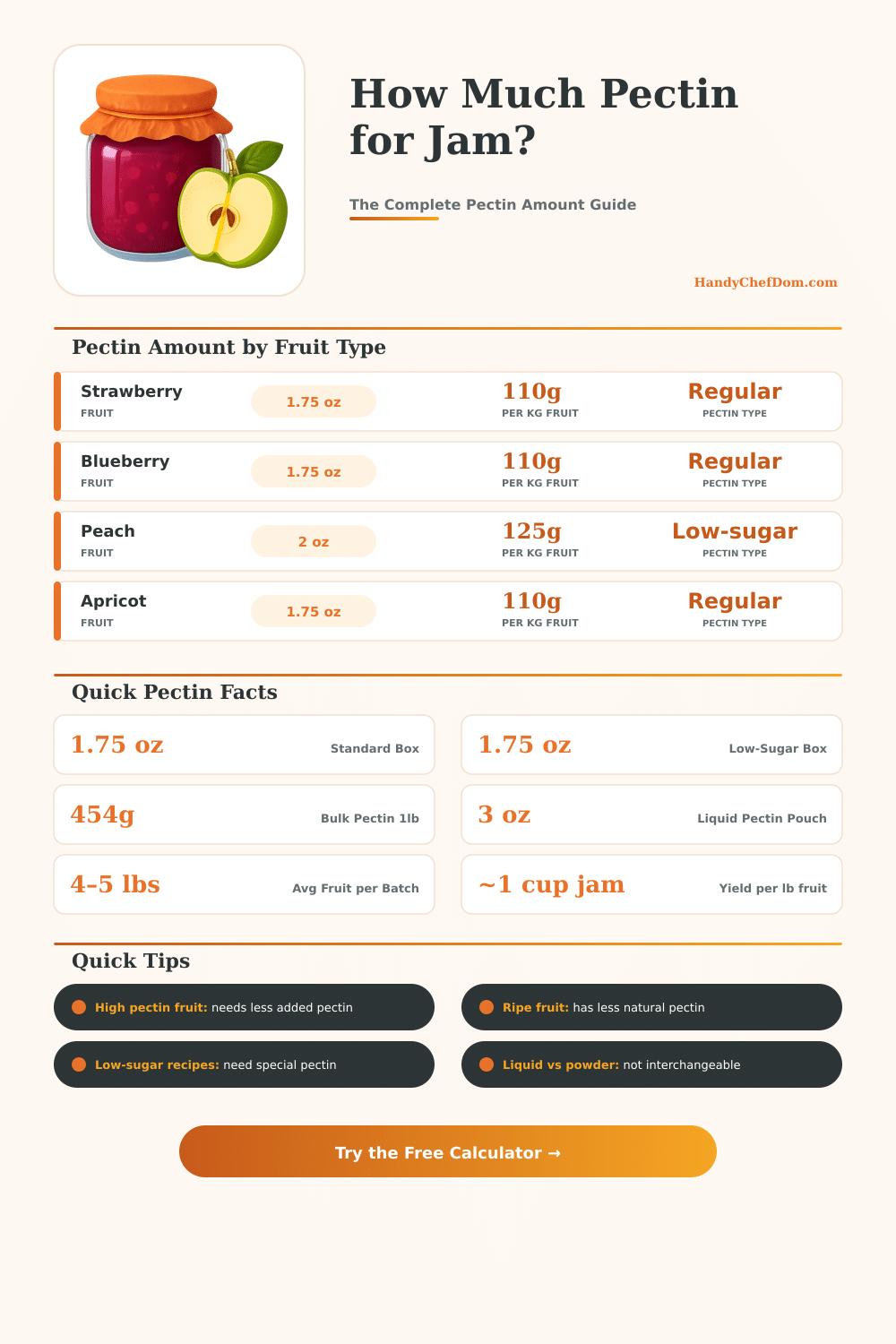
| Fruit | Natural Pectin | Regular Pectin (per lb) | Low-Sugar Pectin (per lb) | Liquid Pectin (per lb) |
|---|---|---|---|---|
| Strawberry | Low | 1.75 oz / 50g | 1.75 oz / 50g | 3 oz / 85g |
| Blueberry | Medium | 1.75 oz / 50g | 1.75 oz / 50g | 3 oz / 85g |
| Raspberry | Medium | 1.75 oz / 50g | 1.75 oz / 50g | 3 oz / 85g |
| Blackberry | Medium | 1.75 oz / 50g | 1.75 oz / 50g | 3 oz / 85g |
| Peach | Low | 2 oz / 57g | 1.75 oz / 50g | 3 oz / 85g |
| Apricot | Medium | 1.75 oz / 50g | 1.75 oz / 50g | 3 oz / 85g |
| Plum | High | 1.5 oz / 43g | 1.75 oz / 50g | 2.5 oz / 71g |
| Cherry | Low | 2 oz / 57g | 1.75 oz / 50g | 3 oz / 85g |
| Fig | Low | 2 oz / 57g | 2 oz / 57g | 3.5 oz / 99g |
| Mixed Berry | Medium | 1.75 oz / 50g | 1.75 oz / 50g | 3 oz / 85g |
| Pectin Product | Package Size | Metric | Covers (approx.) | Best For |
|---|---|---|---|---|
| Sure-Jell Regular | 1.75 oz box | 49g | 4–5 lbs fruit | Full-sugar jams |
| Sure-Jell Low Sugar (Pink) | 1.75 oz box | 49g | 4–5 lbs fruit | Reduced-sugar jams |
| Ball RealFruit Classic | 1.75 oz box | 49g | 4–5 lbs fruit | Full-sugar jams |
| Ball RealFruit Low-Sugar | 1.59 oz box | 45g | 4 lbs fruit | Reduced-sugar |
| Certo Liquid Pectin | 3 oz pouch (x2) | 85g each | 4–5 lbs fruit | Liquid method jams |
| Pomona's Universal | 1 oz box | 28g | Up to 8 cups fruit | No-sugar/any sweetener |
| Bulk Powder Pectin | 1 lb bag | 454g | ~40–45 lbs fruit | Large batches |
| Fruit Weight | Metric | Est. Jam Yield | Half-Pint Jars (8 oz) | Pint Jars (16 oz) |
|---|---|---|---|---|
| 1 lb | 454g | ~1 – 1.5 cups | 1 jar | 0.5 jar |
| 2 lbs | 907g | ~2.5 – 3 cups | 2–3 jars | 1–2 jars |
| 4 lbs | 1.8 kg | ~5 – 6 cups | 5–6 jars | 3 jars |
| 6 lbs | 2.7 kg | ~7 – 9 cups | 7–9 jars | 4–5 jars |
| 8 lbs | 3.6 kg | ~10 – 12 cups | 10–12 jars | 5–6 jars |
| 10 lbs | 4.5 kg | ~12 – 15 cups | 12–15 jars | 6–8 jars |
Jam is made up of fruits cooked with sugar until they become thick. One took whole fruits, cut them in bits or beat them, then cooked with water and sugar until reaching the setting point. That setting is caused by natural or added Pectin.
Pectin is fiber that dissolves in water, that appears in many fruits in different amounts. Not all fruits need added Pectin to set well, but Jam does need at least a bit of Pectin to set well.
How to Make Jam at Home
Home making Jam is fairly easy. In short words, it only means to cook fruit with a bit of water, add sugar and keep the boiling until the setting point. One way to check whether it already set, is the test by means of cooling.
Also a thermometer for Jam works well. During the cook, one should stir the Jam first rarely, then more often when the juices thicken. It usually lasts around forty to fifty minutes, until the liquid dries up and the fruit breaks down into a thick consistency.
Cooking on low and slow heat is important. Jam carries much sugar, and sugar can burn very quickly. Adding acid, for instance lemon juice, helps to stop burning at the sides of the jar.
Even a mix of lemon juice and water can be rubbed on the sides of the pot.
For strawberry Jam, a useful way is first soaking the berries in sugar. The sugar one must add in amount equal to sixty to sixty-seven percent of the wait of the berries, because of its high water content and softness. Then cook the mix in the smallest jar possible on the stove.
The phase of sugar truly affects the taste. Natural enzymes on the skins of fruits can start little fermentation, until the high sugar content stops it. That is a little secret of Jam making, that seems now almost forgotten.
If one cooks Jam too long or on too high heat, it can turn too wet. This is a typical trouble for newcomers. To follow the instructions correctly, until one gets feeling for the right amounts of sugar and times of cook, is wise advice.
From a nutrition viewpoint, one spoon of Jam stores around fifty to fifty-six calories, depending on the brand. The calories come mostly from sugar. It has almost no fat, ninety-nine percent carbs and one percent protein.
Jam is a very high calorie spread with limited nutrition value compared to fresh fruit. It fits in a balanced diet best, if one eats it in small amounts.
Jam works surprisingly as a spread for sandwiches during breakfast. It is underrated, but totally important. Besides toast, one can use it in baking for things like Jam tarts, Jam roly-poly or steamed Jam pudding.
It also serves as filling for sandwich-style biscuits with buttercream. Some use apricot Jam as a glaze forcuts of pork with dried chilies.