☕ Cold Brew Ratio Calculator
Calculate exact coffee & water amounts for any batch size or strength preference
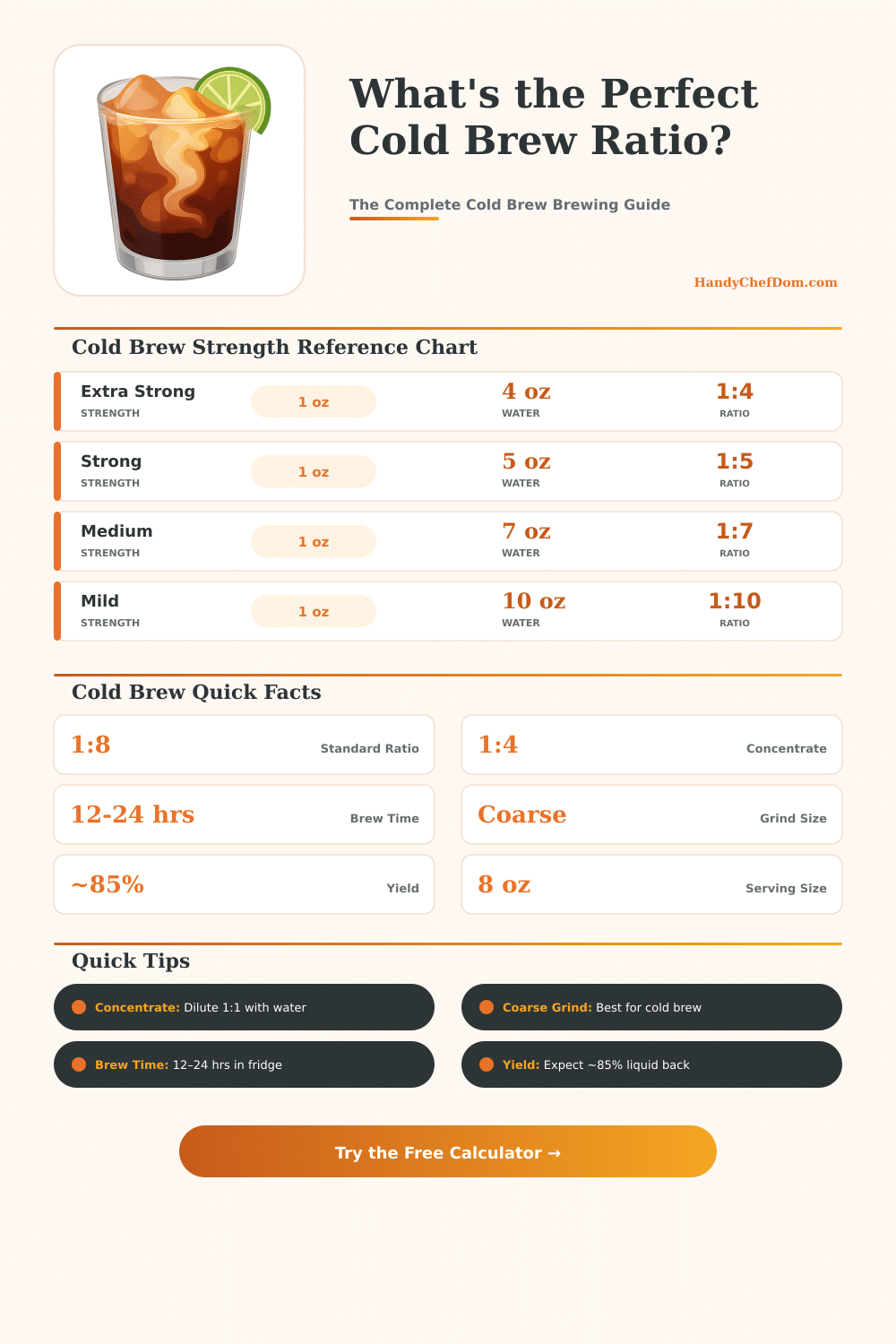
| Strength | Ratio | Coffee per 32 oz | Best For | Caffeine Est. |
|---|---|---|---|---|
| Concentrate | 1:4 | 6.4 oz / 181g | Dilute before serving | ~180mg/8oz* |
| Extra Strong | 1:5 | 5.3 oz / 150g | Nitro cold brew | ~155mg/8oz* |
| Kyoto Style | 1:6 | 4.6 oz / 130g | Japanese drip style | ~130mg/8oz* |
| Medium-Strong | 1:7 | 4 oz / 113g | Daily driver / bold | ~110mg/8oz* |
| Standard | 1:8 | 3.6 oz / 102g | Everyday cold brew | ~95mg/8oz* |
| Medium-Light | 1:9 | 3.2 oz / 91g | Smooth & approachable | ~80mg/8oz* |
| Mild | 1:10 | 2.9 oz / 82g | Sensitive to caffeine | ~65mg/8oz* |
| Very Mild | 1:12 | 2.4 oz / 68g | Light, low-caffeine | ~45mg/8oz* |
| Container | Volume (fl oz) | Volume (ml) | Servings (8 oz) |
|---|---|---|---|
| 16 oz Mason Jar | 16 fl oz | 473 ml | ~2 servings |
| 32 oz Mason Jar | 32 fl oz | 946 ml | ~4 servings |
| 48 oz Pitcher | 48 fl oz | 1,419 ml | ~6 servings |
| 64 oz Filter Bag | 64 fl oz | 1,893 ml | ~8 servings |
| Half Gallon Jar | 64 fl oz | 1,893 ml | ~8 servings |
| 1 Gallon Jug | 128 fl oz | 3,785 ml | ~16 servings |
| Volume (cups) | Weight (oz) | Weight (grams) | Tablespoons |
|---|---|---|---|
| 1/4 cup | 0.7 oz | 20g | 4 tbsp |
| 1/2 cup | 1.4 oz | 40g | 8 tbsp |
| 3/4 cup | 2.1 oz | 60g | 12 tbsp |
| 1 cup | 2.8 oz | 80g | 16 tbsp |
| 1.5 cups | 4.2 oz | 119g | 24 tbsp |
| 2 cups | 5.6 oz | 159g | 32 tbsp |
| 3 cups | 8.5 oz | 241g | 48 tbsp |
Cold coffee is simply coffee grounds that sit in cold water for some hours. What separates it from iced coffee? That one prepares first warm, later cool.
But cold brew skips all heat and starts directly with cold or room-temperature water. One can drink it cold over ice, or warm it if one wants, it is surprisingly flexible.
How to Make Cold Brew Coffee
Here is how simple it truly is. Take some coffee beans, grind them, toss them in a jar with cold water and leave it to stand. A Mason jar works great for that.
Done not grind grounds help best here, that is what one would use for a French press if one has a grinder at home. Fresh beans beat pre-ground grounds for that method. Because fine grounds can over-extract when they sit a long time and that ruins the taste.
Everything depends on time for cold brew. At least twelve hours, but truly between eighteen and twenty hours in the fridge do the trick. Then one gets a smoother cup with real depth and richness.
Some extend it to twenty-four hours. The more long it soaks, the stronger it becomes. The ready coffee stays good in the fridge about a week, before it goes bad.
Quality matters more then one thinks. Cheap beans like Robusta commonly give harsh and bitter results during cold brewing. Investing in good coffee truly helps.
Even so, do not spend money on fancy beans meant for espresso; many of those soft flavors simply disappear in the cold process anyway.
cold brew has its name because of its smoothness, and it delivers that. One finds in it less bitterness and lower acidity than in hot brewed coffee. It commonly brings out fruity or chocolate notes.
Here is a fun fact: peach notes that hide in warm coffee? They truly come out loud and clear in cold brew. That makes it a good choice if one still wonders whether coffee works for them.
The right ratio depends on what comes later. A ratio of one to fifteen from coffee to water gives something ready to drink directly. If one plans to pour it over ice, one to ten or one to fourteen works better.
Want more focused? Go even to one to two, later dilute when one is ready to drink. For warm cold brew, heat it nicely, only do not boil theconcentrate, or you will destroy the taste.
Filtering is the easiest step. Pour it through a filter and call it done. Be careful during the last pour, so that no grounds stay floating in the cup.
Truly, all it requires is a bowl, water, coffee grounds, patience and something to filter with. Do it at home instead of buying it daily at a cafe on the corner.