🧂 Brine Calculator
Calculate the exact salt & water ratio for any brine — wet or dry, any container size
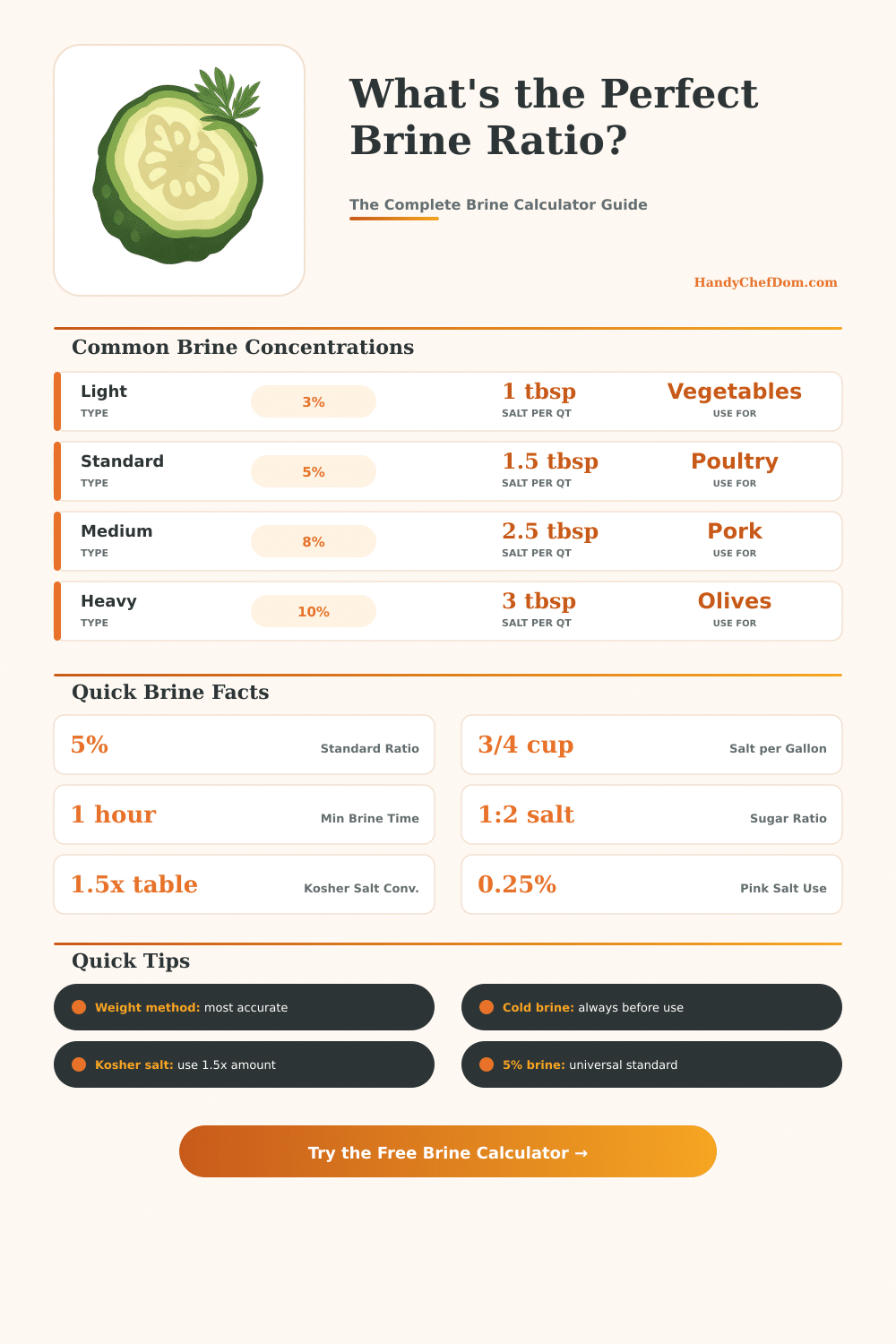
| Brine Type | Salt % | Salt per Quart Water | Salt per Liter Water | Best Used For |
|---|---|---|---|---|
| Lacto-Ferment | 2% | 1 tsp (6g) | 20g | Sauerkraut, kimchi |
| Light Brine | 3% | 1.5 tsp (9g) | 30g | Fish, shrimp, delicate veg |
| Standard Brine | 5% | 2.5 tsp (14g) | 50g | Chicken, turkey, pork |
| Medium Brine | 8% | 4 tsp (23g) | 80g | Ham, robust vegetables |
| Heavy Brine | 10% | 5 tsp (28g) | 100g | Olives, capers, preserving |
| Saturated Brine | 26% | 13 tsp (75g) | 260g | Cheese storage (feta) |
| Salt Type | Weight per Tbsp | Equiv. to 1 Tbsp Table Salt | Notes |
|---|---|---|---|
| Table Salt | 18g | 1 tbsp (baseline) | Fine grain, most concentrated |
| Morton Kosher Salt | 15g | 1.2 tbsp | Medium flake, reliable |
| Diamond Crystal Kosher | 8g | 2.25 tbsp | Large flake, lightest by volume |
| Fine Sea Salt | 17g | 1.05 tbsp | Similar to table salt |
| Pink Himalayan (fine) | 17g | 1.05 tbsp | Same saltiness as table salt |
| Fleur de Sel | 10g | 1.8 tbsp | Coarse, finishing salt |
| Food Weight | Salt (1% of weight) | Salt (1.5% of weight) | Typical Use |
|---|---|---|---|
| 1 lb (454g) | 4.5g (0.75 tsp) | 6.8g (1.1 tsp) | Steak, fish fillet |
| 2 lbs (907g) | 9g (1.5 tsp) | 13.6g (2.25 tsp) | Pork chops, chicken pieces |
| 3 lbs (1.36kg) | 13.6g (2.25 tsp) | 20.4g (3.4 tsp) | Whole chicken (small) |
| 5 lbs (2.27kg) | 22.7g (3.75 tsp) | 34g (5.7 tsp) | Whole chicken, small roast |
| 12 lbs (5.44kg) | 54.4g (3 tbsp) | 81.6g (4.5 tbsp) | Small turkey |
| 20 lbs (9.07kg) | 90.7g (5 tbsp) | 136g (7.5 tbsp) | Large turkey |
| Measurement | Volume (US) | Volume (Metric) | Weight of Water |
|---|---|---|---|
| 1 teaspoon | 1/6 fl oz | 4.9 ml | 4.9g |
| 1 tablespoon | 0.5 fl oz | 14.8 ml | 14.8g |
| 1 cup | 8 fl oz | 237 ml | 237g |
| 1 quart | 32 fl oz | 946 ml | 946g |
| 1 gallon | 128 fl oz | 3.785 L | 3,785g |
| 1 liter | 33.8 fl oz | 1,000 ml | 1,000g |
brine is basic water full of settled salt. The term comes from old English where one wrote it as “brīne“. Simply said, brine is made up of water rich in common salts, most commonly sodium chloride or calcium chloride.
Its strength ranges between around 3.5 percent, similar to sea water, until much more salty mixes. When brine is fully packed, any more salt simply does not dissolve in it.
Brine: meaning and uses
Natural brine happens underground, in salt lakes and oceans. They work as a source for common salts and others, for instance chlorides or sulfates of magnesium and potassium. One uses brine for preserving meat in packing or for salting.
In farms, it has long helped to prepare parts like pork upper leg or belly, to create ham or bacon.
Brining meat means soaking it in a mix of salt and water. The salt goes inward, not only stays outside. It changes the proteins, which allows the cells to hold more moisture.
So, after cooking one gets more juicy and tendor meat. The goal is to reach saltiness of about 0.5 until 1 percent. During traditional wet brining, one applies stronger mix, later removes extra salt by means of dipping and rinsing in fresh water.
Two main kinds exist. Wet brine forms a salt full water base. Dry brine is made up of salty rub with herbs and spices, applied directly on the meat.
For the dry method, just pat the meat dry and leave it sitting on a rack in the fridge a bit of time. Both ways work well for poultry especially.
Even some hours of brining can shorten the cooking time, increase the moisture and help the meat cook evenly. Cuts of meat absorb about 10 until 15 percent of there weight from brine. Important is enough amount to cover it fully.
For instance for an 18-pound turkey, at least two gallons of water work as minimum.
brine does not limit to meat, on the other hand. Olive brine is salty liquid that serves as a key part in a dirty martini. Pickle brine mixes salt with other liquids to ferment or preserve foods like vegetables or eggs.
In bread baking, olive brine can replace part of water and salt in a recipe. Caper brine gives a salty tang that goes well with garlic, butter and herbs.
brine from desalination plants is another concern. It is harmful and causes environmental problems while the need for pure drinkingwater grows. Water based brine adds moisture to meat well, but it works less for building deep taste compared to marinades that use acids and fat.