BBQ Food Quantity Calculator
Plan meat, sides, buns, and leftovers by guest count, appetite, and service style.
Use the guest mix and service style to estimate raw meat, cooked yield, and side portions for the whole cookout.
| Protein | 10 Guests | 25 Guests | 50 Guests |
|---|---|---|---|
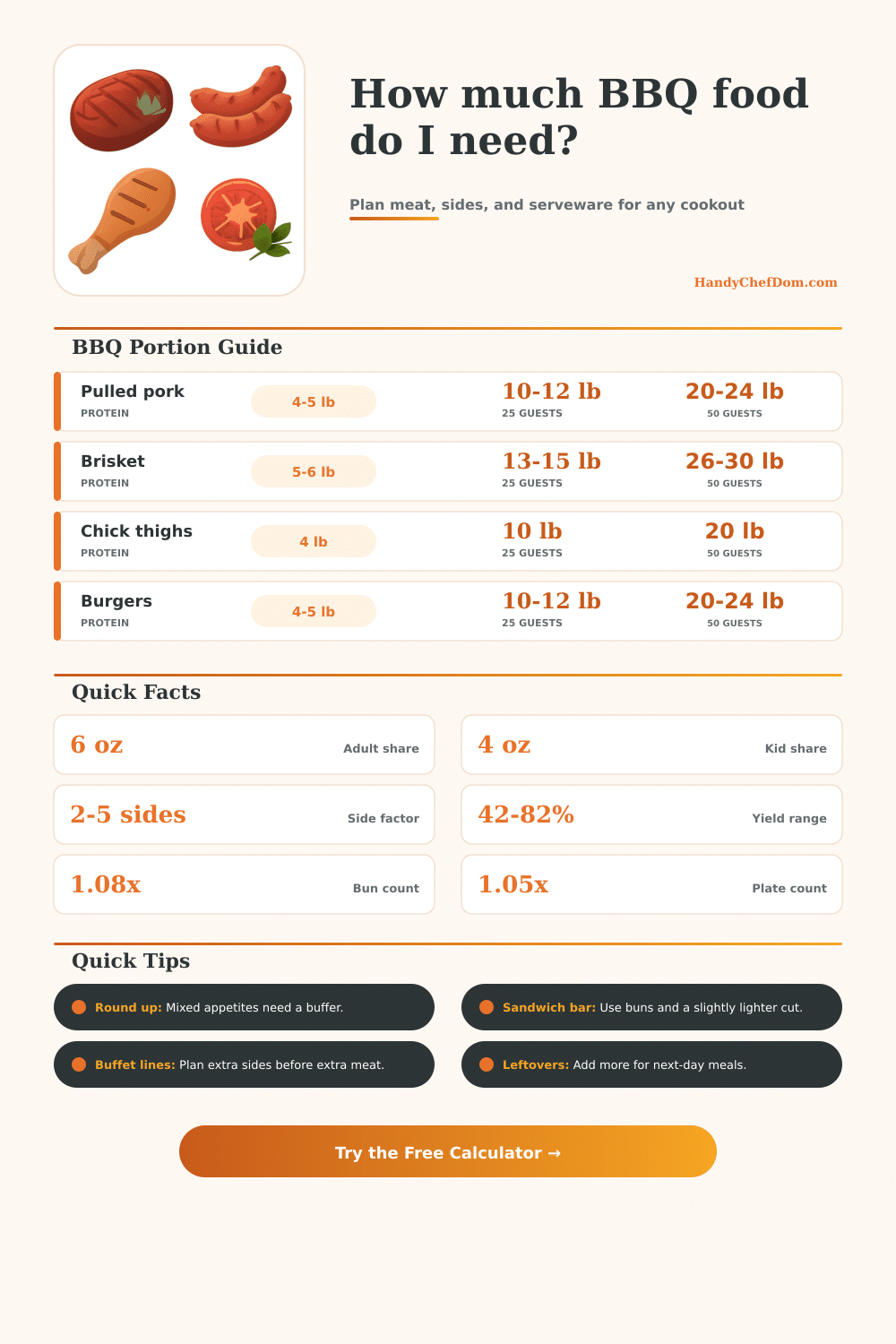
| Pulled pork | 4-5 lb | 10-12 lb | 20-24 lb |
| Brisket | 5-6 lb | 13-15 lb | 26-30 lb |
| Chicken thighs | 4 lb | 10 lb | 20 lb |
| Burgers | 4-5 lb | 10-12 lb | 20-24 lb |
| Protein | Yield | Cooked Portion | Note |
|---|---|---|---|
| Pulled pork | 55% | 5-6 oz | Great for buns |
| Brisket | 50% | 6 oz | Plan trim loss |
| Chicken thighs | 72% | 5 oz | High yield cut |
| Pork ribs | 42% | 6-7 oz | Bone weight matters |
| Side | 10 Guests | 25 Guests | 50 Guests |
|---|---|---|---|
| Baked beans | 2.5 qt | 6 qt | 12 qt |
| Coleslaw | 2 qt | 5 qt | 10 qt |
| Potato salad | 3 qt | 7 qt | 14 qt |
| Corn / veg | 2.5 qt | 6 qt | 12 qt |
| Serveware | 10 Guests | 25 Guests | 50 Guests |
|---|---|---|---|
| Plates | 12 | 30 | 60 |
| Buns | 12 | 30 | 60 |
| Foil pans | 2 | 5 | 10 |
| Napkins | 30 | 75 | 150 |
In order to plan a barbecue, it is important to calculate the correct amount of foods for the guests. If there is too little food purchased, the guests will be hungrily. If there is too much food purchased, the food will be wasted.
Beyond the number of guests that will come to the barbecue, there are also various factor related to the type of meat and the type of side that will be served to the guests. Meat will lose weight during the cooking process. Additionally, meat contains bone that the guests cant eat.
How to Calculate Meat and Other Supplies for a Barbecue
Thus, the raw weight of the meat will be more higher than the cooked weight of the meat that the guests actualy eat. When calculating the amount of meat to purchase, it is also necesary to account for the yield loss of the meat. Yield loss is the loss of weight of the meat that occurs during the cooking process or the loss of the weight of the bones in the meat.
Brisket has a high yield loss due to the fact that the fat of the brisket will leave the brisket during the cooking process. Thus, if the goal is to serve the guests 6 ounce of cooked brisket, the quantity of raw brisket that is purchased must be more higher than 6 ounces. Pulled pork has a yield of approximately 55%.
Thus, 55% of the raw pork becomes the edible meat that can be served to the guests. If cuts of meat that contain bone are selected, the cook must purchase 20% more raw meat to account for the weight of the bones of the meat. Chicken thigh have a higher yield than ribs.
Raw chicken thighs have a yield of 72% while raw ribs have a yield of 42%. The way that the food will be served will impact the amount of meat that will be purchased for the barbecue. If the meat is to be served in a buffet style, the calculations for the amount of meat that is needed will increase for that style of barbecue.
If you serve sandwiches, buns will be used to fill the plate for each guest. The buns will increase the amount of meat that is served to the guests. If plated dinner are served, the portions of meat will need to be more precise.
Plates will not allow the guests to choose the amount of meat that they would like to eat. The types of side dish that will be served will also impact the amount of meat that the guests will eat. If there are many side dishes that will be served, such as coleslaw, beans, and potato salad, the guests will eat less meat.
If only two side dishes will be served, the guests will eat more meat. These side dishes can be used to both balance the meal that is served to the guests as well as to reduce the amount of meat that must be purchased. Five side dishes may be served instead of two, for instance, which would reduce the amount of meat that is required to be purchased for the barbecue.
Beyond side dishes, the age of the guests and their appetite will factor into the amount of meat that is served. Younger guests will eat less meat than adults. Thus, if there are many children that will be attending the barbecue, the quantity of meat that is served to each guest will need to be less than if there were only adults attending the event.
Adults have more pronounced appetites than children. Thus, if the guests are all heavy eaters, the cook should increase the amount of meat that is served to each guest. It is a helpful addition to include a 10% buffer to the total amount of meat that is calculated for the guests.
A 10% buffer will ensure that there is meat that can be prepared for the guests the following day. In addition to the meat, other supplies will need to be purchased for the barbecue. The quantity of buns that will be purchased should be one bun for each guest, but 1.08 buns for each guest will need to be bought to account for any extra buns that may be needed.
The quantity of plates will be one plate for each guest, but 1.05 plates for each guest will be purchased to account for any extra plates that may be needed. Many napkins will also be needed for the guests. Napkins will be used during the barbecue.
If each of these components are purchased according to the calculations, there will be enough meat and food for all of the guests that are to attend the barbecue, and there will be no overpurchase of the food that will result in waste at the barbecue.