🧂 Dry Brine Calculator
Get the exact salt amount for any cut of meat — in teaspoons or grams
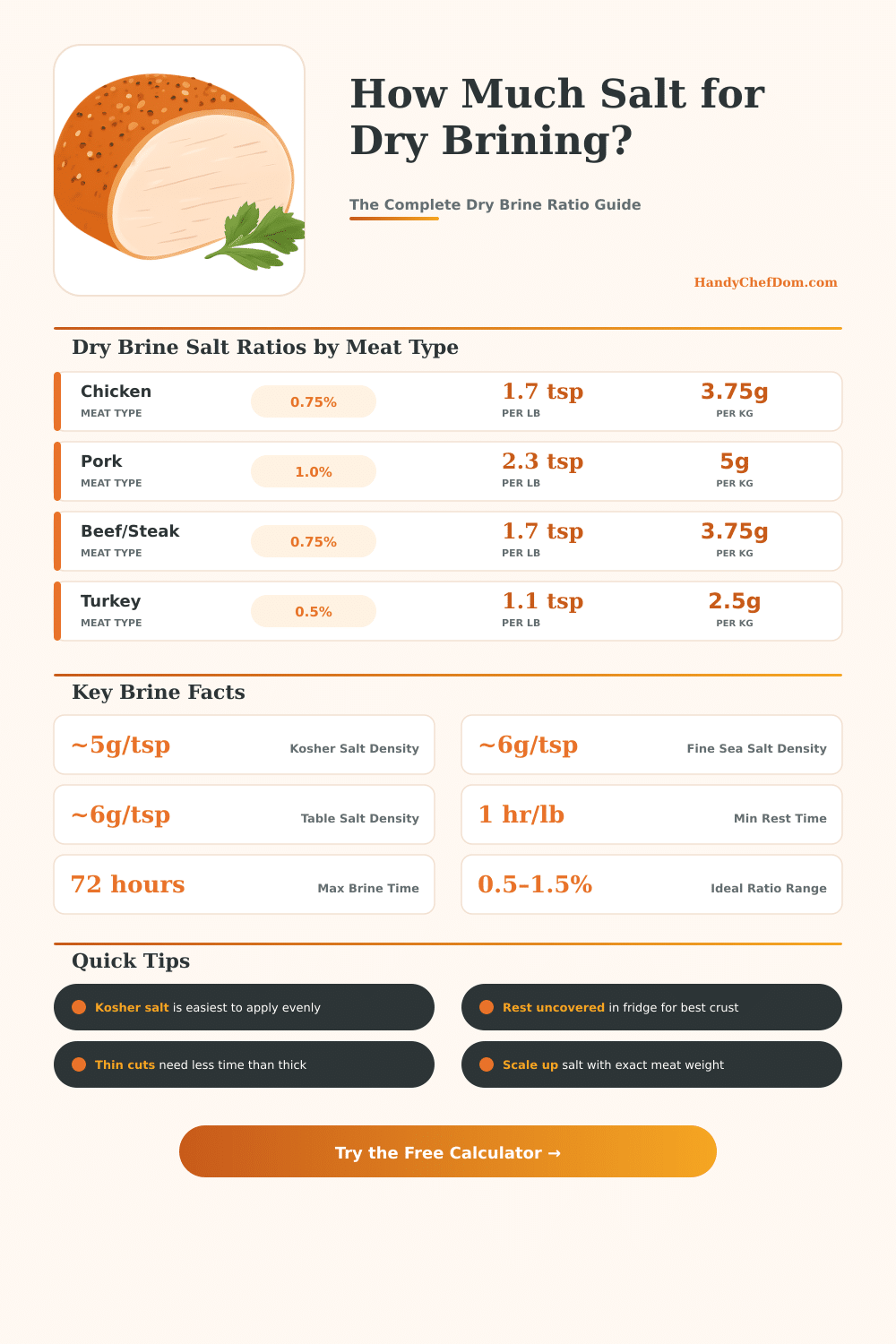
| Meat Type | Salt % (by weight) | Per Pound | Per Kilogram | Notes |
|---|---|---|---|---|
| Whole Chicken | 0.75% | ~1.7 tsp (DC) | ~7.5g | Apply under skin |
| Chicken Breasts | 0.75% | ~1.7 tsp (DC) | ~7.5g | Pat very dry first |
| Whole Turkey | 0.5% | ~1.1 tsp (DC) | ~5g | Apply 24–72 hrs ahead |
| Beef Steak | 0.75% | ~1.7 tsp (DC) | ~7.5g | Great for thick cuts |
| Beef Brisket | 1.0% | ~2.3 tsp (DC) | ~10g | Apply 24–48 hrs ahead |
| Pork Chops | 1.0% | ~2.3 tsp (DC) | ~10g | 45 min to 4 hrs |
| Pork Shoulder | 1.0% | ~2.3 tsp (DC) | ~10g | Apply 12–24 hrs ahead |
| Lamb | 0.75% | ~1.7 tsp (DC) | ~7.5g | Works with bone-in too |
| Fish / Seafood | 0.5% | ~1.1 tsp (DC) | ~5g | 15–30 min only |
| Duck | 0.75% | ~1.7 tsp (DC) | ~7.5g | Score skin before brining |
| Cut / Meat | Minimum Time | Optimal Time | Maximum Time |
|---|---|---|---|
| Fish fillets | 15 min | 30 min | 1 hour |
| Chicken breasts | 30 min | 4 hours | 24 hours |
| Whole chicken | 1 hour | 12–24 hrs | 48 hours |
| Pork chops (1") | 45 min | 4 hours | 12 hours |
| Pork shoulder | 2 hours | 12–24 hrs | 36 hours |
| Steaks (1") | 45 min | 4–12 hrs | 24 hours |
| Beef brisket | 4 hours | 24–48 hrs | 72 hours |
| Whole turkey | 8 hours | 24–48 hrs | 72 hours |
| Leg of lamb | 2 hours | 12–24 hrs | 48 hours |
| Grams of Salt | Tsp (Diamond Crystal) | Tsp (Morton Kosher) | Tsp (Fine Sea / Table) |
|---|---|---|---|
| 2.8g | 1 tsp | 0.58 tsp | 0.47 tsp |
| 5g | 1.79 tsp | 1.04 tsp | 0.83 tsp |
| 7.5g | 2.68 tsp | 1.56 tsp | 1.25 tsp |
| 10g | 3.57 tsp | 2.08 tsp | 1.67 tsp |
| 15g | 5.36 tsp | 3.13 tsp | 2.5 tsp |
| 20g | 7.14 tsp | 4.17 tsp | 3.33 tsp |
Dry Brine simply means salting meat and letting it rest in the refrigerator before cooking. Here is everything. It does not need big buckets full of water, or messy bags with liquids that spill around and certainly does not need hard recipes to follow.
Some call it “pre-salting”, which well describes what happens.
Dry Brine: Salt Meat in the Fridge for Juicier Meat
The way it works is very simple. You rub salt directly on the meat and the skin, sometimes together with spices or sugar. Later the meat rests in the refrigerator a bit of time.
In that time the salt pulls moisture from the meat to the surface. Those wet bits mix with the salt and form a salty wet layer on the outside. Later something new happens: the meat absorbs that salty liquid inward through spreading and osmosis, which indeed brines it using its own juices.
The whole process seasons the meat from inside to outside.
You can see that in real time. After around twenty minutes the steak starts “to sweat” because the salt pulls the moisture. When the salt fully dissolves and the surface seems fairly dry, the brine flows back inward, brinigng taste.
Dry Brine is different from wet brine. Wet brine means soaking meat in salty water. Dry Brine fully skips the water.
It trusts in the natural moisture of the meat itself. One big plus is, that Dry Brine avoids the problem of flavor thinning, that can happen when meat rests in salty water. The result is strongly seasoned and juicy food.
The time of the Dry Brine depends on the size of the meat. For a roast or turkey you can go from twenty-four to forty-eight hours. Steak or chops need only one or two hours.
Thinner bits need less thyme, while thicker or bony bits need more. Leave the meat uncovered on a rack in the refrigerator, so that the air dries the surface; that helps for better browning during the cook later.
Salt also breaks down the muscle proteins, so they do not tighten during cooking. That means less juice gets pressed from the meat. This counts for both kinds of brine, wet and dry, but Dry Brine is a much easier way.
You do not need huge bins or barrels of water.
Dry Brine works not only for turkey. It also works for chicken, steak and even fish like salmon. For birds, rub salt and sometimes herbs or citrus under and above the skin to give rich taste and help for crisp skin.
When the Dry Brine ends, there should not be visible salt on the surface. This method best suits formeat slices that were not already pre-salted.