🥛 ML to Grams Milk Converter
Convert millilitres to grams for whole, skim, oat, almond & more milk types
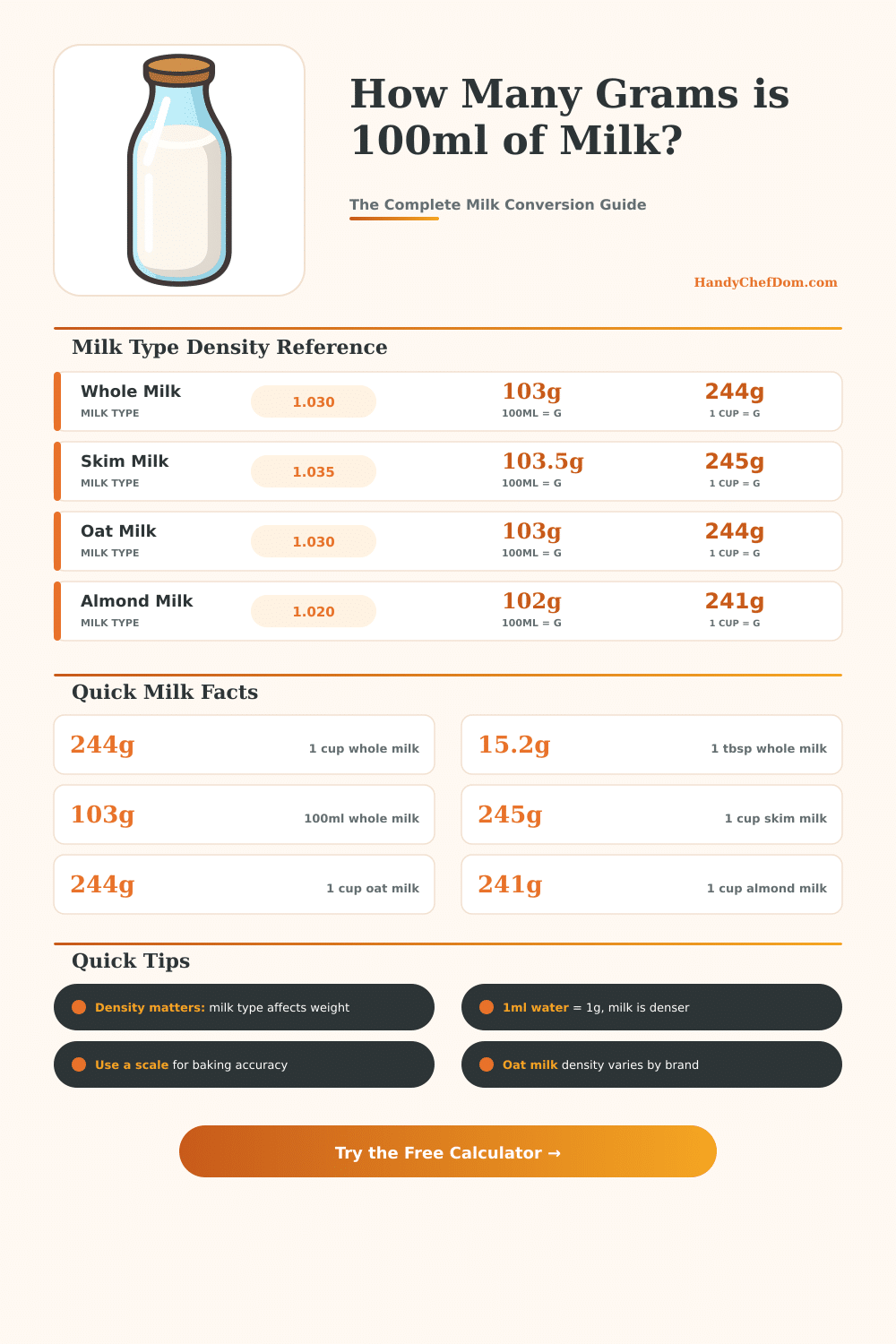
| Milk Type | Density (g/ml) | 100ml = g | 250ml = g | 1 Cup (240ml) = g |
|---|---|---|---|---|
| Whole Milk (3.5%) | 1.030 | 103.0g | 257.5g | 247.2g |
| Semi-Skimmed (1.5%) | 1.033 | 103.3g | 258.3g | 247.9g |
| Skim / Non-Fat | 1.035 | 103.5g | 258.8g | 248.4g |
| Oat Milk | 1.030 | 103.0g | 257.5g | 247.2g |
| Almond Milk | 1.020 | 102.0g | 255.0g | 244.8g |
| Soy Milk | 1.025 | 102.5g | 256.3g | 246.0g |
| Coconut Milk (carton) | 1.010 | 101.0g | 252.5g | 242.4g |
| Goat Milk | 1.034 | 103.4g | 258.5g | 248.2g |
| Condensed Milk | 1.310 | 131.0g | 327.5g | 314.4g |
| Evaporated Milk | 1.066 | 106.6g | 266.5g | 255.8g |
| Measurement | Volume (ml) | Grams (g) | Ounces (oz) |
|---|---|---|---|
| 1 Teaspoon | 5 ml | 5.2g | 0.18 oz |
| 1 Tablespoon | 15 ml | 15.5g | 0.55 oz |
| 2 Tablespoons | 30 ml | 30.9g | 1.09 oz |
| ¼ Cup (US) | 59 ml | 60.8g | 2.14 oz |
| ½ Cup (US) | 118 ml | 121.5g | 4.29 oz |
| 1 Cup (US) | 240 ml | 247.2g | 8.72 oz |
| 1 Pint (US) | 473 ml | 487.2g | 17.19 oz |
| 500 ml | 500 ml | 515.0g | 18.17 oz |
| 1 Litre | 1000 ml | 1030g | 36.34 oz |
| 2 Litres | 2000 ml | 2060g | 72.69 oz |
| Milk Type | Calories | Protein | Fat | Carbs |
|---|---|---|---|---|
| Whole Milk | 61 kcal | 3.2g | 3.4g | 4.7g |
| Semi-Skimmed | 46 kcal | 3.4g | 1.6g | 5.0g |
| Skim Milk | 35 kcal | 3.5g | 0.1g | 5.0g |
| Oat Milk | 46 kcal | 1.0g | 1.5g | 6.6g |
| Almond Milk | 17 kcal | 0.6g | 1.1g | 1.3g |
| Soy Milk | 43 kcal | 3.3g | 1.8g | 2.9g |
| Coconut Milk (carton) | 20 kcal | 0.2g | 2.0g | 0.7g |
| Goat Milk | 69 kcal | 3.6g | 4.1g | 4.5g |
Milk usually is white liquid food although it can be yellow, cream, pink or brown. Mammals produce it with mammary glands. It feeds young mammals until they can eat solid food.
Milk has many nutrients, also calcium. Breast milk is best for babies, because it is well tolerated while their digestive organs mature.
Milk: Uses, Types and Benefits
Milk is among the most versatile dairy foods, and it gives everyday nutrients for good health. It has proteins, fat and carbohydrates. You easily strengthen and enrich it.
One 8-oz serving of milk delivers good amounts of thirteen everyday nutrients, so it belongs to the most nutritious foods. Adults should drink three cups milk or dairy products daily. One cup of milk matches one sevrnig.
Cow milk is full of nutrients like calcium and protein. Drinking milk every day can give stronger bones, more fullness, better muscle repair and better hydration. It also has potassium, phosphorus and iodine, together with vitamin B2 and B12. For stable blood sugar, choose milk with few carbohydrates, without added sugar and enough protein.
For children until age two you advise whole-fat milk. That is milk as it comes from the cow, with its natural cream. Remove a bit of cream to make it low fat or fat free milk.
Fat free and less fat types however lose even more natural nutrients from cow milk.
Non-dairy milks have their advantages and disadvantages. Cow and soy milk have more protein, but almond and oat milk less. Protein almost lacks in coconut milk.
Cow milk seems neutral, and it even reduces inflammation.
Milk is useful in baking. In bread making you commonly replace water with milk. Lactose free whole milk works for bread, because you simply added to it the enzyme lactase.
Milk powder can replace part of water in recipes by using normal milk. Some recipes for sweet dough require milk powder, foaming cream and whole milk together.
Evaporated milk is made with a vacuum, so it boils at low temperatures instead of high. Boiling milk on high heat makes proteins clump and curdle. It thickens, but does not act the same in cooking or baking.
Store thickened milk is different from that you do by simmering on a stove. For good cappuccino or latte you use cold milk, to avoid cooking it. Raw whole milk is amazing because of the lot of products you can makefrom it.