🍺 Homebrew Mash Calculator
Calculate strike water temperature, mash thickness, water volumes & grain absorption for your brew day
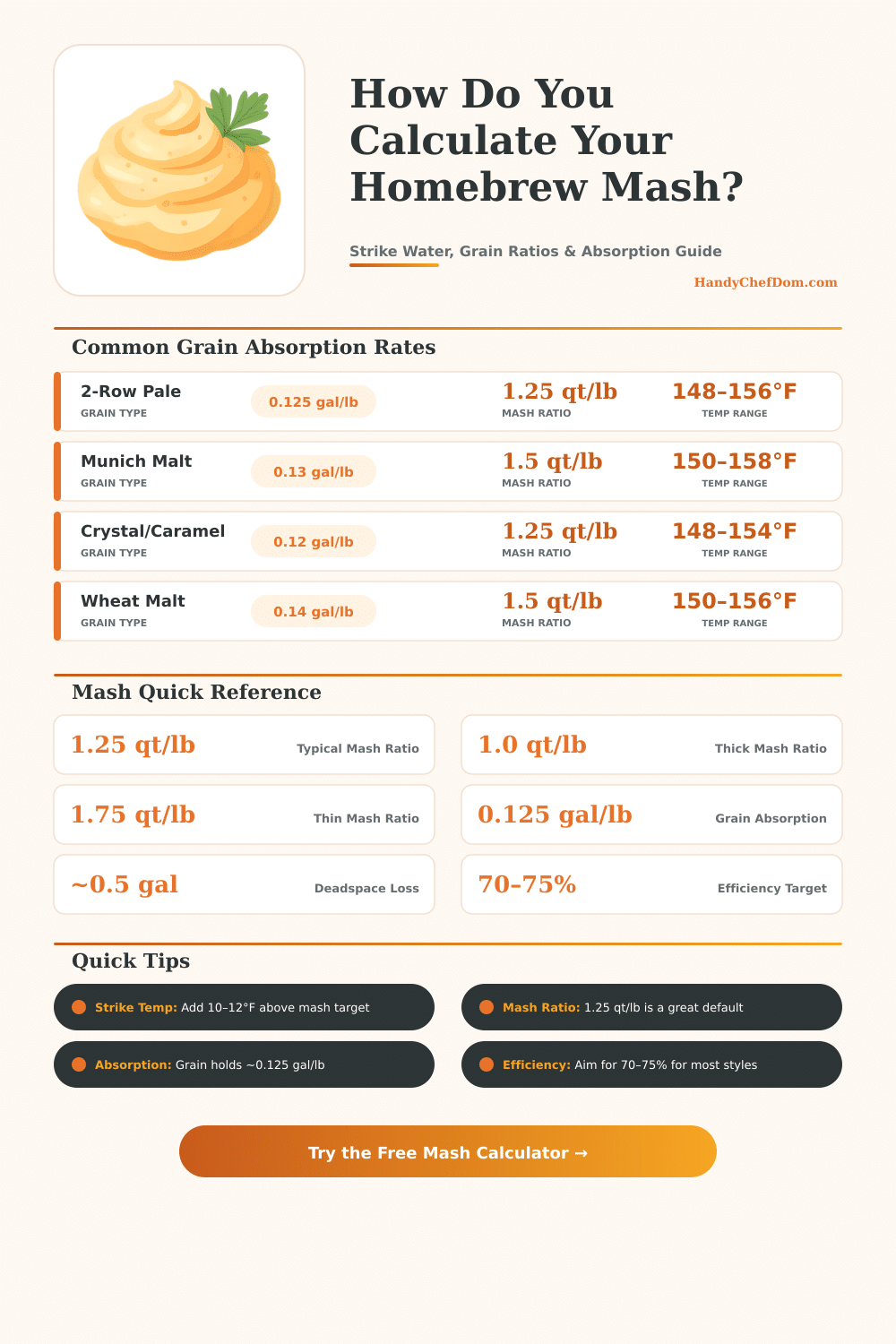
| Grain Type | Absorption (gal/lb) | Absorption (L/kg) | Best Mash Ratio | Typical Mash Temp |
|---|---|---|---|---|
| 2-Row Pale / Base Malt | 0.125 | 1.04 | 1.25 qt/lb | 148–156°F |
| Munich Malt | 0.130 | 1.08 | 1.5 qt/lb | 150–158°F |
| Vienna Malt | 0.125 | 1.04 | 1.25–1.5 qt/lb | 149–156°F |
| Crystal / Caramel (any °L) | 0.120 | 1.00 | 1.25 qt/lb | 148–154°F |
| Wheat Malt | 0.140 | 1.17 | 1.5 qt/lb | 150–156°F |
| Roasted Barley / Black Malt | 0.110 | 0.92 | 1.25 qt/lb | 148–155°F |
| Flaked Oats / Corn | 0.130 | 1.08 | 1.5 qt/lb | 148–154°F |
| Rye Malt | 0.140 | 1.17 | 1.5–2.0 qt/lb | 149–156°F |
| Mash Temp (°F) | Mash Temp (°C) | Fermentability | Body | Best For |
|---|---|---|---|---|
| 144–147°F | 62–64°C | Very High | Thin / Dry | Dry Stout, Session Lager |
| 148–151°F | 64–66°C | High | Light | IPA, Pale Ale, Pilsner |
| 152–155°F | 67–68°C | Medium | Balanced | Amber Ale, Porter, Saison |
| 156–158°F | 69–70°C | Low | Full | Stout, Barleywine, Bock |
| 159–162°F | 71–72°C | Very Low | Very Full | Sweet Stout, Heavy Ales |
| US Gallons | Liters | US Quarts | Imperial Gallons |
|---|---|---|---|
| 1 gal | 3.785 L | 4 qt | 0.833 Imp. gal |
| 2 gal | 7.571 L | 8 qt | 1.665 Imp. gal |
| 5 gal | 18.93 L | 20 qt | 4.163 Imp. gal |
| 6.5 gal | 24.61 L | 26 qt | 5.412 Imp. gal |
| 10 gal | 37.85 L | 40 qt | 8.327 Imp. gal |
homebrew mash is the stage in that the malted grain soaks in warm water to release sugar. Sugars from it feed the fermentation that later turns it in beer. While malting, the process creates enzymes inside the grain.
These enzymes break down complex carbohydrates to more basic sugar during the mash. Water at warm temperature helps the enzymes work well giving them the right conditions for their task.
How Mash Makes Sugar for Beer
mash is this simple, that one only heats the malted grain in water at 140 to 160 degrees Fahrenheit for around 60 minutes. When the enzymes already converted everything that they can… Usually after 60 minutes.
Extending the mash does not make the fermentation of the wort easier. For a good result, aim for between 144 and 156 degrees Fahrenheit.
Temperature during mash seriously affects the final beer. At lower levels, for instance 148 degrees, one gets wort that ferments to clear, ending at around 1.005 particular gravity. At higher, like 154 degrees, stays more sugar, what ends close to 1.015 gravity.
That changes the beer in taste and density. In a sample, beer from low mash reached 4.4 percent ABV, while that form high only 3.4 percent. High temperature helps to create rich, full beer with little alcohol.
mash tun is the container for the mash. It also eases the lautering, the separation of the liquid wort from the grains. A small mash tun helps to keep stable heat and drain the wort.
For a standard batch of 5 gallons under 1.060 original gravity, the tun only needs to be a bit more than 4.5 gallons big.
Thickness of the mash also matters. If one uses more malt mix, say 2.0 quarts each pound instead of 1.25, everything becomes more watery. So one easily crushes the dough ball and mixes the whole thing.
In such thin mash, enzymes more easily turn starches in sugar.
There are three main kinds of mash: infusion mash, decoction mash and temperature-controlled infusion mash. During decoction mash, one removes part of the mix and boils it separately. That caramelizes some sugar, giving the beer deeper flavor and color, while it releases more starches.
Stepped temperature in mash works well if the malt is not fully modified or for German styles of brewing. Homebrew fans that do stepped mash usually use a tun with direct heat to raise the temperature through the steps.
Quick mash is another option. Temperature can drop somewhere between 2 and 8 degrees Fahrenheit per hour in a kettle oreven more quickly. Critics warn about too much conversion and beer with too little body.
Even so, the main thing stays the time.