🍺 Beer Fermentation Calculator
Calculate ABV, apparent attenuation, calories & fermentation progress from your gravity readings
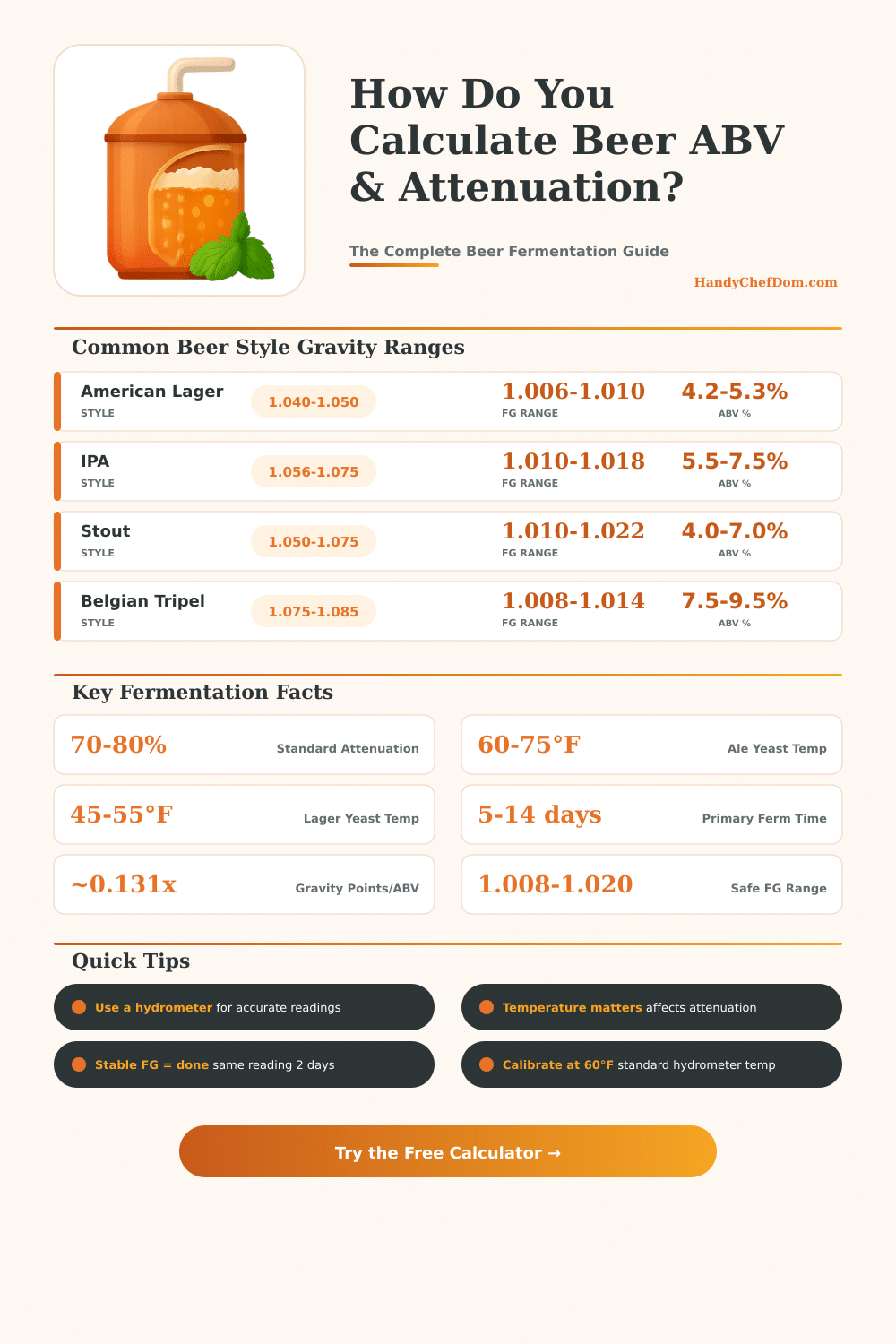
| Style | OG Range | FG Range | Target ABV | SRM (Color) |
|---|---|---|---|---|
| American Lager | 1.040–1.050 | 1.006–1.010 | 4.2–5.3% | 2–4 |
| American Pale Ale | 1.045–1.060 | 1.010–1.015 | 4.5–6.2% | 5–14 |
| American IPA | 1.056–1.075 | 1.010–1.018 | 5.5–7.5% | 6–14 |
| Double / Imperial IPA | 1.075–1.100 | 1.010–1.020 | 7.5–10.0% | 6–14 |
| Hefeweizen | 1.044–1.052 | 1.008–1.016 | 4.9–5.6% | 3–9 |
| Saison | 1.048–1.065 | 1.002–1.012 | 5.0–7.0% | 5–14 |
| Dry Irish Stout | 1.036–1.050 | 1.007–1.011 | 4.0–5.0% | 25–40 |
| Robust Porter | 1.048–1.065 | 1.012–1.016 | 4.8–6.5% | 22–35 |
| Belgian Tripel | 1.075–1.085 | 1.008–1.014 | 7.5–9.5% | 4–7 |
| American Barleywine | 1.080–1.120 | 1.016–1.030 | 8.0–12.0% | 10–19 |
| Specific Gravity | Brix | Plato (°P) | Sugar (g/L) |
|---|---|---|---|
| 1.010 | 2.56 | 2.56 | 25.4 |
| 1.020 | 5.07 | 5.07 | 50.3 |
| 1.030 | 7.57 | 7.57 | 75.3 |
| 1.040 | 10.00 | 10.00 | 99.8 |
| 1.050 | 12.39 | 12.39 | 124.0 |
| 1.060 | 14.74 | 14.74 | 147.7 |
| 1.070 | 17.05 | 17.05 | 171.1 |
| 1.080 | 19.33 | 19.33 | 194.3 |
| 1.090 | 21.56 | 21.56 | 216.9 |
| 1.100 | 23.77 | 23.77 | 239.2 |
| Stage | Day Range | Gravity Drop | Activity |
|---|---|---|---|
| Lag Phase | 0–12 hrs | Minimal | Yeast adapting to wort |
| Exponential Growth | 12–48 hrs | 25–50% of total | Vigorous airlock activity |
| Peak Fermentation | 2–4 days | 50–80% of total | Krausen peak, CO2 bubbling |
| Stationary Phase | 4–7 days | 80–95% of total | Slowing, gravity stabilizing |
| Conditioning | 7–14 days | 95–100% of total | Cleanup, clarity improving |
| Terminal / FG Reached | 7–21 days | 100% | Same reading 2 days apart |
Beer is a type of alcoholic drink that one prepares by means of fermentation of starches from grains. Barley malt is the main grain for that, although also wheat, corn, rice and oats work. The grains pass through milling, that changes the starch into sugar.
Those sugars mix with water to create something that one calls wort. The whole process includes also boiling, commonly with hops, followed by fermentation. In many lands, like Germany, the law exactly defines what beer is.
Beer: How It Is Made and Used
There exist hundreds of different beer styles. For instance pilsners belong to bottom fermented beers, produced at low temperatures. They belong because of their crisp and pure character whether looking at or tasting.
Other styles include stouts, porters, IPAs, ales and many more. Barrel-aged beers form a separate group, and the contrast between a well done sample and bad are huge. Some beers have a malty taste, other hoppy, and some bitterness.
Session beers normally sit around four to five percent of alcohol and tend to be too hoppy or too dark.
In general, a standard serving of beer matches twelve ounces with around five percent of alcohol. In bars and restaurants, one commonly offers three main glass sizes: four ounces, eight ounces and sixteen ounces. Four-ounce glasses work for tasting rounds, because four of them form one pint.
Eight-ounce pours give right portion for beers with higher alcoholic content. Domestic beer types usually sit between four and five percent of alcohol and they come in twelve-ounce cans or bottles.
In the kitchen, beer is useful very well. One can add it to bread, replacing water, and the flavor changes according too the strength of the beer. Batter with beer works for fried foods like zucchini.
Beef stew with ale is traditional food, especially if one uses dark beers like porters or brown chocolate ales. One can reduce dark beer to give rich taste to slowly cooked stews. Even in chili recipes appear beer, where root beer adds a bit of sweet toast.
For batter, best avoid stouts, porters and IPAs, because they commonly are too dark, hoppy or bitter for that use.
Matching beer with foods can be pleasant, but requires attention. Sweet dishes widely do not go with most beers. Only very rare fruits match well with beer, unless it already is sweet.
Over time, beer can become flat, old or skunky. Aging helps for certain styles, but eventually fat acids break down and create unwantedflavors. Sales of barrel beer went down partly, because the pandemic made domestic canned beer more practical for many drinkers.