🧪 Sugar to ABV Calculator
Project alcohol potential from sugar readings in Brix, specific gravity, or g/L while tracking real-world efficiency, packaging yield, and correction assumptions.
Fermentation Presets
Topic Labels
Calculator Inputs
Formula set: SG drop x 131.25 for projected ABV, Brix x 0.59 for dry potential, and sugar drop / 16.83 for sugar-path cross-check.
Sugar to ABV Breakdown
Method Comparison Grid
Reference Tables
| Profile | Start Brix | Dry ABV | Typical lane |
|---|---|---|---|
| Light cider | 11-13 | 5.5-7.0% | Session |
| Table white | 17-20 | 9.0-11.5% | Still wine |
| Rose | 19-22 | 10.5-12.8% | Off-dry |
| Fruit mead | 22-26 | 12.0-14.8% | Semi sweet |
| Sugar wash | 24-28 | 13.0-16.0% | Distill base |
| SG start | FG near dry | Approx ABV | Use |
|---|---|---|---|
| 1.040 | 1.000 | 5.3% | Light beer |
| 1.055 | 0.998 | 7.5% | Cider |
| 1.070 | 0.998 | 9.5% | Dry wine |
| 1.085 | 0.996 | 11.7% | Strong wine |
| 1.100 | 1.000 | 13.1% | Sweet finish |
| Sugar g/L | Potential ABV | At factor | Comment |
|---|---|---|---|
| 100 | 5.9% | 16.83 | Low gravity |
| 150 | 8.9% | 16.83 | Table lane |
| 200 | 11.9% | 16.83 | Wine lane |
| 250 | 14.9% | 16.83 | High lane |
| 300 | 17.8% | 16.83 | Stress risk |
| Temp F | Adj factor | Direction | Practical note |
|---|---|---|---|
| 50 | 0.97x | Lower | Cold samples under-read ferment pace |
| 60 | 0.985x | Slightly low | Common cellar pull |
| 68 | 1.000x | Baseline | Default calibration point |
| 75 | 0.989x | Slightly low | Warm room sample |
| 85 | 0.974x | Lower | Cool then retest if possible |
The only material that can become alcohol in the fermenter is the sugar that is already present in the fermenter. Because the sugar is the only material that can become alcohol, an understanding of the sugar are a prerequisite to bottling the liquid. While a hydrometer and refractometer can measure the amount of sugars in the liquid, those measurements will not necessarily reflect the percentage of alcohol that will result from the fermentation process.
The gap between the two measurements are due to various factors that impact the fermentation process. While some math can be used to account for that gap between the measurement of the sugar and the alcohol percentage that will result. Three different measurement scales can be used to determine the amount of sugar that is present in the fermenter: Brix, specific gravity, and grams per liter.
Measuring Sugar to Predict Alcohol
Brix is a common measurement of the amount of sugar in juice from fruit. Brix is a helpful measurement because it is calibrated according to the way that the dissolved solids in the liquid refract the light that passes through the liquid. You can utilize specific gravity to measure the density of the liquid in the fermenter.
Specific gravity is useful as the density of the liquid will change according to the fermentation process. Grams per liter indicates the weight of the sugar that is contained in the volume of the liquid that is being measured. Grams per liter is one direct measurement of the amount of sugar that can be added to the fermenter.
Each of these scales can be selected when utilizing the calculator to determine the percentage of alcohol that will be produced, and the calculator will calculate the percentage of alcohol that will result. Fermantation efficiency is the percentage of the sugar that becomes ethanol. Fermentation efficiency will never be 100%.
Yeast require some of the sugar to provide itself with the energy that is required to ferment the sugar. Additionally, the yeast does not completely consume all of the sugar, leaving some of the sugar behind. Because some of the sugar will be left behind, the percentage of alcohol will be lower than if all of the sugar was fermented into ethanol.
The efficiency function in the calculator allows for the percentage of efficiency to be set. For instance, if the fermenter will be filled with sugar wash and yeast, the fermentation efficiency can be set at a high percentage. However, the efficiency percentage should be lower if the liquid will contain fruit must and wild yeast.
The temperature of the liquid will impact the measurements of the fermenter. Hydrometers are calibrated to work at a specific temperature. If the temperature of the liquid is low, the liquid is more densly than it would be at room temperature.
This higher density will create an inaccurate reading on the hydrometer. In order to correct for this impact on the measurements, you can use the temperature field in the calculator. This field will allow the percentage of alcohol to remain accurate despite potential changes in the temperature of the liquid.
Because some of the liquid will evaporate during the fermentation process, the volume of the liquid will decrease. This loss of liquid can be accounted for in the loss allowance field in the calculator. This allowance will ensure that you dont plan out for producing more bottle of your beverage than you are able to fill with the amount of liquid that will actualy be produced during fermentation.
The size of the package in which the beverage will be distributed will determine the number of bottles of the beverage that you will need. The most common size for wine bottles is 750 milliliters, though bottles of cider and kombucha are often sold in smaller sizes than wine bottles. The calculator will divide the amount of the beverage that will actually be produced by the size of the bottles.
This will indicate the number of bottles of your beverage that will need to be produced. Knowing the number of bottles allows you to plan for the number of closures that will be required, as well as if you will need to print labels for each bottle. Depending upon the type of beverage that is to be produced, there are different targets that need to be established in the fermentation process.
For instance, if the target is a dry cider, it will need to have a low gravity when it is finished fermenting. A low gravity accounts for the “dry” nature of the finished beverage. In contrast, an off-dry rose or a semi-sweet mead will contain more sugar than a dry beverage.
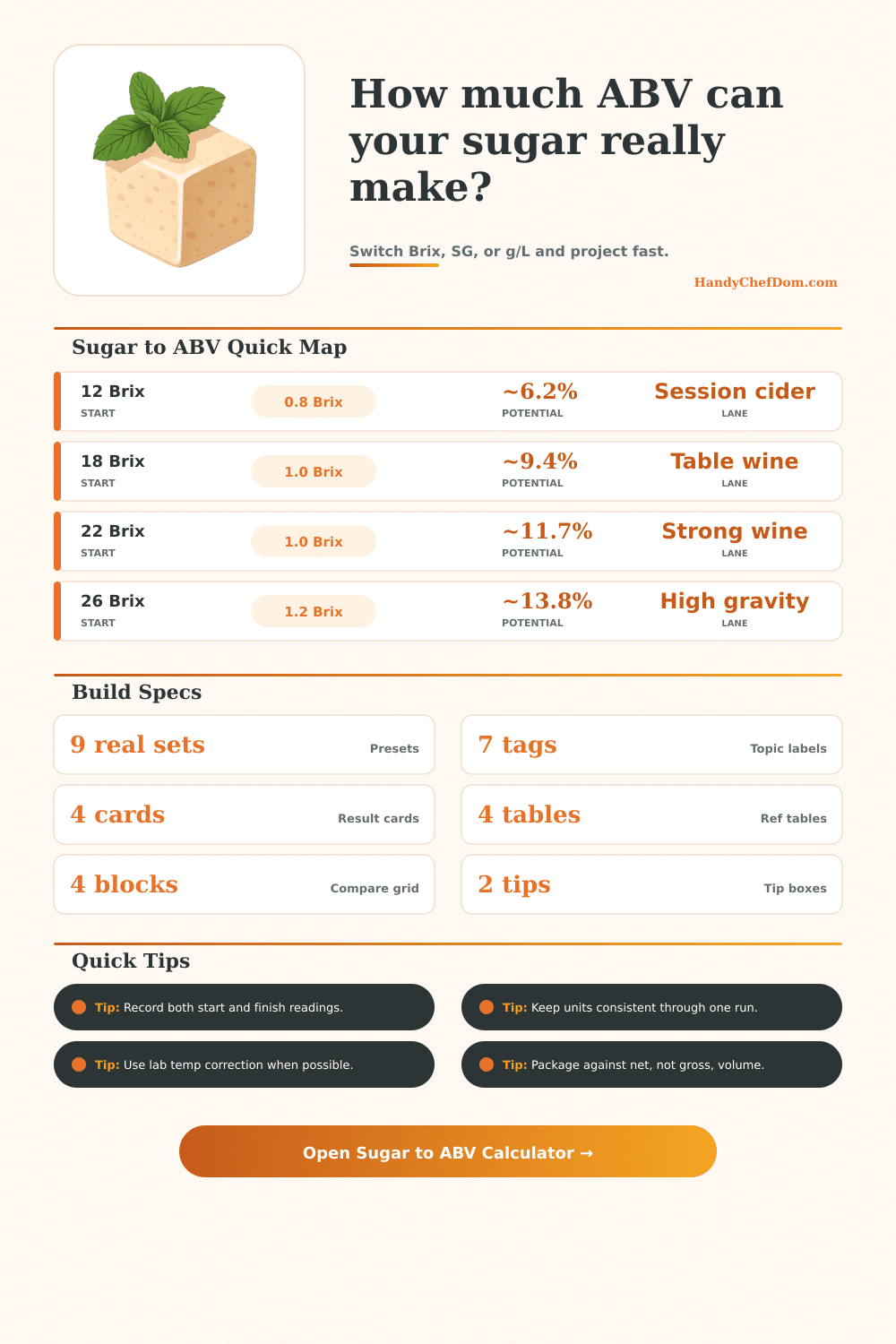
The presets established in the calculator will account for these different targets, allowing for the fermentation process to be established with a prescription of the type of beverage that will be produced. The reference tables contain information regarding the type of beverage that will be produced and the amount of alcohol that will result. For instance, light ciders can start at a Brix of 15 and finish at 1, while fruit meads can start at 16 Brix and finish at 1 Brix.
These tables are not strict guidelines, but they do help to establish the parameters for what percentage of alcohol will be produced by the fermentation process. For instance, table white wines will start at 19 Brix and end at 1 Brix, indicating that the resulting percentage of alcohol will be between 9% and 11%. High-gravity washes will start at 26 Brix, indicating that the percentage of alcohol will be higher than 14%.
These tables help to provide an idea of the percentage of alcohol that can be produced by the fermentation process, allowing for the planning of the fermentation process prior to beginning the process of placing the yeast into the fermenter. Common mistakes made by fermenters can include the use of different units of measurement, or for failing to keep accurate records of the fermentation process. For instance, if an individual uses Brix to measure the initial amount of sugar in the fermenter, but specific gravity is used after the initial measurement, then the individual will introduce an error into the fermentation process.
The amount of sugar at the start of the process and the amount of sugar at the end of the process should be measured in the same units. Additionally, each of these measurements should be recorded to that individual’s fermentation process. The calculator helps to store these variables, thus avoiding the need to perform the calculations manually.
In addition to the percentage of alcohol that will be produced, there are other factors that will impact the character of the beverage. For instance, the mouthfeel of the beverage will impact the way that an individual feels the liquid while drinking it, as will the acidity, tannin, and sweetness of the beverage. A cider that is 10% alcohol and dry will have a different mouthfeel than a 9% mead that contains more sugar.
These other features of the beverage are accounted for in the efficiency and carryover fields in the calculator. These fields allow for the modeling of the finished character of the beverage. The only ingredient that the yeast will use to produce alcohol is the sugar that is measured at the beginning of the fermentation process.
All other factors regarding the fermentation process are adjustments to the amount of sugar that is used. Thus, the calculator can provide an understanding of the relationship between sugar and alcohol percentage, and can ensure that the percentage of alcohol indicated on the label of each bottle of the beverage is accurate.