🥄 Teaspoon to Cup Converter
Convert teaspoons to cups, tablespoons, milliliters, and fluid ounces instantly
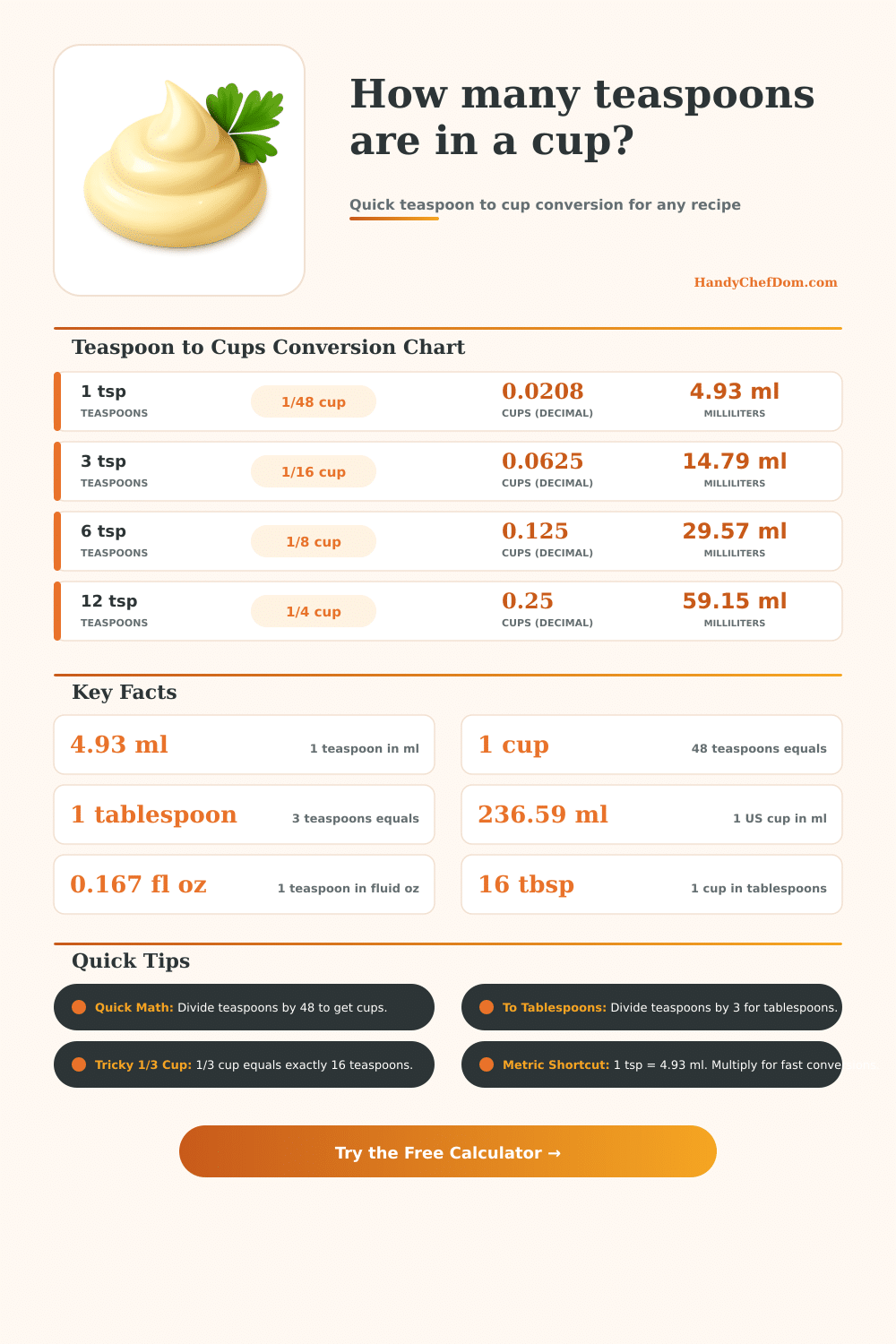
| Teaspoons | Tablespoons | Cups (Fraction) | Cups (Decimal) | Milliliters |
|---|---|---|---|---|
| 1 tsp | 1/3 tbsp | 1/48 cup | 0.0208 | 4.93 ml |
| 3 tsp | 1 tbsp | 1/16 cup | 0.0625 | 14.79 ml |
| 6 tsp | 2 tbsp | 1/8 cup | 0.125 | 29.57 ml |
| 9 tsp | 3 tbsp | 3/16 cup | 0.1875 | 44.36 ml |
| 12 tsp | 4 tbsp | 1/4 cup | 0.25 | 59.15 ml |
| 16 tsp | 5 tbsp + 1 tsp | 1/3 cup | 0.333 | 78.86 ml |
| 24 tsp | 8 tbsp | 1/2 cup | 0.5 | 118.29 ml |
| 32 tsp | 10 tbsp + 2 tsp | 2/3 cup | 0.667 | 157.73 ml |
| 36 tsp | 12 tbsp | 3/4 cup | 0.75 | 177.44 ml |
| 48 tsp | 16 tbsp | 1 cup | 1.0 | 236.59 ml |
| 96 tsp | 32 tbsp | 2 cups | 2.0 | 473.18 ml |
| Ingredient | Per Tsp (g) | Per Tbsp (g) | Per 1/4 Cup (g) | Per Cup (g) |
|---|---|---|---|---|
| Water / Liquid | 4.93 g | 14.79 g | 59 g | 237 g |
| All-Purpose Flour | 2.60 g | 7.81 g | 31 g | 125 g |
| Granulated Sugar | 4.17 g | 12.50 g | 50 g | 200 g |
| Butter (solid) | 4.73 g | 14.19 g | 57 g | 227 g |
| Table Salt | 6.00 g | 18.00 g | 72 g | 288 g |
| Honey / Syrup | 7.08 g | 21.25 g | 85 g | 340 g |
| Baking Powder | 4.60 g | 13.80 g | 55 g | 221 g |
| Cocoa Powder | 2.50 g | 7.50 g | 30 g | 120 g |
Changing units is made up of the step, that takes value in one group of units and changes it to equal value in other group. A unit of measure forms part of a system that explains the size of an object. Various ways exist for measuring masses, length and heat, and those changes involve simply multiplying or sharing by means of a set number.
In many nations one measures distance by means of kilometers, masses by means of kilos and heat by means of degrees Celsius. Because different measuring systems yet count everywhere in the world, for instance in United States and United Kingdom, the change between units becomes daily work. For masses the metric system bases on the gram, so prefixes as kilo, centigram and others come in play.
Easy Ways to Convert Units
While changing inside that system, every step in prefix shows move of one place in the decimal system. If one goes down in the scale that adds zeros to the decimal parts.
A good way to remember is that any amount stays same, if one multiplies it by means of “one”. Like this one can convert, multiplying the original value by means of one or several versions of that number. For sample, for passing of inches to centimetres, one multipiles the amount of inches by means of 2,54.
A converter tool gives maybe more exact result, however the accuracy depends on the accuracy of the initial rating.
Here are fast samples. If one has 400 metres with a factor, where 1 metre matches 3,28 feet, the result must be in feet. It really easily does, when the conversion factor already is known.
Free online calculators for changes are available, that switch between usual units for length, heat, surface, space, mass and time. Some of them have a smart main part, that offers possible changes according too the input, what eases the usage. Those aids reach 77 or more different converters for all kinds of units.
Cooking shows a lesson, where changing of measures really matters. Use the standard cups from the most little until the biggest: 1/8 cup, 1/4 cup, 1/3 cup, 1/2 cup and 1 whole cup. Each tablespoon holds 3 teaspoon.
One tablespoon matches half of liquid ounce, while one cup has 16 tablespoons. 28 grams give one ounce, and only more than 450 grams form a pound. This ties to mass, not to liquid unit, that measures thevolume.
One commonly does not need exact changes during cooking. A more practical way is to estimate 1 liquid ounce as 30 milliliters or 1 ounce as 30 grams. Changes of cups to grams range, so know that well, because not each follows a universal rule.
A digital kitchen scale with changing of grams to ounces helps for same results. Weighing the ingredients removes a lot of guessing, compared with only estimating by means of volume.