☕ Coffee TDS Calculator
Measure total dissolved solids, extraction yield, brew ratio, retained water, and bypass dilution for filter coffee, espresso, immersion brews, and cold brew.
Enter your brew data from a scale and refractometer. If retained water is left at zero, the calculator estimates it from brew water, bypass water, and final beverage mass.
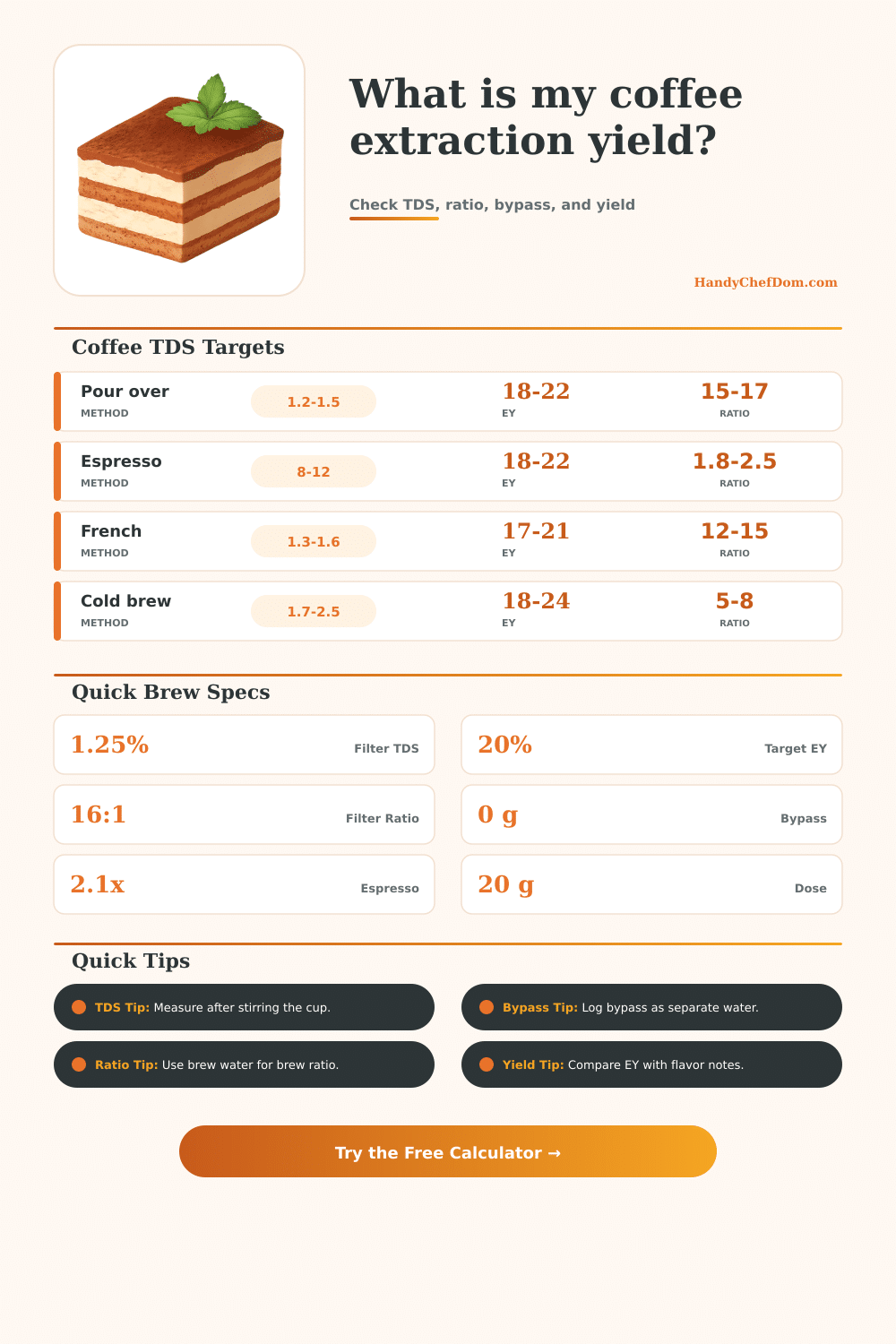
| Brew Method | Final TDS Target | Extraction Yield | Brew Ratio |
|---|---|---|---|
| Pour over filter | 1.20-1.50% | 18-22% | 15:1-17:1 |
| Flat-bed dripper | 1.25-1.55% | 18-22% | 15:1-17:1 |
| Espresso | 8.00-12.00% | 18-22% | 1.8:1-2.5:1 |
| French press | 1.30-1.60% | 17-21% | 12:1-15:1 |
| AeroPress | 1.40-2.20% | 18-22% | 6:1-14:1 |
| Cold brew | 1.70-2.50% | 18-24% | 5:1-8:1 |
| Batch brewer | 1.20-1.45% | 18-22% | 15:1-17:1 |
| Moka pot | 3.50-6.00% | 16-22% | 4:1-7:1 |
| Retention Pattern | Typical Range | What It Means | Calculator Use |
|---|---|---|---|
| Filter dripper | 1.8-2.4 g/g | Paper and grounds hold brew water | Estimate if retained is blank |
| Immersion press | 2.0-2.8 g/g | Wet grounds remain saturated | Check beverage yield ratio |
| Espresso puck | 0.8-1.4 g/g | Compressed puck holds less water | Useful for shot mass checks |
| AeroPress | 1.2-2.2 g/g | Pressing changes retained liquid | Compare press styles |
| Cold brew bag | 2.5-4.0 g/g | Coarse grounds absorb more liquid | Track concentrate yield |
| Moka basket | 1.0-1.8 g/g | Small bed with forced flow | Watch final cup mass |
| Brew Ratio | Style | Common Use | Watch Point |
|---|---|---|---|
| 1.8:1-2.5:1 | Espresso | Short, dense shots | TDS changes quickly |
| 5:1-8:1 | Concentrate | Cold brew or AeroPress | Record bypass water |
| 12:1-15:1 | Immersion | French press and steeped cups | Retention is higher |
| 15:1-17:1 | Filter | Pour over and batch brew | Balance TDS and EY |
| 18:1-20:1 | Light cup | Delicate filter brews | Strength may feel thin |
| 4:1-7:1 | Moka pot | Rich stovetop coffee | Final mass varies |
| Bypass Scenario | Before Bypass | After Bypass | Use This Reading |
|---|---|---|---|
| No bypass filter | 285 g at 1.40% | 285 g at 1.40% | Final cup |
| Iced pour over | 180 g at 2.10% | 260 g at 1.45% | Pre-bypass |
| AeroPress bypass | 120 g at 3.00% | 240 g at 1.50% | Either, if matched |
| Cold brew dilute | 180 g at 4.00% | 360 g at 2.00% | Pre-bypass |
| Batch top-up | 900 g at 1.55% | 1000 g at 1.40% | Final cup |
| Espresso long cup | 42 g at 9.50% | 120 g at 3.33% | Pre-bypass |
Calculator math uses beverage mass times TDS for dissolved solids. Extraction yield is dissolved solids divided by the dry coffee dose.
Coffee brewing involve the relationship between the taste of the coffee and the measurement of the coffee. While many people use their senses of taste to determine if their brewed coffee is good or not, the measurements of coffee can also help peoples understand why the coffee tastes the way that it does. There are a few different measurement of brewed coffee that can help people more better understand the brewing process and how to adjust it to taste.
One of the most important measurement is total dissolved solids, or TDS. TDS measure the total amount of material from the coffee that has entered the liquid coffee. Another measurement of brewed coffee is extraction yield, which measure the percentage of the total coffee dose that has moved into the water.
Simple Coffee Brewing Measurements
While both of these measurements can be used to understand the brew independently of one another, they must be used in conjunction to one another in order to properly understand the brew. For example, it is possible to brew coffee that contains high total dissolved solids yet low extraction yield, or coffee that has low total dissolved solids but high extraction yield. These measurements is useful in that they allow individuals to adjust the coffee recipe in the case that the brewed coffee has a thin flavoring or harsh flavoring.
The calculator on this page collects various measurement from the brew kettle and coffee maker, such as the coffee dose, brew water, the beverage mass, and the refractometer reading. These number are provided so that individuals can make adjustments to the brewing process of the coffee. The retained water and bypass water measurement are included in the coffee because adding water after brewing will have an impact on the TDS of the coffee prior to and after adding water.
Therefore, including these factor allows individuals to ensure that the reader is not making assumption about the brewed coffee based off the TDS measurements after adding water to the brewed coffee. Each brewing method include different target ranges for the TDS of the coffee. For instance, espresso beans are high in both pressure and heat, leading to the fact that espresso has a high TDS compared than other brewing methods like filter coffee.
Methods like French press and AeroPress sit in the middle of these extremes in that they hold the coffee grounds in contact with water for longer periods of time. Finally, cold brew method use very long contact times between the coffee grounds and water, leading to the brew of coffee concentrate that must be mixed with water after brewing. Therefore, the strength of cold brew coffee may appear low with dilution, yet the extraction process may be high.
However, the reference band indicated for these brewing method will automatically apply when individuals select brewing methods, ensuring the individual understands that the brewed coffee is within the parameter of that brewing method. Retained water is the amount of water that remain within the coffee grounds after brewing. Though individuals may tend to disregard this measurement, this amount of water has the potential to remove solid from the coffee that is brewed.
If individuals do not account for this amount of water, the indicated extraction yield will appear to be higher than the actual extraction yield of the brewed coffee. The calculator will include an estimate of the amount of retained water unless the individual enter that amount himself. The estimated amount is based upon the amount of water poured into the coffee brewer versus the amount of liquid poured from the coffee after brewing.
Though this is not exact in measurement, the estimate can prevent individuals from making large error in brewing their coffee. Bypass water is water that can be added to coffee after brewing, though this lower the TDS of the coffee. However, the amount of bypass water does not impact the extraction yield of brewed coffee.
If the TDS is measured before adding bypass water, the calculator can calculate the true extraction yield. However, if the TDS is measured after adding bypass water, the calculator will report the strength of brewed coffee after adding water, and calculate the extraction yield based upon the total mass of the coffee concentrate. This distinction make it so that individuals cannot make incorrect change to the coffee recipe based upon these measurements.
Some of the most common mistake with brewed coffee include not accounting for dilution in cold brew coffee, or brewing espresso with a too-high ratio that indicate a thin espresso. Furthermore, while individuals will always use their taste to determine if brewed coffee is good or not, these measurements help to indicate whether adjustment to dose, water, or brewing method are needed. The reference table include the target TDS and extraction yield for various brewing methods.
Though individuals are not required to adhere to these parameter, they are a good starting point when brewing coffee. Furthermore, individuals will not want to compare an espresso brewing method to a batch brewer, for instance, as the two type of brewing methods have different target for TDS and extraction yield. Finally, taste is the last and final way that brewed coffee can be judged.
Individuals should always use their sense of taste to determine if brewed coffee is good or not. The number provided from the calculator are simply a way of describing the coffee to the individual that tastes the brewed coffee. For instance, if the coffee tastes thin the extraction yield must be too low.
If the coffee tastes harsh the extraction yield must be too high. By using each of these parameter, individuals will eventually begin to recognize pattern in brewing coffee. The goal of brewing coffee is to develop an understanding of each brewing method and how each adjustment will impact the outcome of brewed coffee.
For instance, changing the grind size for a V60 brew will impact the extraction yield. Adding water to an AeroPress will not impact the extraction yield. Therefore, these adjustment can be made in a repeatable fashion, without having to rely upon an individual’s memory of what adjustment was made to achieve the desired outcome.
Finally, these measurement have the most value when the type of coffee bean or the brewing water changes. For instance, if the coffee dose and ratio are held constant, the extraction yield can be used to evaluate whether the change in coffee bean altered the extraction of brewed coffee. Therefore, these value and measurement are helpful to individuals that would like to turn occasional knowledge of brewing methods to brew good coffee, to a knowledge of how to brew coffee in a reliable and repeatable fashion.