Salt to Sodium Conversion Calculator
Convert salt amounts into sodium mg, compare salt types, and check recipe servings against daily limits.
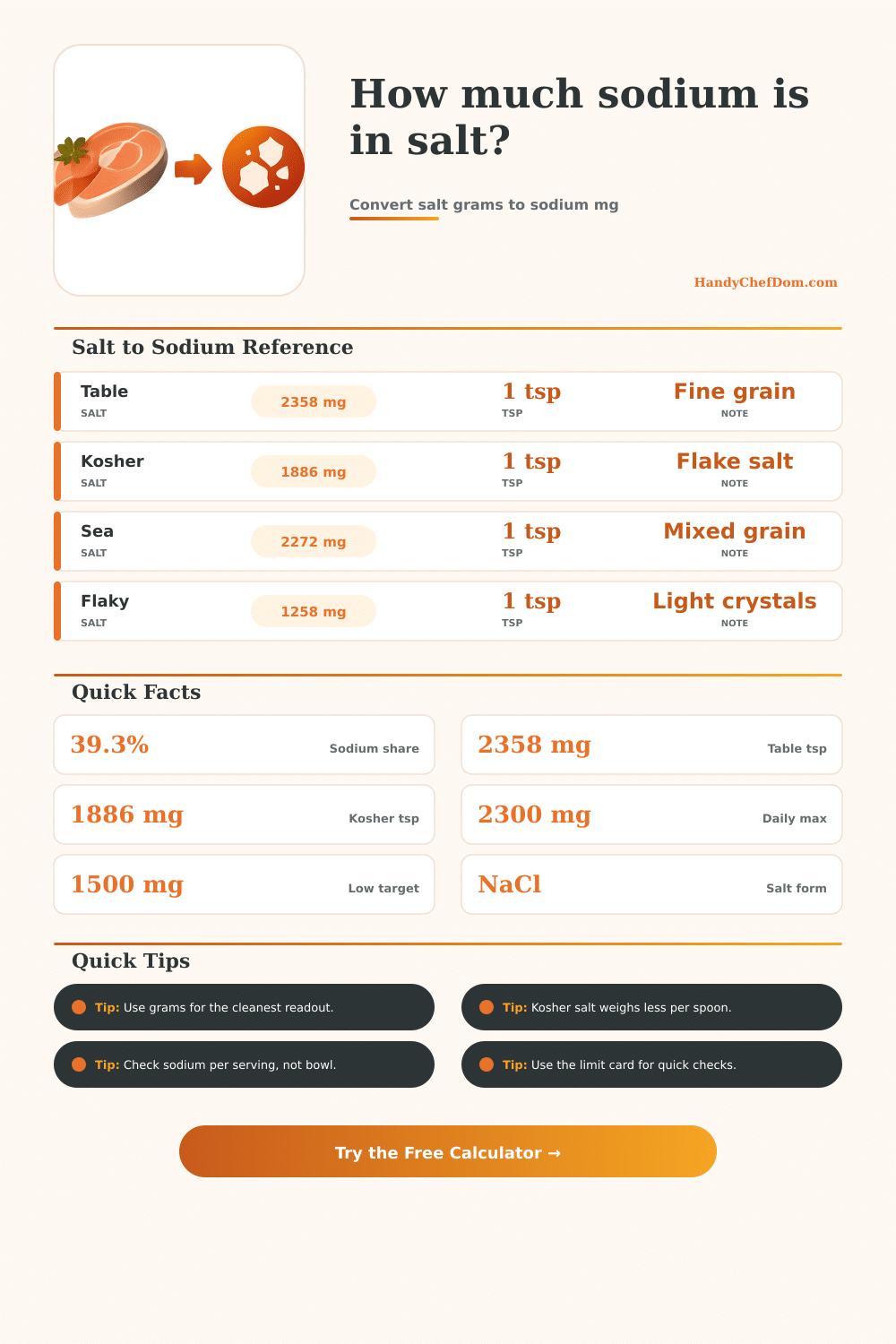
| Salt | g/tsp | Sodium | Use |
|---|---|---|---|
| Table | 6.0 | 2358 mg | All purpose |
| Kosher | 4.8 | 1886 mg | Seasoning |
| Sea | 5.8 | 2272 mg | Everyday |
| Pink | 5.7 | 2233 mg | Mineral |
| Pickling | 6.0 | 2358 mg | Brining |
| Flaky | 3.2 | 1258 mg | Finish |
| Measure | Tsp Eq | g Eq | Na mg |
|---|---|---|---|
| 1/4 tsp | 0.25 | 1.5 g | 590 mg |
| 1/2 tsp | 0.5 | 3.0 g | 1179 mg |
| 1 tsp | 1.0 | 6.0 g | 2358 mg |
| 1 tbsp | 3.0 | 18 g | 7074 mg |
| Guide | Limit | Use | Note |
|---|---|---|---|
| Low | 1500 mg | Watch | Strict cap |
| Standard | 2300 mg | Common | Daily max |
| Half day | 1150 mg | Per meal | Split use |
| Snack | 300 mg | Light | Small hit |
| Type | Texture | Sodium | Note |
|---|---|---|---|
| Table | Fine | High | Fast dissolve |
| Kosher | Flake | Med | Less dense |
| Sea | Mixed | High | Varies by grind |
| Lite | Blend | Lower | Check label |
Sodium is a mineral that is found in salt. Sodium is a substance that you must monitor because too much of it can lead to high blood pressure. Although people use table salt to season food, you need to understand the difference between salt and sodium.
Table salt contains sodium chloride, which is an compound that contains both sodium and chloride. The sodium account for approximately 40 percent of the weight of table salt, while the chloride accounts for the remaining 60 percent. Because each of these component has different properties, it is important to understand that not all salts contains the same amount of sodium.
How Different Salts Change How Much Sodium You Eat
Therefore, it is important to understand the difference between salt and sodium. The different type of salt contain different densities. Each type of salt have a different density, which alters the amount of sodium that you consume when you use a measuring spoon to measure the salt.
For example, the fine and dense nature of table salt means that one teaspoon of table salt contain a high amount of sodium. Kosher salt crystals is larger and airier than table salt crystals, meaning that one teaspoon of kosher salt will contain less mass of the salt than one teaspoon of table salt. Therefore, one teaspoon of kosher salt will contain less sodium then one teaspoon of table salt.
The same can be said for sea salt, as the density of sea salt can range from as dense as table salt to as coarse as kosher salt. Flaky salt crystals is very light and will contain a large volume of the salt when you consider sodium intake. The size of the salt crystals will change the amount of sodium content in a teaspoon of the salt.
Another consideration with salt is the number of servings that contain the salted recipe. The number of servings that you prepare will determine the amount of sodium that each portion of the recipe contains. For example, a recipe that contains salt and prepares many serving of the recipe will contain a higher total amount of sodium then the recipe will contain in each serving.
If an individual consume only one very large portion of the recipe compared to others who consume a small portion of the same recipe, they will consume more sodium than those who eat a smaller portion. In most instances, individuals should consume less sodium then the recommended amount for each day. The recommended amount of sodium for an individual is 2,300 mg for most adult.
For individuals who have risk for heart disease or hypertension, the limit is 1,500 mg daily. By monitoring the amount of sodium that you consume each day, you can ensure that you dont consume too much of this mineral from the foods that you eat. Salt isnt just a mineral that is found in the salt shaker.
Many processed foods contains a significant amount of sodium. Many individuals consume too much sodium due to the amounts of salt contained in canned broths, cheeses, and breads. These foods contains a significant portion of the amount of sodium that individuals consume in a day.
Because the sodium in these foods is hidden from the individual, you must read the ingredient list and sodium content prior to consumption. To reduce the amount of sodium that you consume daily, use herbs, citrus, or vinegar to flavor the food that you prepare. Additionally, rinse the canned foods prior to cooking to remove some of the excess sodium from the canned goods.
Another option to measuring salt is to use a weight measurement instead of a volume measurement of the salt. Weighing the salt with a scale account for the different sizes of salt crystals. This will help ensure that you know the amount of sodium that you are consuming.
Many individuals who prepare food dont use a scale to measure the amount of salt that they adds to food. By not using a scale to measure salt, individuals consume too much of this mineral. By understanding the impact that the mass of salt have on the sodium content in food, you can make betterer choices with your health.
By reducing the amount of salt and sodium that enters your body, you will lower your blood pressure by reducing the amount of water that enters the bloodstream.