Sous Vide Pasteurization Calculator
Set protein, thickness, shape, and bath temp to estimate pasteurization time with a clear heating and hold breakdown.
Baldwin-style tables are used as the core reference. The calculator keeps the heat-through estimate separate from the pasteurization band so you can see which part drives the schedule.
| Thickness | Slab-like | Cylinder-like | Sphere-like |
|---|---|---|---|
| 10 mm | 19 min | 11 min | 8 min |
| 25 mm | 1 hr 15 min | 40 min | 25 min |
| 40 mm | 2 hr 30 min | 1 hr 15 min | 55 min |
| 60 mm | 4 hr 45 min | 2 hr 30 min | 2 hr |
| Thickness | 57C | 60C | 63C | 66C |
|---|---|---|---|---|
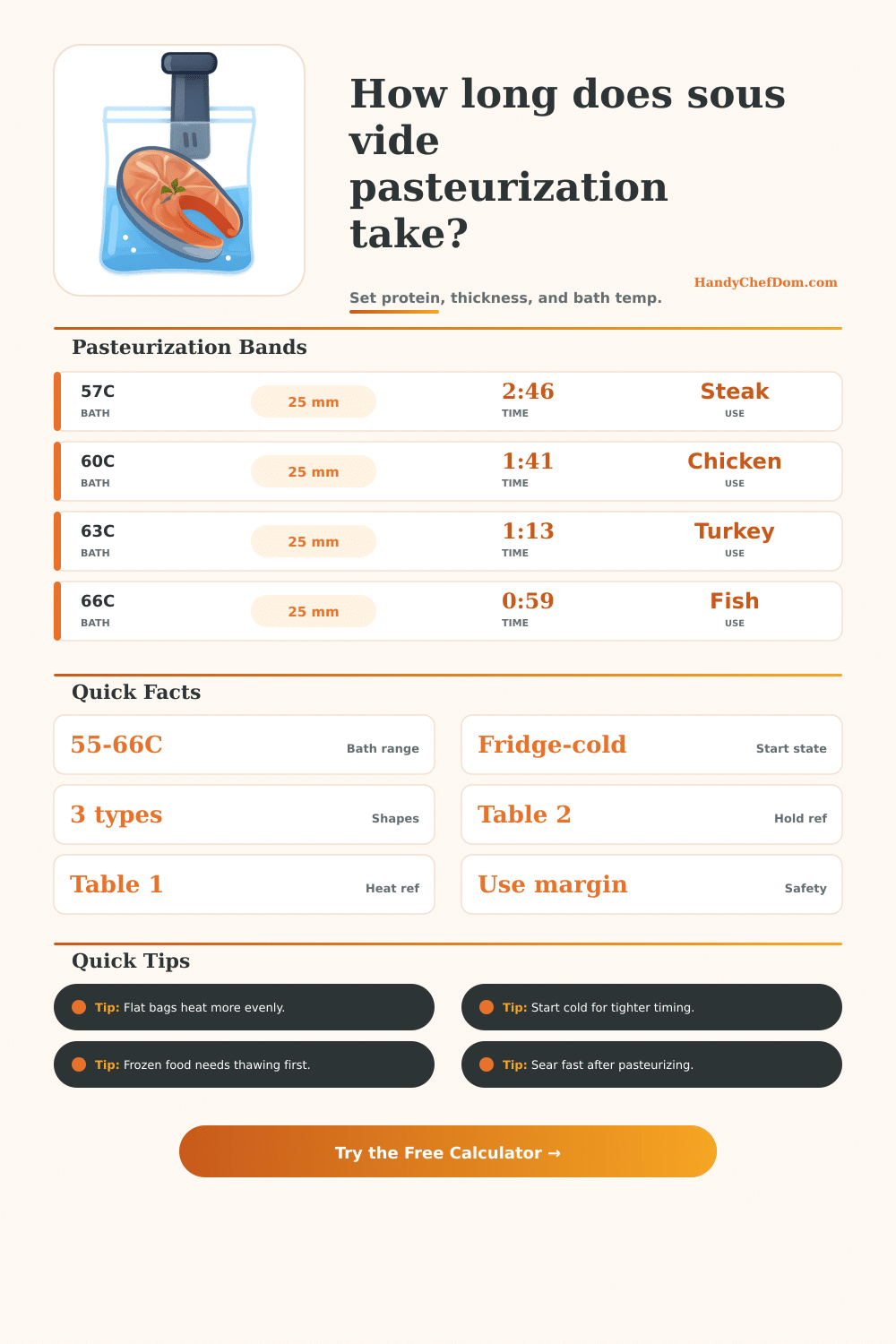
| 25 mm | 2:46 | 1:41 | 1:13 | 0:59 |
| 40 mm | 3:29 | 2:22 | 1:50 | 1:32 |
| 55 mm | 4:39 | 3:26 | 2:47 | 2:23 |
| 70 mm | 6:03 | 4:42 | 3:54 | 3:23 |
| Protein | Bath temp | Shape | Default |
|---|---|---|---|
| Beef steak | 57C / 135F | Slab | 25 mm |
| Chicken breast | 60C / 140F | Slab | 25 mm |
| Salmon fillet | 55C / 131F | Slab | 20 mm |
| Eggs / custard | 63C / 145F | Sphere | 45 mm |
| Start state | Temp | Effect | Note |
|---|---|---|---|
| Fridge | 4C / 39F | Baseline | Best default |
| Chilled | 8C / 46F | Slightly faster | Shorter warm-up |
| Room | 20C / 68F | No reduction | Use caution |
| Frozen | -18C / 0F | Large bump | Thaw first |
Sous vide pasteurization is a cooking method that use precise water temperatures and specific amount of time to kill the pathogens that are present in the food. Sous vide pasteurization kills the harmful type of bacteria, such as salmonella. Sous vide pasteurization is a process that kill these types of bacteria by exposing the food to a specific temperature for a specific length of time.
Sous vide pasteurization is a process that allow individuals to prepare and cook food without ever overcooking the interior of the food. The process relies upon the concept that heat must travel through the food to reach the center of the food prior to the pasteurization process beginning. One of the factor in sous vide pasteurization is the shape of the food.
Simple Rules for Safe Sous Vide Cooking
The shape of the food can impact the rate at which heat travel into the food. For instance, foods that are flat, like steaks, allow heat to travel from both side of the food to the center of the food. Foods that is thick or cylindrical, however, allow for heat to have to travel a longer distance to reach the center of the food.
Therefore, foods should be cooked in flat bag to allow for even heat to travel to the center of the food. Bags that are too thick will allow for longer cooking times due to the longer distance that heat must travel to reach the center of the food. In addition to the shape of the food, the starting temperature of the food also have an impact upon the cooking time required to pasteurize the food.
One way to ensure that the food is properly pasteurized is to start with food that is cold from the refrigerator, about 39°F. Using this starting temperature allow for cooks to more easy set a timeline for the cooking process. Warm food may lead to underestimations of the time required for proper pasteurization of the food. Finally, you should avoid food that is starting in a frozen state for sous vide pasteurization techniques.
The presence of ice in the food will allow for the heat to not be able to properly travel into the food, thus increasing the cooking times of the food by more than one hour. Another factor in sous vide pasteurization is the type of protein that are being cooked. Different type of protein require different cooking temperatures and times.
For instance, chicken requires a higher degree of pasteurization than beef due to the presence of salmonella on the surface of chicken. Salmon, however, is a more delicate protein that require lower water temperatures during the pasteurization process in order to not make the salmon meat too tough. The third main factor in sous vide pasteurization is the thickness of the food.
The thickness of the food is the most important in the cooking equation. Each additional millimeter of thickness create additional time for the heat to reach the center of the protein. The fourth factor for sous vide pasteurization is the temperature of the water that is used to pasteurize the food.
By increasing the temperature of the water in which the food is cooked, the time required to pasteurize the food will decrease. For instance, steak will pasteurize in less than three hours at 135°F, but it will pasteurize in less time if the water temperature are increased to 140°F. Higher temperatures, however, may lead to the protein that is being cooked becoming tougher. It is also important to distinguish between the heat up time of the food and the pasteurization hold time.
The heat up time is the length of time that it take for the center of the food to heat up to the required cooking temperature. The pasteurization hold time is the length of time that the food is held at that cooking temperature. For thin foods, the heat up time may be the longest portion of the cooking process.
For thick foods, however, the pasteurization hold time will be the longest portion of the cooking process. Calculators are available online that can determine these time value for different cut of meats and proteins. In addition to knowing the different factor related to sous vide pasteurization, it is also important that the cooking implement be prepared properly.
The food should be placed into a bag in such a way that the food is flat and even within the bag. Any crumpling of the bag will lead to some area of the food being thicker than others, and thus the heat will travel at vary rates throughout the food. Additionally, there should be no air pocket within the bag, as these air pockets will create cold spot in the food, preventing it from properly pasteurizing.
Finally, after removing the food from the bag, the food should be dried of any moisture that may be on its surface, as any moisture will prevent it from properly sear when cooked.