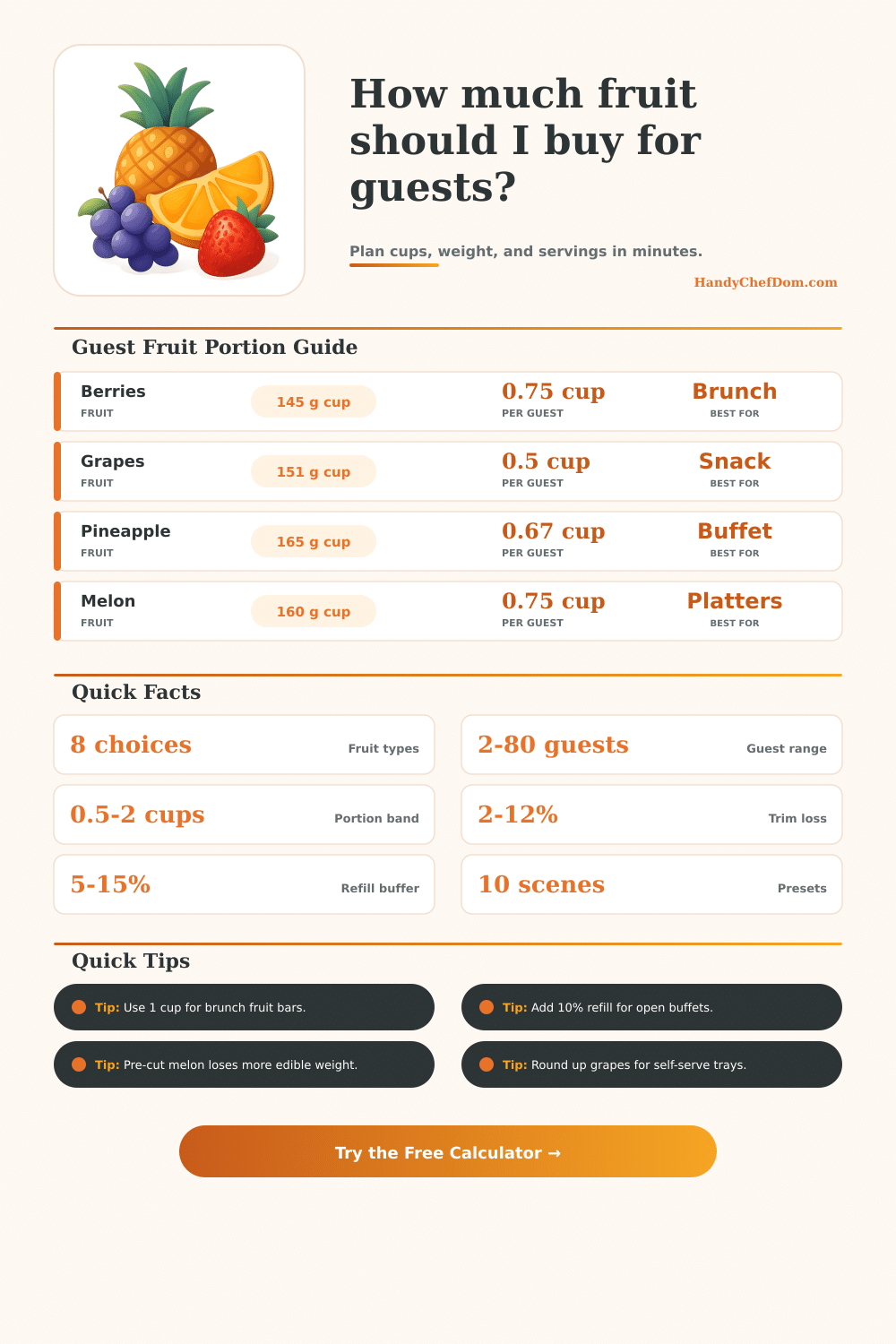
Fruit for Guests Calculator
Plan fruit cups per guest, trim-adjusted buy weight, refill buffer, and nutrition totals for snack tables, brunch bars, and larger events.
📌Quick Presets
⚙Calculator Inputs
Choose a fruit type and event style, then set cups per guest and adjustment factors. The calculator returns edible cups, buy weight, and serving coverage.
Guest fruit snapshot
See buy weight, edible cups, serving coverage, and calories at a glance.
📐Serving Size Grid
📑Reference Tables
| Fruit type | Cup weight | Edible yield | Raw to edible |
|---|---|---|---|
| Mixed berries | 145 g | 95% | 1.05x raw |
| Grapes | 151 g | 96% | 1.04x raw |
| Pineapple chunks | 165 g | 56% | 1.79x raw |
| Melon cubes | 160 g | 52% | 1.92x raw |
| Watermelon cubes | 152 g | 64% | 1.56x raw |
| Apple slices | 110 g | 78% | 1.28x raw |
| Orange segments | 180 g | 73% | 1.37x raw |
| Banana slices | 150 g | 66% | 1.52x raw |
| Guests | 0.75 cup each | 1.0 cup each | 1.25 cup each |
|---|---|---|---|
| 8 guests | 6 cups | 8 cups | 10 cups |
| 12 guests | 9 cups | 12 cups | 15 cups |
| 20 guests | 15 cups | 20 cups | 25 cups |
| 30 guests | 22.5 cups | 30 cups | 37.5 cups |
| 40 guests | 30 cups | 40 cups | 50 cups |
| 60 guests | 45 cups | 60 cups | 75 cups |
| 80 guests | 60 cups | 80 cups | 100 cups |
| 100 guests | 75 cups | 100 cups | 125 cups |
| Edible cups | Approx kg | Approx lb | Service cue |
|---|---|---|---|
| 6 cups | 0.9 kg | 2.0 lb | Small snack setup |
| 12 cups | 1.8 kg | 4.0 lb | Family brunch tray |
| 20 cups | 3.0 kg | 6.6 lb | Office refresh table |
| 30 cups | 4.5 kg | 9.9 lb | Buffet side fruit |
| 40 cups | 6.0 kg | 13.2 lb | Event station |
| 60 cups | 9.0 kg | 19.8 lb | Wedding service |
| 80 cups | 12.0 kg | 26.5 lb | Large fair line |
| 100 cups | 15.0 kg | 33.1 lb | Festival day |
| Prep format | Loss | Held texture | Best match |
|---|---|---|---|
| Whole pieces | 2% | Longest hold | Grab-and-go |
| Halved or sliced | 4% | Good hold | Brunch bowls |
| Mixed cubes | 8% | Medium hold | Shared platters |
| Skewers | 10% | Medium hold | Walk-around events |
| Individual cups | 6% | Stable hold | School events |
| Open buffet | 12% | Fast turnover | Long service |
| Cold refill rounds | 7% | Steady hold | Office service |
| Late refill only | 4% | Good hold | Short events |
🍎Nutrition Snapshot
💡Practical Tips
Planning the fruit for an group of people requires that you calculate how much edible fruit will remain after you prepare the fruit for the guests. Many people find that when they go to the store to purchase fruit, they typically purchase more of the fruit than the amount of edible fruit that the group of people will consume. This is due to the amount of weight of the fruit that is lost during the process of preparing the fruit for consumption by the guests.
Thus, it is important for the person planning the fruit to account for this loss of weight in order to ensure that there is enough fruit of the calculated weight for each guest to consume during the event. Fruits lose different amounts of weight during the preparation process. For instance, grape will lose very little weight during the process of preparing the fruit for consumption, whereas fruit like pineapple and melon will lose a significant amount of weight due to the need to remove the skin and the seeds for the fruit to be considered edible.
How Much Fruit to Buy for a Group
Berries, on the other hand, will lose very little weight during preparation because the only step in the preparation of the berries is to rinse the berries. Each of these types of fruit can be accounted for in the calculator to determine how much total weight of fruit should be purchased. The type of event that will be hosted will play a role in determining the amount of fruit that the guests will consume.
For instance, if the event is to include a quick snack table that will only be hosted for short period of time, the amount of fruit that will be consumed will be less then if the event is to include an open brunch that will occur for several hours. Additionally, the more guests that feel that they will be able to return for second servings of the fruit, the more fruit those guests will take as compared to if the fruit is only one part of a large meal. Additionally, the appetite of the guests will effect the amount of fruit that is required to be purchased for the event.
For instance, guests that have high appetites, like athletes, will consume more fruit than a group of young childrens. The way in which the fruit is to be prepared will also impact the amount of weight of the fruit that is prepared and consumed. For instance, if the fruit is to be prepared in a way that the fruit is to be sliced, it may be easier for the guests to consume the fruit, but more weight may be lost due to the browning of the fruit.
Whole pieces of fruit will remain fresh, but will require more effort from the guests to be consume. Additionally, if the fruit is to be prepared on skewers, the skewers may lead to the loss of some of the fruit if the fruit is dropped during the serving of the fruit to the guests. Each of these preparation formats can be accounted for in the calculator.
In addition to the factors described above, it is also important to purchase a portion of the fruit that is to remain in the refrigerator and served later during the event. By keeping a portion of the fruit fresh in the refrigerator, the guests will have access to fresh fruit throughout the event. However, this means that more fruit will have to be purchased than would be required for the event if the fruit was not to be refrigerated.
Additionally, some of the fruit may be lost during the serving of the fruit to the guests. Some of the fruit may become dropped, moved, or left on plates by the guests that has consumed it. Due to these factors, it is recommended that some additional fruit is purchased to account for these losses.
The reference tables located on this page help to show the edible portions of different types of fruit in relation to the weight of the fruit that needs to be purchased. These tables are not intended to replace the calculator, but they can help to show whether the amount of fruit that is to be purchased is too large or too small to reflect the factors discussed above. It is important to recognize that not all fruit is created equally.
For instance, a cup of melon cubes will weigh more than a cup of berries, and a cup of melon cubes will contain different nutrition than a cup of berries. If the event is to include different types of nutrition for the guests, different fruits can be selected in place of others in order to provide these types of nutritional benefits to the guests that attend the event. The nutrition information for each of the fruits is displayed in the calculator for each fruit.
Factor of temperature and the timing of the serving of the fruit is important to consider. For instance, if the fruit is to be displayed outside in the sun, it may lose its visual appeal and its juice may water. To avoid losing the fruit to browning, it is possible to prepare a second batch of fruit to be displayed in the refrigerators until served to the guests.
However, this will require the purchase of more of the fruit than the minimum amount to provide for the guests. Finally, it is also important to determine the portion size for the guests. For instance, if the portion size for the guests is to be half a cup, that portion size can be used for individuals that may attend events that last for only a few hour.
However, a portion size of a full cup of prepared fruit would be better suited for a brunch event. The serving size grid located on this page can help to determine the proper portion size for the guests based off the length of the event. By using the calculator to account for the number of guests, the portion size for the guests, and the preparation style for the fruit, it is possible to determine the total weight of the fruit that will need to be purchased in order to ensure that each guest will be supplied with enough edible fruit to consume.