Fruit and Veg Portion Calculator
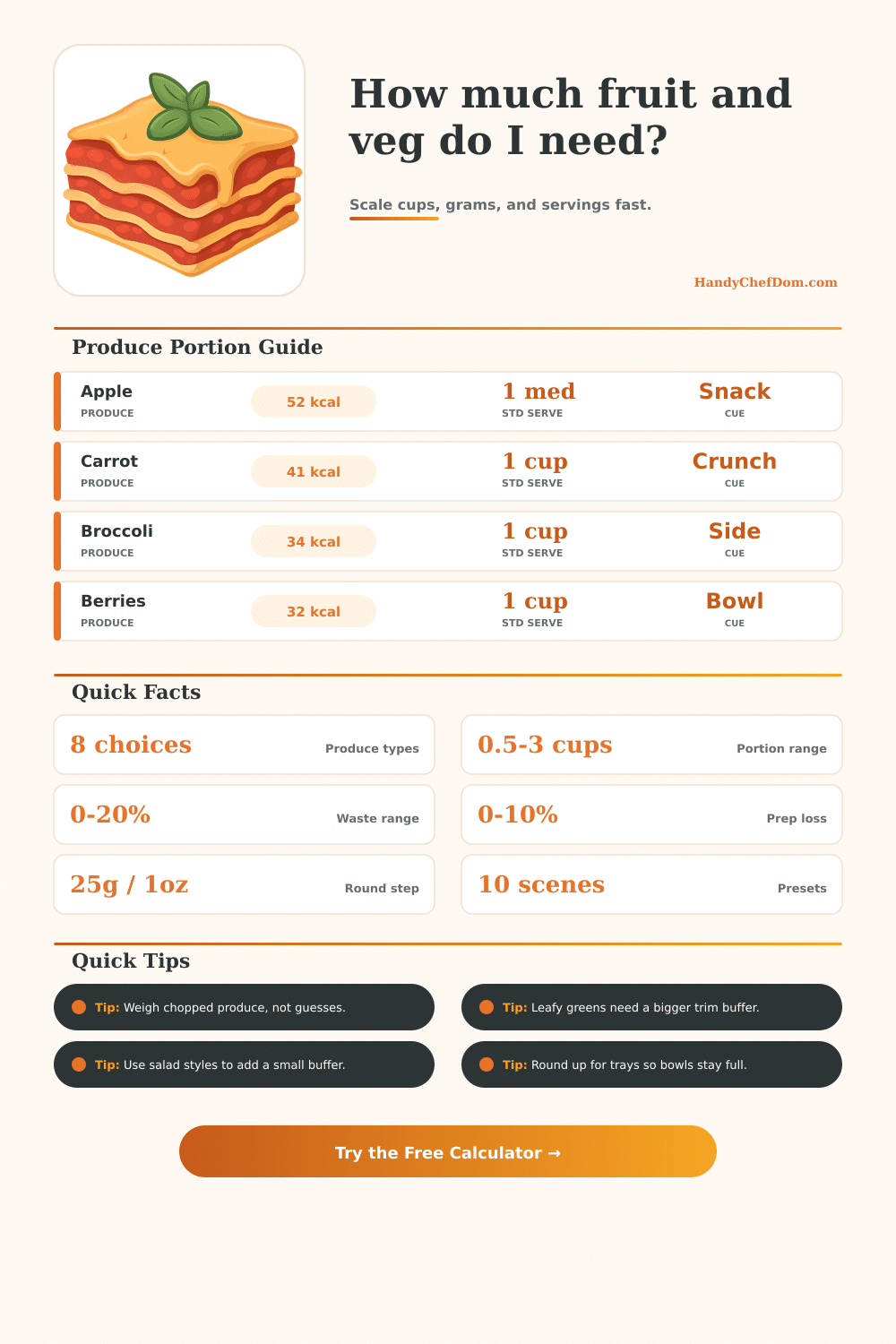
Set a produce type, tune the serving style, and see the buy weight, edible yield, servings covered, and calories in one clean pink panel.
📌Quick Presets
⚙Calculator Inputs
Choose a produce type, then adjust cups per person, style, prep loss, and waste. The calculator turns your plan into a realistic purchase weight and cup yield.
Portion snapshot
See the buy weight, edible yield, standard servings, and calories in one glance.
📑Reference Tables
| Produce | Std serve | Gram cue | Note |
|---|---|---|---|
| Apple | 1 medium | 182 g | Crisp snack |
| Banana | 1 medium | 118 g | Easy fruit |
| Berries | 1 cup | 152 g | Soft bowl |
| Grapes | 1 cup | 151 g | Quick bite |
| Carrot | 1 cup | 128 g | Crunch side |
| Broccoli | 1 cup | 91 g | Floret mix |
| Greens | 2 cups | 47 g | Leafy volume |
| Tomato | 1 cup | 180 g | Juicy mix |
| Type | Edible | Loss | Use |
|---|---|---|---|
| Whole | 100% | 0% | Snack bowls |
| Washed | 98% | 2% | Quick prep |
| Chopped | 95% | 5% | Mixed trays |
| Trimmed | 90% | 10% | Leafy cuts |
| Peeled | 88% | 12% | Firm fruit |
| Shared | 92% | 8% | Potluck use |
| Buffet | 85% | 15% | Second help |
| Meal prep | 94% | 6% | Lunch boxes |
| Group | Fruit bowl | Veg side | Buy cue |
|---|---|---|---|
| 2 people | 2 cups | 2 cups | Small snack |
| 4 people | 4 cups | 4 cups | Family meal |
| 8 people | 8 cups | 8 cups | Lunch tray |
| 12 people | 12 cups | 12 cups | Party spread |
| 16 people | 16 cups | 16 cups | Buffet line |
| 20 people | 20 cups | 20 cups | Big platters |
| 25 people | 25 cups | 25 cups | Large event |
| 30 people | 30 cups | 30 cups | Heavy serve |
| Cup cue | Metric | Imperial | Note |
|---|---|---|---|
| Apple | 125 g | 4.4 oz | Sliced fruit |
| Banana | 150 g | 5.3 oz | Soft slices |
| Berries | 152 g | 5.4 oz | Whole berries |
| Grapes | 151 g | 5.3 oz | Snacking cup |
| Carrot | 128 g | 4.5 oz | Chopped bite |
| Broccoli | 91 g | 3.2 oz | Floret cup |
| Greens | 47 g | 1.7 oz | Big volume |
| Tomato | 180 g | 6.3 oz | Juicy pieces |
🍎Nutrition Snapshot
💡Practical Tips
Use this fruit and veg portion calculator to size snacks, salads, and sides with less guesswork. Compare produce types, adjust waste, and scale trays or bowls for any meal.
When shopping for produce, you may experience uncertainty regarding whether the amount of produce you purchase will provide the volume of edible produce that you requires for your recipes. The weight of the produce and the volume of the produce is two different measurement. When you purchase produce from a grocery store, you may buy a certain weight of produce.
However, the edible volume of that produce may be less than the weight that you purchased. This is because the density of produce differ for different varieties of produce and because there are loss in preparation that must be accounted for when calculating how much produce to purchase. The density of produce will determine how much that specific amount of produce weigh.
How to Buy the Right Amount of Produce
For instance, spinach will weigh less than carrots that is measured in the same cup measurements. If an individual is preparing a recipe that utilize produce in cup measurements but intends to purchase the produce based on the weight of that produce, then a calculation is necessary to determine the weight of that produce based on the volume measurements required in the recipe. The calculator that is provided can help with this calculation, as the calculator accounts for the density of each type of produce when calculating the weight of the produce that is need for the recipe.
Preparation of produce will result in some loss of the total weight of the produce that will be edible. For instance, if the produce must be peeled before cooking or if the cook must remove the stems from the produce, then there will be a loss of that weight of the total produce that will be edible. Produce like whole fruit will have very little loss in the preparation stage, but produce that must be peeled will have a highly level of prep loss.
If an individual dont account for this loss in the preparation stage, the total produce may not be sufficient for the total amount of produce that is needed for the recipe. In addition to the considerations of density, prep loss, and measurements, the appetite of the guests that will be eating the meal also play a role in the amount of produce that should be purchased for the recipes. Individuals that have a lighter eating appetite will consume less of the produce than individuals that have a hearty eating appetite.
The same amount of produce can also be consumed at a buffet-style meal as compared to a meal that controls the portion size of the produce that is served. The calculator also accounts for these variables in the calculation of the amount of produce that must be purchased to account for the appetite of each guest. Finally, it is possible for some of the produce to be discard due to bruising or softness of certain portion of the produce.
Any produce that is discarded cannot be consumed by the guests, so it is important to account for this in the calculation of the total amount of produce that should be purchased. Some people may not account for the amount of produce that may be wasted, and this may leave them with insufficient amount of edible produce to prepare their recipes. The different type of produce will behave differently as referenced in the tables provided.
For instance, leafy greens will have a high volume but will weigh less than other types of produce. Conversely, produce like tomatoes will have a high weight to volume ratio due to the heaviness and juiciness of the vegetable. If preparing meals for a large group, it is necessary to round the amount of produce that should be purchased to the nearest gram.
It is impossible to purchase produce in gram amounts, so rounding the volume of produce that is calculated for the recipe to the nearest gram will create a safety net for the produce that may be needed by the guests who prepare the recipe. It is always better to purchase an excess amount of produce than to have insufficient amount of produce for the guests that will eat the prepared meals. Knowing the nutritional content of the produce will allow an individual to alter the caloric content of the meals.
For instance, if broccoli is to be replaced with carrots, the caloric content of the meal will change due to the different nutritional content of these vegetables. Such calculations will allow an individual to make these types of changes. Thus, as a result of these calculations, an individual will know the amount of produce that is necessary to purchase in order to prepare enough meals to satisfy the guests.