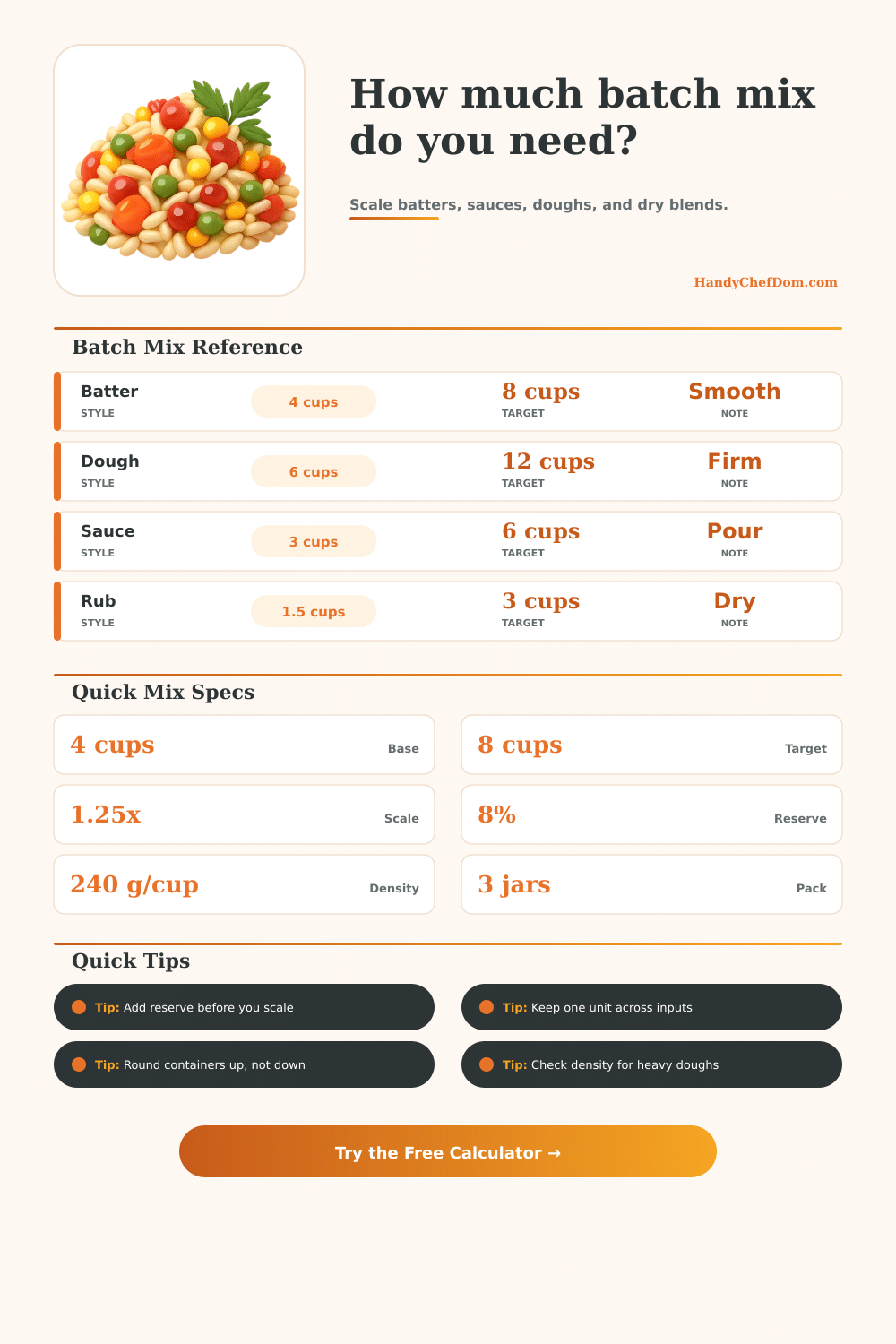
Batch Mix Calculator
Scale batters, sauces, doughs, and dry blends for the batch size you actually need.
Pick a mix style, set your base batch, and scale to the target amount. The calculator keeps reserve, waste, and container count in view.
| Style | Mix | Best for | Note |
|---|---|---|---|
| Batter | Light | Pans | Smooth pour |
| Dough | Firm | Trays | Holds shape |
| Sauce | Silky | Bowls | Easy coat |
| Seasoning | Dry | Jars | Shake well |
| Soup base | Brothy | Kettle | Ladle ready |
| Glaze | Sticky | Racks | Thin finish |
| Marinade | Loose | Jugs | Fast pour |
| Beverage | Chilled | Pitchers | Party pour |
| Group | Base | Target | Use |
|---|---|---|---|
| 4 people | 4 cups | 6 cups | Small meal |
| 8 people | 6 cups | 10 cups | Family tray |
| 12 people | 8 cups | 14 cups | Buffet set |
| 20 people | 10 cups | 18 cups | Party batch |
| 30 people | 12 cups | 24 cups | Prep day |
| 40 people | 16 cups | 30 cups | Event bowl |
| 50 people | 20 cups | 36 cups | Big run |
| 100 people | 36 cups | 72 cups | Catering |
| Cup | ml | oz | Approx g |
|---|---|---|---|
| 1/4 cup | 59 | 2 | 60 |
| 1/2 cup | 118 | 4 | 120 |
| 1 cup | 237 | 8 | 240 |
| 2 cups | 473 | 16 | 480 |
| 4 cups | 946 | 32 | 960 |
| 1 qt | 946 | 32 | 960 |
| 1 L | 1000 | 33.8 | 1000 |
| 1.5 L | 1500 | 50.7 | 1500 |
| Container | Volume | Pack | Note |
|---|---|---|---|
| Small tub | 2 cups | 1 x | Test batch |
| Quart tub | 4 cups | 1 x | Fridge safe |
| Pitcher | 6 cups | 1 x | Drink mix |
| Half pan | 8 cups | 1 x | Tray work |
| Large tub | 12 cups | 2 x | Party hold |
| Cambro | 16 cups | 2 x | Bulk prep |
| Jug | 2 L | 1 x | Liquid mix |
| Food pail | 4 L | 2 x | Catering |
Scaling a recipe for a crowd require more than simply multiplying the numbers in a recipe. Multiplying the numbers in a recipe does not account for the way that food behave in the kitchen. Many people believe that doubling a recipe are a simple task.
However, many people find that doubling a recipe leads to a shortage of food. Food often clings to the sides of the bowl and spatulas with which it is mixed. Therefore, the amount of food that is made has to take into account the amount of food that will be lost to this clinging.
How to Scale a Recipe for Many People
In the kitchen, there are two specific concept that are used to account for the potential loss of food to the cooking process. These concepts are waste and reserve. Waste is any food that is lost to the clinging of food to cooking utensils such as whisks and mixing bowl.
Reserve is the extra amount of food that is prepared such that there will be enough food for the recipe’s serving. Without the reserve and waste margin, there may not be enough food for the recipe’s target yield. Using these margins will ensure that the amount of food that is made is the amount of food that the recipe yields.
The density of a food mixture can impact how much food is prepared for a recipe. Some food mixture are more dense than others. For example, pancake batter is different than bread dough.
The heavy mixture will often cling to the side of the container more than a light mixture will. For this reason, a higher waste margin is used with a heavy food mixture. A higher waste margin is used for any mixture that is thick or firm to the touch.
Knowing the total mass of a food mixture will help a cook to select the appropriate mixing equipment. Furthermore, knowing the total mass of a food mixture will prevent the cook from overloading the mixer with too much mass of food. In addition to knowing how much food to prepare, a cook must also account for the number of container in which the food will be prepared.
The cook must have enough containers for the total volume of the food mixture. A cook who does not plan for the volume of food that must be prepared may not have enough containers to hold all of the prepared food. By calculating the total volume of the food mixture that must be prepared, a cook can avoid this problem.
Furthermore, calculating the total volume will allow a cook to select the correct number of containers before beginning to prepare the food. Portion control is another important factor to consider when scaling a recipe. It is necessary to ensure that there is enough servings of food for all of the individuals who will eat the food.
However, portion control can be dificult. For example, if the target yield is twenty cups of food and each portion is one quarter cup, there will need to be eighty servings. Portions that are too large will create few servings of food.
The reserve margin will help to control the portion of food that is prepared for each individual. The reserve margin will ensure that there is enough food for all of the servings except the one that is incorrectly portioned. When preparing dry ingredient, such as a spice rub, it is necessary to use weight as the unit of measurement for the ingredient.
Volume measurement can be inaccurate when measuring dry ingredients. Using weight measurements will give the cook a more precise measurement of the dry ingredient. Using a concrete mass measurement of the ingredient will ensure that the dry ingredient is evenly distributed throughout the batch of food.
Additionally, only one unit of measurement should be used throughout the recipe. For example, all measurements can use metric units or imperial units. Using only one unit of measurement will prevent errors in the recipe.
Preventing errors in the recipe will ensure that the batch of food remains balanced. Thus, using math and margins to scale a recipe transforms the task of scaling a recipe into a science.