Salt Converter
Convert table salt, kosher salt, sea salt, pickling salt, Himalayan salt, and flaky finishing salt by weight, spoon volume, recipe scaling, and estimated sodium.
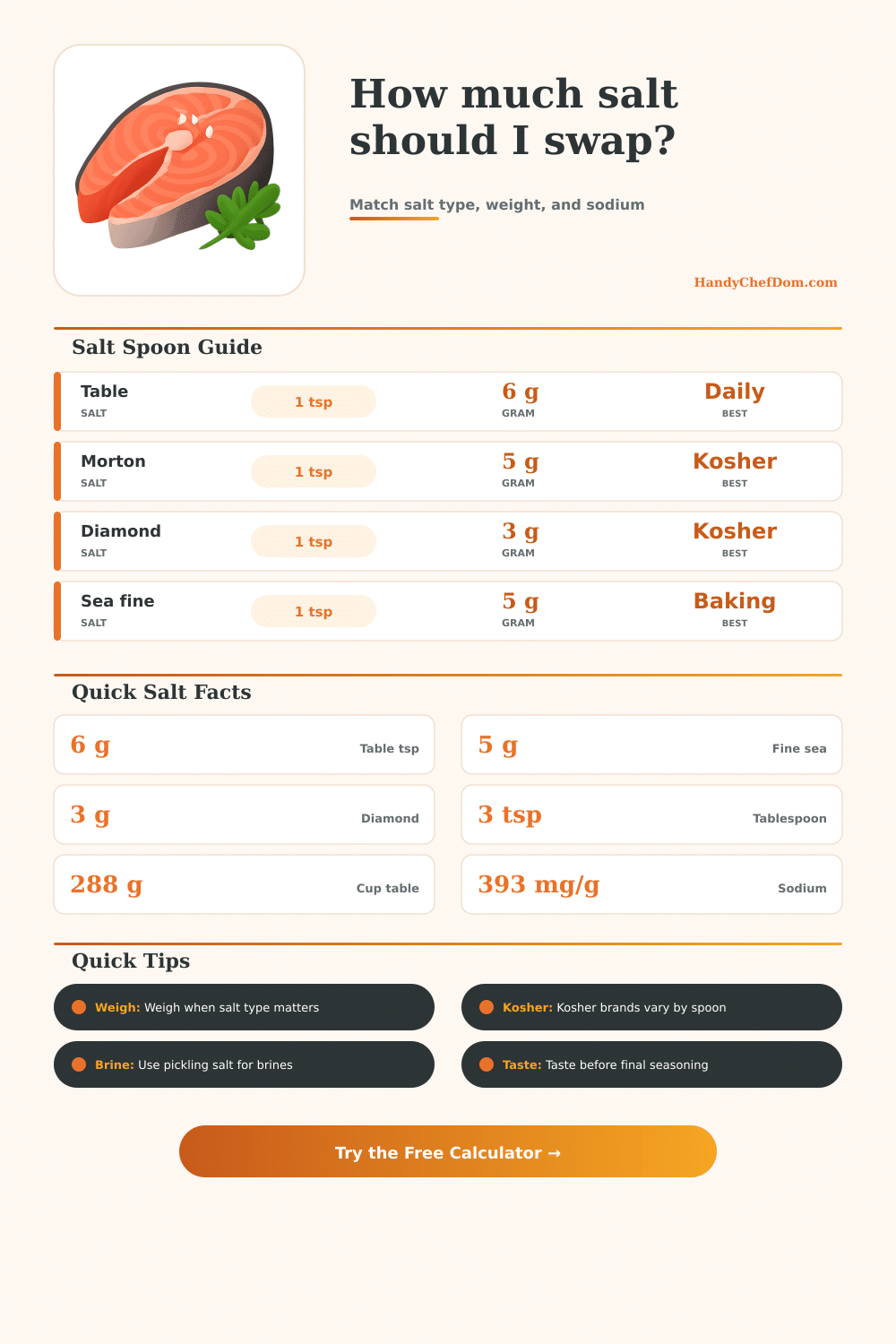
| Salt Type | Grams | Best Use |
|---|---|---|
| Table salt | 6 g | Everyday cooking |
| Pickling salt | 6 g | Clear brines |
| Fine sea salt | 5 g | Baking and seasoning |
| Morton kosher | 5 g | General kosher swaps |
| Coarse sea salt | 4.8 g | Rubs and roasting |
| Diamond Crystal | 3 g | Chef style seasoning |
| Flaky finishing salt | 2 g | Finishing texture |
| Recipe Says | Swap To | Use About |
|---|---|---|
| 1 tsp table | Diamond | 2 tsp |
| 1 tsp table | Morton | 1.2 tsp |
| 1 tsp table | Fine sea | 1.2 tsp |
| 1 tsp Morton | Diamond | 1.7 tsp |
| 1 tsp Diamond | Table | 0.5 tsp |
| 1 tsp flaky | Table | 0.33 tsp |
| Strength | Salt per Liter | Typical Use |
|---|---|---|
| 1 percent | 10 g | Light vegetables |
| 2 percent | 20 g | Ferments |
| 2.5 percent | 25 g | Pickle brine |
| 3 percent | 30 g | Chicken brine |
| 5 percent | 50 g | Short wet brine |
| Salt Weight | Sodium | Serving Note |
|---|---|---|
| 1 g | 393 mg | Small pinch |
| 3 g | 1180 mg | Half tsp table |
| 5 g | 1967 mg | One tsp kosher |
| 6 g | 2360 mg | One tsp table |
| 18 g | 7081 mg | One tbsp table |
How this salt converter works: the calculator first turns your source measurement into grams using the selected salt density. It then applies your recipe scaling, converts the final weight into the target salt style, and estimates sodium from total salt weight.
Why salt type matters: salt is chemically similar by weight, but spoon measures vary because crystal size and shape change how tightly the salt packs. Fine table salt fills a spoon densely, while kosher and flaky salts leave more air space between crystals.
Best kitchen workflow: use the conversion to get close, add most of the salt early when it needs to dissolve, then hold back a small amount for tasting. For baking, curing, pickling, or fermentation, prioritize grams and tested ratios over casual spoonfuls.
The measurements of salt in the kitchen are not always the same for different types of salt. Using a measuring spoon to measure the amount of salt from a container of salt will result in different amounts of salt depending on teh type of salt that is being used in the recipe. Because salts such as table salt, kosher salt, and sea salt has different crystal sizes, the amount that can be measured with a single measuring spoon will be different for each type of salt.
Using a different type of salt than that which is indicated in the recipe could result in either adding too much salt or too little salt to the food that is being prepared according to that recipe. The primary reason for the difference in salt measurements in the kitchen is due to the concept of density. Table salt is a very dense salt, meaning that a level teaspoon will contain a large weight of salt.
Not all salts measure the same
Kosher salt, however, is less dense due to the large and airy crystals of salt, so that a level teaspoon of kosher salt will contain a much smaller weight of salt than a level teaspoon of table salt. Sea salt has a density that is somewhere between table salt and kosher salt, and flaky finishing salt is the least dense of the salts, as the crystals is thin and contain hollow spaces for air to be trapped within each crystal. Because each type of salt can contain a different weight within the same measuring spoon, the cook must account for the density of each salt when replacing one type of salt for another salt in a recipe.
The use of a salt conversion tool will help with the issue of density with different types of salt. The tool will calculate the amount of salt that is required according to the original recipe but in the different type of salt that is to be used instead. To use the tool, you must enter the type of salt that is contained in the original recipe, as well as the type of salt that is to be used instead.
The source of the salt will determine the density of the salt that is to be used, while the target salt will determine the density that is desired. Additionally, a target unit for the amount of salt that is required must be selected. Furthermore, if the recipe that is to be prepared is a brine, the percentage of salt that is to be used in the brine can be entered into the salt conversion tool.
In addition to converting the salt within a recipe from one type of salt for another, the salt conversion tool can also assist in scaling a recipe to prepare more of the same food. In order to make more of a recipe, more salt will be required. For instance, if the recipe is to be made ten times larger, ten times as many salt will be required.
The salt conversion tool will calculate the weight of the salt that is required for the increased batch size of the recipe. Additionally, the tool will estimate the amount of sodium that will be contained within the food according to the amount of salt that will be used in the recipe. This estimate of the sodium content in the food can assist in the understanding of the amount of salt that is contained in the food, but it isnt a replacement for the nutrition label that is included on food products.
One of the most common mistake in the kitchen with salt is thinking that all salt measurements are the same, but instead using a different type of salt than that which is required in the recipe. For example, many recipes may ask for a tablespoon of kosher salt, but the person cooking the recipe may use a tablespoon of table salt. Because table salt is more dense than kosher salt, the amount of table salt will contain more of the ingredient than the amount of kosher salt that is required by the recipe.
A second of the most common mistakes with salt in the kitchen is to use table salt in place of kosher salt with the same volume units. Because kosher salt is less dense than table salt, the volume of kosher salt will contain less of the ingredient than the volume of table salt. Brines are another area of the kitchen in which the correct measurement of salt is important.
A brine is a mixture of salt and liquid. The strength of the brine is often expressed as a percentage of how much salt is contained in the total weight of the liquid. For instance, a two percent brine will require twenty grams of salt to be added to every liter of water.
In order to produce the brine, pickling salt is used. Pickling salt has the ability to dissolve easy in the liquid. Additionally, pickling salt does not contain the ingredients that would make the brine cloudy.
Using a type of salt such as coarse sea salt or kosher salt may lead to the salt not being able to dissolve completely in the liquid. Finishing salts are used differently from cooking salts. Finishing salts are used on the surface of the food after the food is cooked.
Finishing salt can be converted to weight in recipes, but the visual aspect of the salt will dissapears when the salt dissolves into the food. Finishing salt is often added to food by eye rather than being measured. Dry rubs are another ingredient in the kitchen that require some consideration of the type of salt that is used in the recipe.
A dry rub is a mixture of spices and salt that is applied to the surface of the meat. The salt for the dry rub should be coarse enough to be visible on the surface of the raw meat, but fine enough to ensure that the salt releases its flavor into the meat as the meat is cooked. If the recipe for a dry rub is to be increased in strength to accommodate more meat, the weight of the salt should remain the same, even if the volume of the salt changes due to the type of salt that is being measured.
Bread dough is another ingredient that is sensitive to the measurements of salt. If too much salt is added to the dough, the yeast will not be able to perform its actions properly, and the bread will not rise. If too little salt is added, the bread will not contain enough flavor.
Because of the sensitivity of the bread to the amount of salt in the dough, the baker can measure the amount of salt that is required in the recipe in grams so that they can be measured correctly. Although the salt conversion tool can assist in determining the amount of salt that should be added to food, it cannot taste the food. The tool cannot account for the fact that different brands of salt may contain different amounts of density.
Therefore, because salt of each brand has slightly different properties, it is always recommended to taste the food that has been prepared after adding the amount of salt calculated by the salt conversion tool. It is recommended to use the calculated amount of salt, but to hold back a small amount to add more salt to the food if necessary. Thus, while the salt conversion tool can aid in measuring the amount of salt required for a recipe, the taste of the food is the only true way to determine the correct amount of salt to add to the food.