Recipe Nutrition Calculator for Full Batch Macros
Estimate real recipe calories and macros from cooked yield, pan-loss, and finishing add-ons so each serving is tracked with kitchen-level precision.
Pick a cooked recipe profile, then refine weight and macro fields from your label, USDA entry, or app log. Yield and pan-loss adjust the batch to what actually lands in bowls.
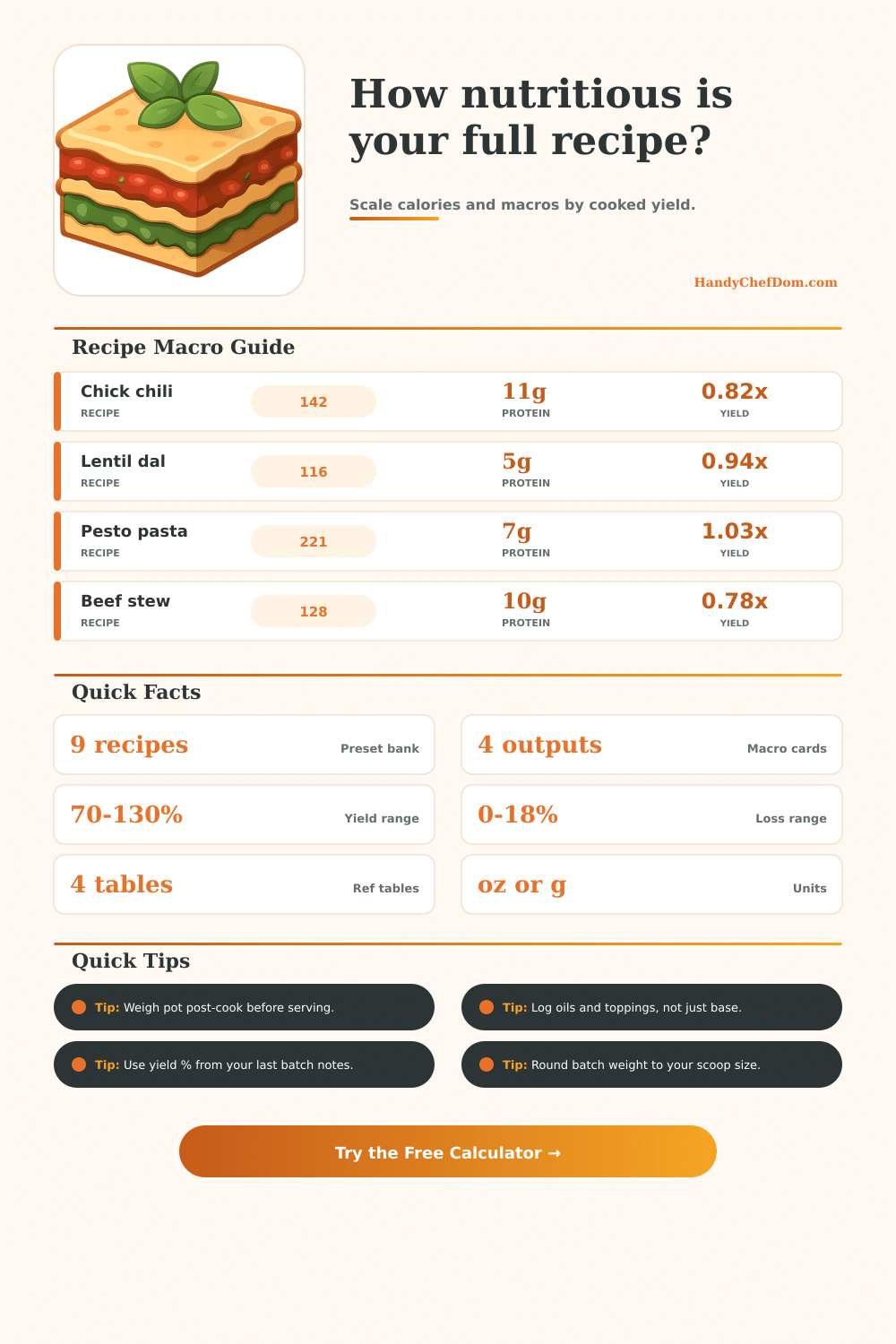
| Recipe | kcal | Protein | Carbs | Fat |
|---|---|---|---|---|
| Turkey chili | 88 | 7.8 g | 7.8 g | 3.1 g |
| Lentil dal | 116 | 6.8 g | 17.4 g | 3.4 g |
| Pesto pasta | 221 | 7.2 g | 24.9 g | 10.4 g |
| Beef root stew | 128 | 10.5 g | 8.2 g | 5.8 g |
| Tofu grain bowl | 145 | 8.9 g | 16.0 g | 5.2 g |
| Salmon veg tray | 173 | 15.6 g | 6.4 g | 9.0 g |
| Ingredient prep | Yield | Use when | Kitchen cue |
|---|---|---|---|
| Chicken breast sear | 0.75x | Meal prep proteins | Moisture loss |
| Ground turkey saute | 0.82x | Chili or taco mix | Fat drains |
| Dry pasta boiled | 2.30x | Pasta salads | Water uptake |
| Dry rice simmered | 2.70x | Bowl bases | Steam absorb |
| Lentils simmered | 2.40x | Dal and soups | Hydration gain |
| Roasted vegetables | 0.78x | Sheet pan sides | Evaporation |
| Tofu pan-seared | 0.92x | Stir-fry boxes | Light water loss |
| Stew reduction | 0.85x | Long braises | Sauce reduces |
| Measure | Approx g | Best for | Practical note |
|---|---|---|---|
| 1 cup cooked rice | 158 g | Grain bowls | Loose packed cup |
| 1 cup thick chili | 245 g | Stews/chili | Levelled cup |
| 1 cup pasta cooked | 140 g | Pasta dishes | Drained well |
| 1 ladle stew | 120 g | Service line | 6 oz ladle |
| 1 tbsp olive oil | 14 g | Finish fats | Count every spoon |
| 1 tbsp chia seed | 12 g | Overnight oats | Dry spoon level |
| 1 cup Greek yogurt | 245 g | Creamy bases | Strained style |
| 1 cup broth | 240 g | Soups and sauces | Near water weight |
| Macronutrient | Per gram | Energy rule | Use in calc |
|---|---|---|---|
| Protein | 4 kcal | g x 4 | Muscle target |
| Carbohydrate | 4 kcal | g x 4 | Fuel target |
| Fat | 9 kcal | g x 9 | Satiety target |
| Fiber | 2 kcal | approx | Optional check |
| Alcohol | 7 kcal | g x 7 | Sauce check |
When you prepare meal in the kitchen, the weight of the food can change from the raw ingredient to the cooked meal. Many individual calculate the calories within a meal by calculating the weight of the raw ingredients and dividing that weight by the number of portions of that meal. Because the weight of the raw ingredients are not the same as the weight of the ingredients after they are cooked (due to the loss of water and fat within the food), the weight of the raw ingredients is not always an accurate measurement of the weight of the cooked meal.
Thus, it is important to account for the difference in weight between raw and cooked ingredient. The weight of ingredients can change in various way when cooked. For instance, food like lentils will absorb water while being cook, and thus will weigh more after cooking than the raw lentils contained within that food.
How Food Weight Changes When You Cook
In contrast, food item like chicken breast will lose some of its moisture when roasted, and will therefore weigh less after cooking than the raw chicken breast before it was roasted. Understanding these difference between the weight of raw food items vs. Cooked food items, which is referred to as the yield factor, is essential to accurately calculate the calorie density of the food after cooking. Failure to account for the yield factor will lead to guesses as to the weight of the food portions after cooking, especially since the weight of the raw food items isnt the same as the cooked food portion.
In addition to the difference in weight between raw and cooked food items, it is also important to account for the loss of food items that can get stuck in the pan after cooking. The loss of sauce and oil from the pan is referred to as pan loss. This loss of food items can contain a significant amount of calories.
Thus, it is important to account for pan loss so that you dont undercount the calories of a meal due to ignored sauce and oil within the pan. It is also important to account for any additional ingredient that are added to a cooked meal after cooking. For instance, many dishes contains Greek yogurt, cheese, or oil after they have been cooked.
The addition of these ingredients can contain a significant amount of calories. Thus, you should account for these additional ingredients in the nutritional value of the meal so that you dont inaccurately measure the measurements of the meal. Finally, it is important to account for how the meal is serve.
For instance, if food is served in a large pot, family style portions may not be the same as each individual serving. Some individual may take more food than others. Thus, the use of a service mode factor is essential to account for the difference in the portions served to each individual.
One way to measure the weight of the food that is cooked is to weigh the empty pot prior to cooking, and then to weigh the same pot after the cooking process is complete. The weight of the food will be calculated as the difference between the weight of the full pot and the empty pot. This method of measuring the weight of the cooked food is a means of removing the guesswork associated with the preparation of meals.
Through regularly using this measuring process, an individual will be able to recognize the amount of weight that specific food item lose when cooked (like beef stew) or gain when cooked (like pasta salad). Once an individual know the weight of the cooked food, he or she should find a way to consistently serve the food. For instance, using a specific ladle or scale will ensure that each portion of food contains the same amount of ingredient.
Thus, if an individual uses the same scoop size for each portion, logging the nutritional value of each serving will be made easier. Reference table can also be used to determine how much certain food will weigh after cooking, which could be especially helpful for individuals that do not weigh the food within the pot. Thus, by accounting for the changes of the weight of the food from raw to cooked, the loss of food to the pan, and the calories from any added finishing ingredient, individuals will be able to account for and track the nutrition of their meal in an accurate manner.