Microwave Defrost Calculator
Estimate thaw time by food type, weight, wattage, thickness, and turn interval.
Use the microwave only as a thawing tool. The calculator adjusts for food type, wattage, package style, and thickness.
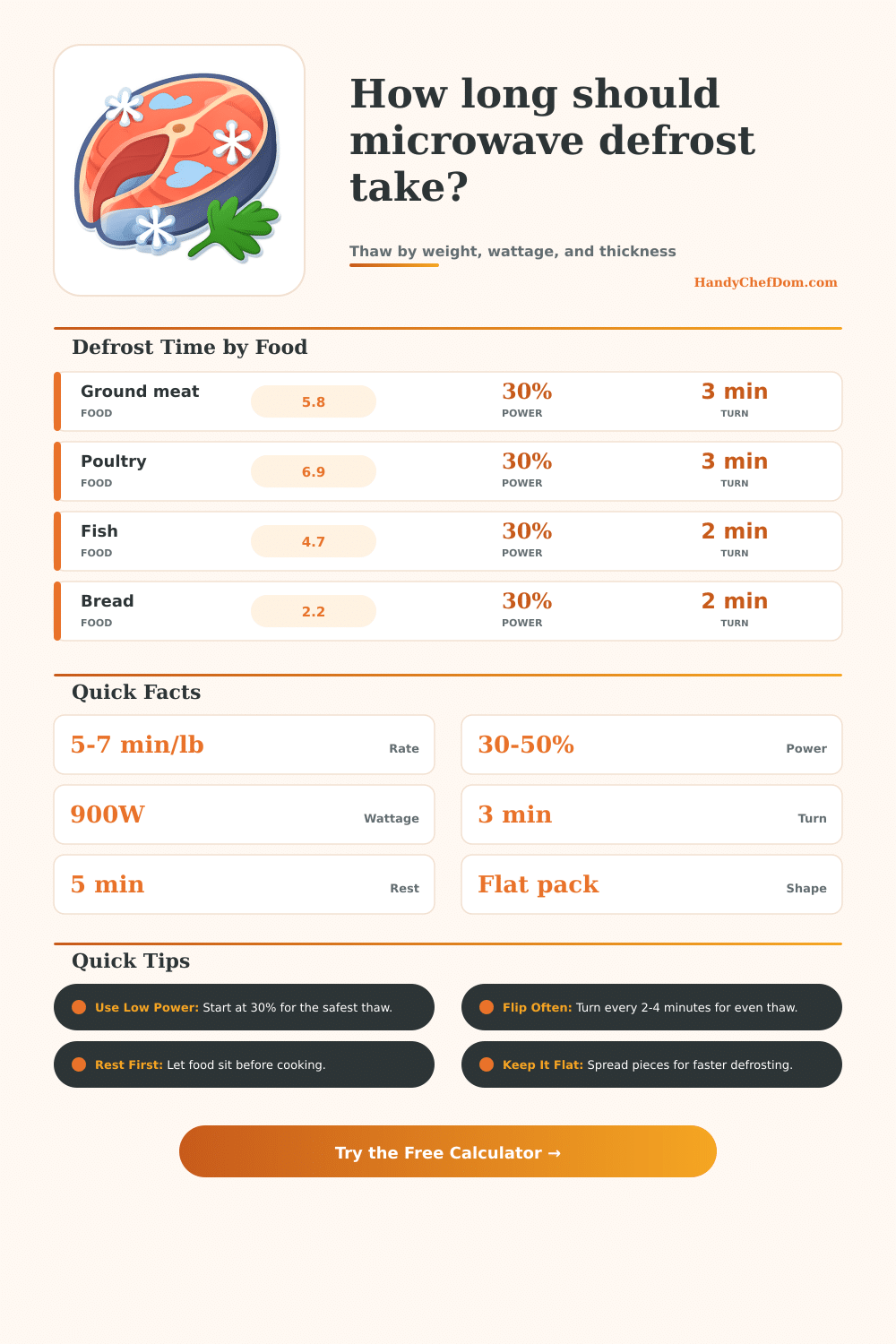
| Food | Base Rate | Best Shape | Best Power |
|---|---|---|---|
| Ground Meat | 5.8 min/lb | Flat pack | 30% |
| Poultry | 6.9 min/lb | Tray | 30% |
| Fish Fillet | 4.7 min/lb | Flat layer | 30% |
| Shrimp | 5.1 min/lb | Loose pieces | 30% |
| Bread Loaf | 2.2 min/lb | Wrapped | 30% |
| Leftovers | 3.6 min/lb | Open bowl | 30% |
| Wattage | Factor | Use | Note |
|---|---|---|---|
| 700W | 1.28x | Older units | Slower thaw |
| 900W | 1.00x | Standard | Baseline |
| 1100W | 0.86x | Fast thaw | Watch edges |
| 1200W | 0.79x | Strong ovens | Short bursts |
| 1500W | 0.68x | Large ovens | Check early |
| Shape | Factor | Best For | Note |
|---|---|---|---|
| Block | 1.25x | Thick packs | Slow center |
| Flat Pack | 0.92x | Meat sheets | Even thaw |
| Loose Pieces | 0.82x | Bulk bags | Fast thaw |
| Single Layer | 0.88x | Fish/bread | Turn often |
| Turn Interval | Risk | Use Case | Rest |
|---|---|---|---|
| 2 min | Low | Small packs | 3-4 min |
| 3 min | Low | Most foods | 5 min |
| 4 min | Med | Thicker blocks | 5-6 min |
| 5 min | High | Large packs | 6-8 min |
| 6 min | High | Dense foods | 8 min |
Defrosting food products that has been frozen requires the consideration of a variety of different variable. If you defrost food incorrectly, the edge of the food can cook while the center of the food is still frozen. These hot spot within the food that the microwave creates can ruin the texture of the food.
In order to defrost food correctly, it is important to consider a variety of factor regarding the food and the microwave itself. One of the first factors to consider is of what type of food you are defrosting. Foods with different density will defrost at different rates.
How to Defrost Food Safely in the Microwave
For instance, ground meat will defrost at a different rate then fish fillets due to the different densities of these food products. Additionally, the thickness of the food will impact the rate at which the food will defrost. Foods that are thin will defrost at a more faster rate than foods that are thick due to the fact that the heat from the microwave does not have to travel as far through thin food to thaw it.
The shape of the food package also has an impact upon the defrosting process; flat packages will defrost at a faster rate than food that is sealed and thick. Another factor to consider is the power levels of the microwave. It is best to avoid using the highest power settings on your microwave for defrosting; at high rates, the exterior of the food will cook prior to the interior of the food being defrozen.
Instead, use a lower power setting, such as thirty percent power. Additionally, the wattage of the microwave will impact the time required to properly defrost the food. Microwaves that are older and of lower wattage will require more time to properly defrost food compared to newer microwaves that have higher wattage setting.
Finally, you should also rotate the food every two or three minutes to ensure that it defrosts evenly. Several scenario may allow you to further define the conditions for defrosting food correctly. For instance, if the food you are defrosting is a two-pound package of chicken breast that is one-point-seven inches in thickness, you should use thirty percent power and turn the chicken breast every three minutes.
If the food to be defrosted is a one-pound bag of shrimp that consists of small pieces of shrimp, defrost the shrimp using thirty percent power but check the shrimp every two minutes. After the food is microwaved, allow the food to rest on a counter top for approximately five minutes. Allowing the food to rest permits the residual heat in the food to continue defrosting the food.
A few common mistake should be avoided during the defrosting process. For example, it is a mistake to place multiple items onto the turntable of the microwave; the edges of the food items will be placed next to each other such that the food that is frozen will remain frozen. Skipping the resting period after the food is defrosted is another mistake to avoid; if the food is skipped over and defrosted for cooking, the center of the food may remain solid.
Finally, ensure that food safety is observed during the defrosting process; food that reaches forty degrees and above can contain bacteria. Thus, it is only necessary to defrost food if you intend to cook it immediately. Another factor that you should remember is that microwaving food is for the purpose of cooking the food.
It is not meant for defrosting food for long periods of time; refreezing food that has been defrosted in a microwave is not recommended. Defrosting food for too long will make the food dry because the juice will exit the food. If the food is defrosted for insufficient amount of time, the center of the food will be raw when it is cooked.
Thus, by considering these factor, you can ensure that the food is defrosted correctly prior to cooking.