Beef Cooking Time Calculator by Cut, Thickness, and Doneness
Estimate realistic beef cook timing with method pace, doneness pull targets, carryover rise, and resting minutes in one pink planning panel.
USDA style baseline: whole beef cuts reach at least 145 F plus a 3 minute rest; ground beef reaches 160 F. Use a thermometer for final pull decisions.
Pan Sear
Best for 1 to 1.5 in steaks needing fast crust and simple pan control.
Grill
Great for high heat char flavor with frequent flip timing by thickness.
Oven Roast
Steady pace for bigger cuts with dependable thermometer checkpoints.
Braise
For chuck or brisket style tenderness where pull-apart texture matters.
| Beef type | Safe minimum | Rest rule | Source style |
|---|---|---|---|
| Steaks and roasts | 145 F | Rest 3 min | USDA FSIS |
| Ground beef | 160 F | No hold rule | USDA FSIS |
| Braise finish | 190-205 F | Texture rest | Culinary ref |
| Reheat leftovers | 165 F | Serve hot | Food safety |
| Doneness | Pull temp | Final after rest | Center look |
|---|---|---|---|
| Rare | 120-125 F | 125-130 F | Cool red |
| Medium rare | 128-132 F | 133-137 F | Warm red |
| Medium | 138-142 F | 143-147 F | Pink core |
| Medium well | 145-150 F | 150-155 F | Faint pink |
| Well done | 155-160 F | 160-165 F | Brown thru |
| Pull-apart | 195-205 F | 195-205 F | Shreds easy |
| Method | Base pace | Main driver | Best cut fit |
|---|---|---|---|
| Pan sear | 8.5 min/in | Thickness | Ribeye |
| Grill | 7.5 min/in | Thickness | Sirloin |
| Oven roast | 22 min/lb | Weight | Tri-tip |
| Reverse sear | 28 min/lb | Weight | Tenderln |
| Braise | 58 min/lb | Weight | Chuck |
| Cut | Calories | Protein | Fat |
|---|---|---|---|
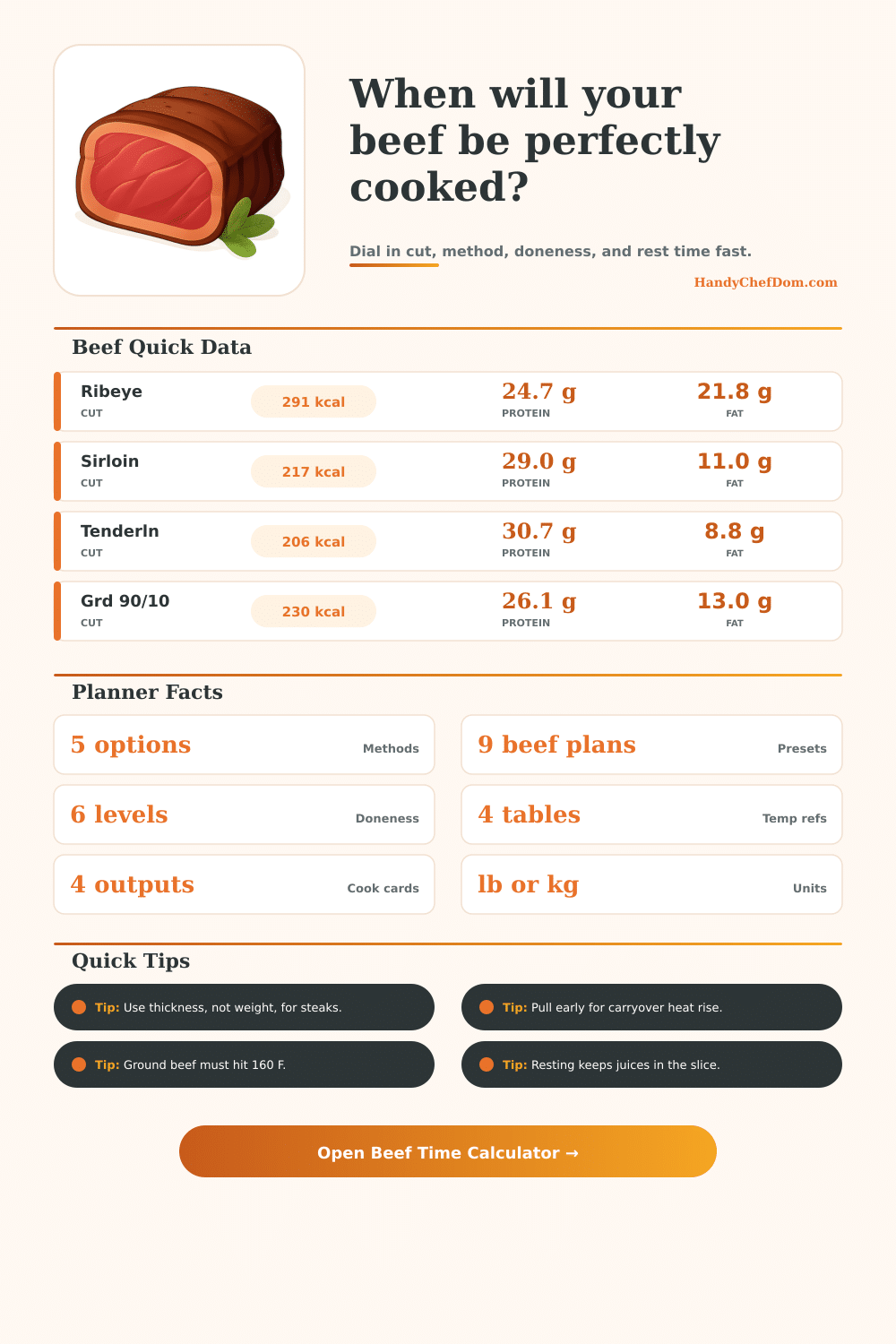
| Ribeye steak | 291 kcal | 24.7 g | 21.8 g |
| Top sirloin | 217 kcal | 29.0 g | 11.0 g |
| Tenderloin | 206 kcal | 30.7 g | 8.8 g |
| Chuck roast | 250 kcal | 27.1 g | 15.1 g |
| Brisket flat | 246 kcal | 30.6 g | 12.0 g |
| Ground beef 90/10 | 230 kcal | 26.1 g | 13.0 g |
Cooking beef correctly require an understanding of several specific variables. These include the cut of the beef, the thickness of the beef, the heat applied to the beef, and the amount of time the beef rest after being cooked. While many people focus on the weight of the beef, the thickness are a more important variable in determining the cook time for the beef.
If you understand these variable, you can prepare the beef in a way that will ensure that it is juicy when you serve it to your guest. The calculator on this page allows for you to input these different variable to the beef cooking process to provide you with an accurate estimate. In order for the calculator to properly calculate the cook time for your beef, you must input the cut profile of the beef.
Cooking Beef: Time, Thickness, Heat, and Rest
Some cut of beef cook at different rate than others. Additionally, you must also input the cooking method that you will use for the beef. Different cooking method allow for the beef to reach the desired internal temperature at a different rate.
Finally, you must also input the target doneness that you would like to cook your beef to. You also need to input the thickness of the cut of beef that you will prepare, as well as the starting temperature of the beef. The thick piece of beef that start at a lower starting temperature will require more cooking time than thin cut of beef that start at a higher starting temperature.
Based on these variable, the calculator will provide you with an active cook time for the beef, the temperature at which you should pull the beef from the heat source, and the amount of time that the beef should rest after being cooked. The beef must rest after it has been cooked. While the beef is resting, the carryover rise will allow the beef to reach its target internal temperature.
Carryover rise is the transfer of heat from the outside of the beef to the center of the beef. The calculator take this into consideration in the preparation of the pull temperature for the beef. Larger cut of beef will experience more carryover rise than thinner cut of beef.
However, since the calculator accounts for carryover rise, you will know when to pull the beef from the heat source. The temperature that you would like your beef to be when you are serving it to your guests will not be the same as the temperature that you would like the beef to be when you pull it from the heat source. The difference between these two temperature is the carryover rise.
As the thickness of the beef increase, the carryover rise will also increase. Thin cut of beef will require less time to allow for carryover rise than whole muscle cut of beef. The calculator has accounted for these time requirement so that you dont have to account for carryover rise in your mental math while you are cooking the beef.
For ground beef, the cooking rule are different than beef that contains whole muscle. Safety reason and the texture of the ground beef require that ground beef be cooked to higher internal temperature. The cook will cook the beef to well-done so that all of the bacteria that were on the exterior of the beef during the grinding process will be eliminated.
While the safety target for beef with whole muscle will be lower, a rest period for the beef must still be accounted for. The rest period will allow the beef to reach the internal temperature required for safety. For example, a rest period of three minute is recommended for beef with whole muscle even if you prepare the beef to medium-rare doneness.
The thickness of the beef will have a primary influence upon the cook time for the beef. Two piece of beef that weigh the same amount may cook at different rate if one cut of beef is thin and the other cut of beef is thick. The calculator account for the thickness of the beef when determining the cook time for pan searing and grilling.
For roast and braise method the weight of the beef is used to calculate the cook time. The starting temperature of the beef will also affect the cook time for the beef. If the beef starts at a lower starting temperature the cook time will be longer to heat the center of the beef to the target internal temperature.
If you allow the beef to sit out for twenty or thirty minute at room temperature the cooking time will be shorter. The calculator will account for whether the internal temperature of the beef started at fridge-cold, room temperature, or tempered condition. Resting the beef after cooking is important.
While the beef rests the internal temperature of the beef will even out. The carryover rise will also be finished. If the beef is sliced while it is still hot the juice will run out of the beef.
The calculator suggests the amount of time that the beef rests after cooking. The rest time will account for the size of the cut of beef and the method that you cook the beef. Thin cut of beef will require a shorter resting period than large roast of beef.
Different cooking method will cook the beef at a different rate. Pan searing and grilling method require that you flip the meat while it is cooking to ensure even cooking. Method like roasting and reverse searing allow for the beef to cook at a more gentle rate.
Braising method involve cooking the beef over a long time period to turn the collagen in the beef into gelatin. Braising is often used for tough cut of beef. Each of these method have a different base rate of cooking in the calculator that accounts for the physics of each method.
In addition to the variable that are accounted for in the calculator the cook can also improve the result of the recipe by using a meat thermometer to check the internal temperature of the beef before it is done cooking. When you are approximately three-quarters of the way through the cooking time you should begin to probe the beef to check the internal temperature. Checking the internal temperature of the beef before it is done cooking will allow you to know if the beef is approaching the target internal temperature.
Checking the internal temperature of the beef also will prevent you from overcooking the beef. If you follow the instruction regarding thickness, starting temperature, and target internal temperature you will be able to successfully cook beef.