🍷 Yeast Nutrient per Gallon Calculator
Estimate yeast nutrient teaspoons, grams, per-gallon rate, and staggered additions for cider, mead, and wine fermentation planning.
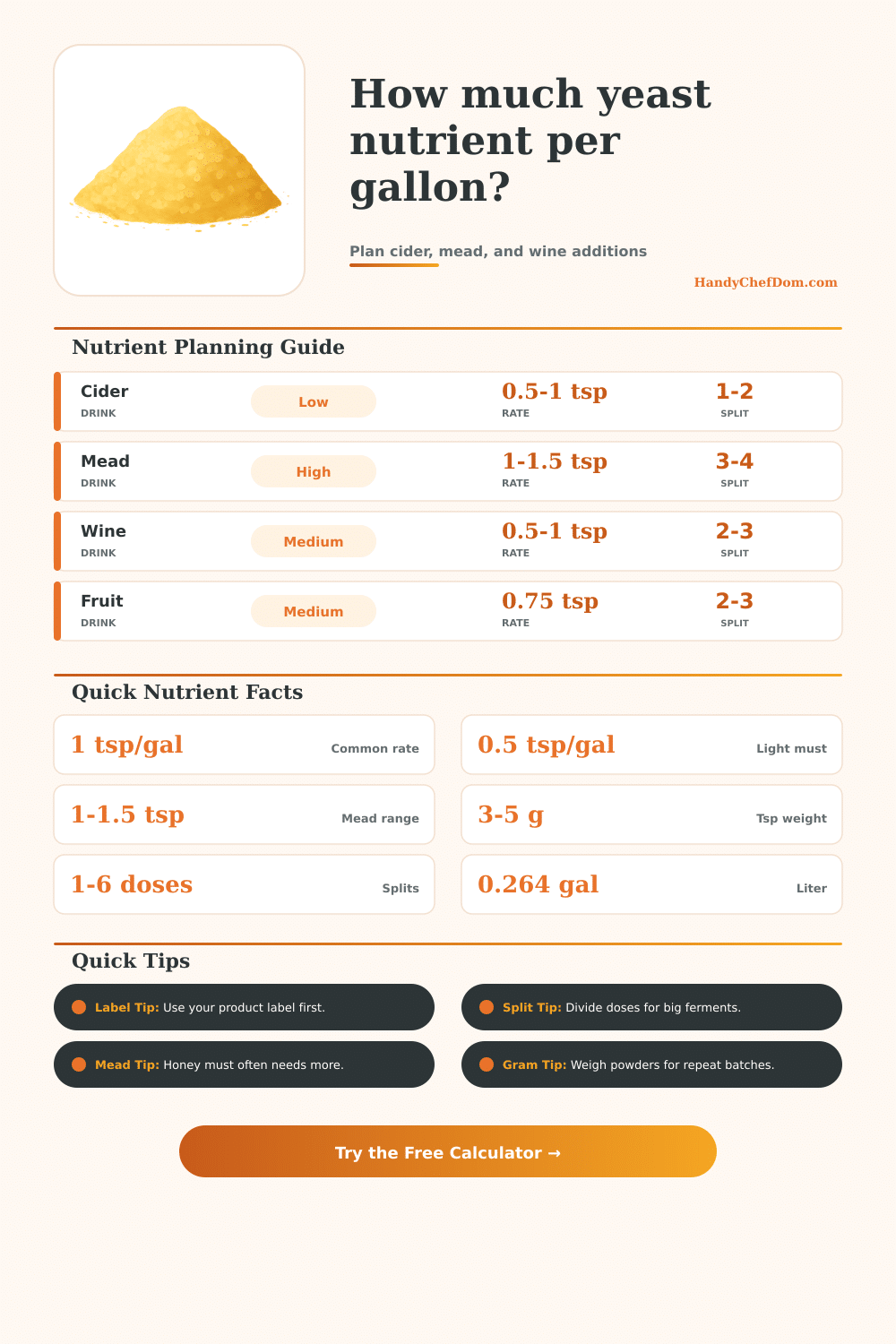
Use the product label as the final guide. This planner starts from common label-style rates, often around 1 teaspoon per gallon for standard nutrient blends, then adjusts for beverage, gravity, yeast demand, and split additions.
| Beverage | Usual nutrient need | Planning factor | Typical split pattern |
|---|---|---|---|
| Fresh apple cider | Low to medium | 0.80x | 1 or 2 additions |
| Cyser | Medium high | 1.15x | 3 additions |
| Traditional mead | High | 1.35x | 3 or 4 additions |
| Fruit mead | Medium high | 1.20x | 3 additions |
| White grape wine | Medium | 0.95x | 2 or 3 additions |
| Red grape wine | Medium | 0.90x | 2 additions |
| Country fruit wine | Medium | 1.05x | 2 or 3 additions |
| Dessert style must | High | 1.30x | 4 additions |
| Measured amount | At 3 g/tsp | At 4 g/tsp | At 5 g/tsp |
|---|---|---|---|
| 1/4 tsp | 0.75 g | 1.0 g | 1.25 g |
| 1/2 tsp | 1.5 g | 2.0 g | 2.5 g |
| 3/4 tsp | 2.25 g | 3.0 g | 3.75 g |
| 1 tsp | 3.0 g | 4.0 g | 5.0 g |
| 2 tsp | 6.0 g | 8.0 g | 10.0 g |
| 1 tbsp | 9.0 g | 12.0 g | 15.0 g |
| Schedule | Best fit | Example split | Planner note |
|---|---|---|---|
| All at pitch | Simple cider | 100% | Fastest measuring plan |
| Pitch and 24 hours | Low gravity wine | 50% / 50% | Easy two-step plan |
| Pitch, 24, 48 hours | Standard wine or cider | 33% each | Balanced stagger |
| Through one-third break | Mead and cyser | 25% each | Common staggered planning style |
| Gentle daily splits | Large batch | Even daily | Smooth measuring routine |
| Light finish adjustment | Label-directed tweak | Small final dose | Use only if planned |
| Nutrient type | Common label style | Calculator role | Best planning use |
|---|---|---|---|
| Standard blend | About 1 tsp/gal | Baseline | General cider, wine, and mead |
| Light blend | About 0.5 tsp/gal | Lower rate | Lower sugar batches |
| DAP blend | Varies by label | Use label rate | Grape wine style planning |
| Complex nutrient | Often gram-led | Density matters | Repeatable staggered additions |
| Energizer | About 0.75 tsp/gal | Mid rate | Recipe-specific use |
| Custom product | Your label | Manual entry | Any brand or lab sheet |
Adding yeast nutrient to a liquid that will be fermented requires a planning to determine the correct amount of nutrient to add to ensure that the yeast remain healthy. Yeast require nitrogen and minerals to complete the fermentation process. If there is not enough yeast nutrient added to the liquid, the yeast will stall and the fermentation process will cease before it has processed all of sugar in the liquid.
If there is too much yeast nutrient added, however, the yeast may produce off flavor that make the mead taste unpleasant. The amount of nutrient that the brewer will require to add to the fermenting liquid depend upon the type of liquid to be fermented, the amount of sugar that will be present in the liquid, and the requirement of the yeast strain that will be used in the fermentation process. The type of liquid that is to be fermented will impact the amount of yeast nutrient that is required.
How Much Yeast Nutrient to Add
For instance, cider and mead are two types of alcoholic beverage that have some similarities in the type of liquid that is to be fermented. Apple cider contains some of the nitrogen and minerals that is required by the yeast to complete the fermentation process. As a result, a relatively low amount of yeast nutrient is required to make apple cider.
By contrast, mead is fermented from a liquid composed of only sugar and no amino acid. Consequently, a much higher amount of yeast nutrient is required to make mead. Other liquids that contain high levels of sugar, such as dessert wines and melomels, require more yeast nutrient to facilitate fermentation.
The higher the level of sugar in the liquid, the more nutrient the yeast require to break it down. Other factor besides the type of liquid that is to be fermented will impact the amount of nutrient that is required. One factor in particular is the gravity level of the liquid and the type of yeast strain that is used.
Lower gravity levels, such as 1.060, require less yeast nutrient than liquids with higher gravity levels. As the gravity of the liquid increase, the amount of work that the yeast is required to perform increases, and more nutrient is required to support the yeast in performing its task. The type of yeast that is to be used can also impact the amount of nutrient that is required.
Different strain of yeast have different requirements for nitrogen. Some strains require very little nitrogen to survive while others require the continuous addition of nitrogen to survive. Both gravity and type of yeast have an impact on the amount of nutrient that should be added to the fermenting liquid.
Another factor that will impact the amount of nutrient that is added to the fermenting liquid is referred to as staggered addition. While it is possible to add all of the yeast nutrient to the liquid at the same time that the yeast is added, it may be better to add the yeast nutrient in smaller dose over time. In particular, if the amount of nutrient is to be added to large batch of fermenting liquid, it may overwhelm the yeast.
For this reason, it is common to split the amount of nutrient into three or four dose that are added over the first few days of fermentation. Using this method, the amount of nitrogen in the liquid remains steady and there is less chance of shocking the yeast with the sudden introduction of nutrient to the liquid. If the nutrient is measured in gram (instead of teaspoons), the number of dose of nutrient can be easily repeated for every batch of mead that is made.
The specific type of yeast nutrient that is to be used can also impact the amount of nutrient that is required to be added to the fermenting liquid. One brand of yeast nutrient may require one teaspoon of nutrient per gallon of fermenting liquid while a different brand may require a different amount of nutrient per gallon of fermenting liquid. Using the incorrect amount of nutrient may lead to underfeeding or overfeeding of the yeast.
To avoid this mistake, calculator are available online that allow an individual to enter the amount of nutrient required by the brand of yeast nutrient that is purchased. By entering the amount of nutrient that is required by the yeast nutrient that is used, the amount of nutrient that is calculated is accurate for that type of product. As with any process, it is possible to make mistake in the planning of the amount of yeast nutrient to be added to fermenting liquid.
Some of the most common mistakes include ignoring the type of liquid that is to be fermented, ignoring the requirements of the yeast strain that is to be used, and forgetting that the gravity level of the fermenting liquid require more nutrient. In each of these case, the fermentation may be sluggish or the finished mead may taste thin and solventy due to the yeast not having recieved the correct amount of nutrient required to complete fermentation. Finally, there are step that can be taken to improve the planning of the amount of yeast nutrient to be added to fermenting liquids.
For instance, records of the amount of nutrient that was added to each batch of fermenting liquid, the time at which the yeast nutrient was added, and the way in which the fermentation process proceed can be written down and maintained in a location where they can be referenced when planning future batches of fermenting liquids. Through maintaining these record it is possible to recognize patterns in the type of fermentation that occurs with different source of honey or with different brand of yeast strains. While the calculator ensure that the amount of nutrient to be added to the fermenting liquid will be correct for the majority of case, maintaining these records will ensure that the result of the fermentation process are the same from batch to batch.