Pork Cooking Time Calculator by Cut and Method
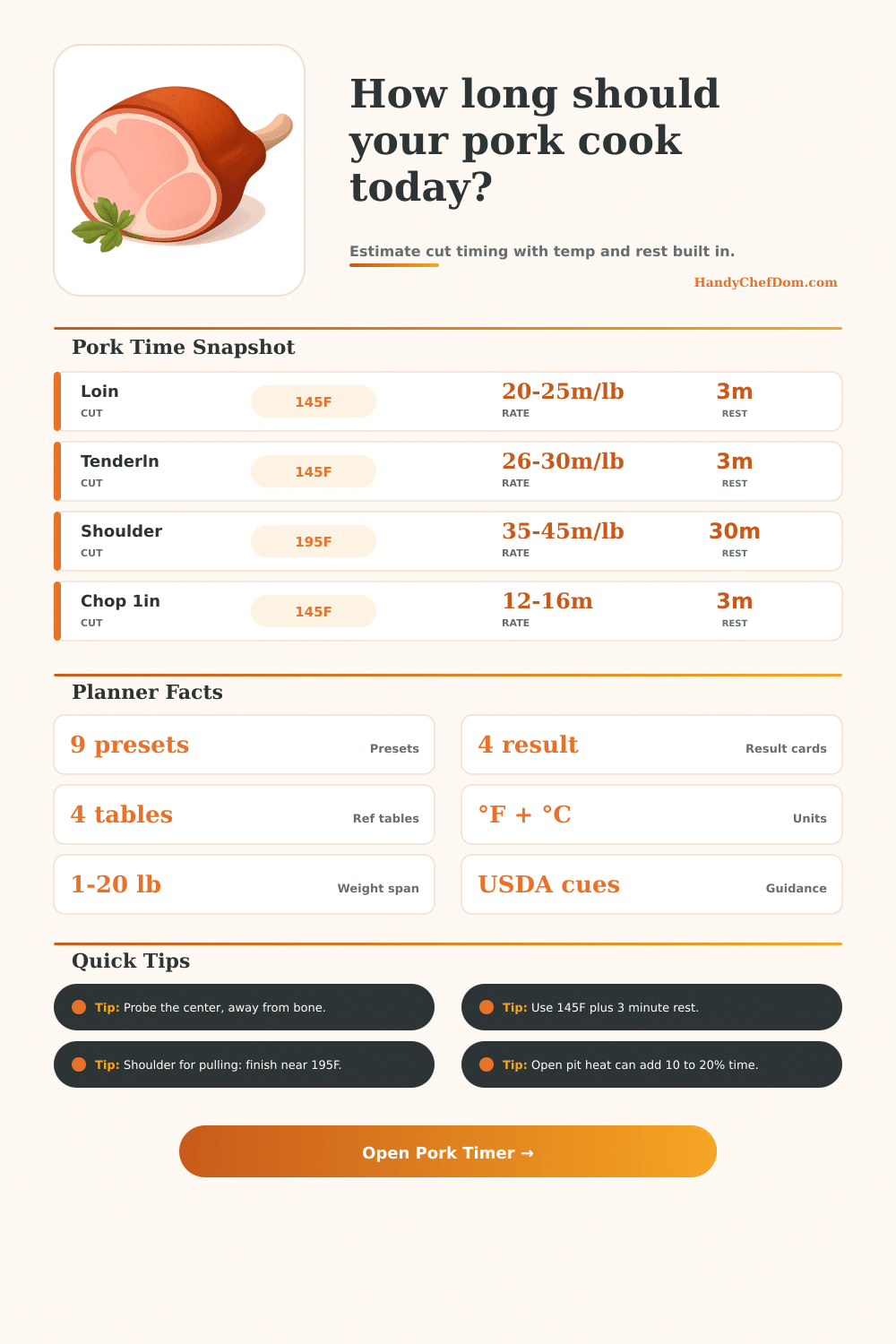
Estimate cook minutes, target pull point, and rest window for chops, roasts, and shoulder with one structured pork timeline.
USDA cue: whole muscle pork is considered safe at 145°F with at least a 3 minute rest. This tool helps you plan time, then confirm safety with a thermometer.
Full Breakdown
| Cut | kcal | Protein (g) | Fat (g) | Profile |
|---|---|---|---|---|
| Tenderloin, roasted | 143 | 26.0 | 3.5 | Very lean |
| Loin roast, cooked | 206 | 27.0 | 10.0 | Lean roast |
| Center loin chop | 231 | 25.7 | 14.0 | Balanced |
| Shoulder roast | 262 | 24.0 | 18.0 | Rich |
| Fresh ham roast | 212 | 27.0 | 11.0 | Firm slice |
| Pork belly, roasted | 518 | 9.3 | 53.0 | High fat |
| Cut | Typical weight | Minutes per lb | Target | Rest |
|---|---|---|---|---|
| Loin roast | 2-5 lb | 20-25 | 145°F | 3-10 min |
| Tenderloin | 0.8-1.5 lb | 26-30 | 145°F | 3-8 min |
| Fresh ham | 5-8 lb | 22-25 | 145°F | 10-20 min |
| Shoulder roast | 3-6 lb | 35-45 | 195°F | 20-30 min |
| Pork belly slab | 2-4 lb | 30-35 | 170°F+ | 10-15 min |
| Cut style | Thickness | Grill total | Pan total | Safe temp |
|---|---|---|---|---|
| Loin chop | 1/4 in | 3-4 min | 3-4 min | 145°F + rest |
| Loin chop | 3/4 in | 8-9 min | 7-8 min | 145°F + rest |
| Loin chop | 1 in | 10-14 min | 9-12 min | 145°F + rest |
| Loin chop | 1 1/2 in | 12-16 min | 12-16 min | 145°F + rest |
| Item | Final temp | Pull point | Rest cue | Texture |
|---|---|---|---|---|
| Whole cuts | 145°F | 140-142°F | 3+ min | Juicy slice |
| Ground pork | 160°F | 157-158°F | 1-3 min | Firm safe |
| Pulled shoulder | 195-203°F | 192-198°F | 20+ min | Shreds |
| Belly for bite | 170-180°F | 167-175°F | 10+ min | Tender fat |
This calculator is designed for planning, not replacing thermometer checks. Use it to build a clear cook schedule by cut, thickness, and method, then confirm final safety at the center of the meat before serving.
Cooking pork require an understanding of the specific needs of the cuts of pork you intend to prepare. Different cuts of pork require different amounts of heat and time to cook. For example, loin roasts and pork shoulders both contains the same type of pork, but each requires a different roast temperature to properly cook the cut of meat.
A calculator can help to determine the cooking time for these types of pork roast by taking into account the weight of the roast, the thickness of the roast, the cooking method that will be used, and the target cooking temperature for the roast. Each of these factors can impact the cooking time of a roast. Using the estimated cooking time for pork based off the weight of the pork roast and the recommendation of minutes per pound is inaccurate.
How to Use a Pork Roast Time Calculator
Pork roasts that are bone-in will require more cooking time than pork roasts that are boneless. Additionally, the internal temperature of pork that is taken from a refrigerator will require more cooking time than pork that is at room temperature. Finally, the temperature of the oven or outdoor grill may not be the same as the setting that is displayed on the appliances.
All of these variables can be accounted for in the calculator to provide an estimate of the cooking time required for the pork roast to reach the target cooking temperature. The target cooking temperature for pork roasts that contain muscles, like loin roasts, tenderloins, and chops is 145 degrees. Cooking these types of roasts to 160 degrees will lead to dry pork roasts.
However, pork roasts like pork shoulders contains a type of protein named collagen. The collagen must break down to 195 degrees for the roast to have the proper texture for pork shoulders. The target temperature of the pork roast must be set to the correct temperature in the calculator to ensure the pork will have the proper texture once cooked.
The thickness of the pork roast can impact the cooking time of pork roasts that are smaller in size. For example, a one-inch thick pork chop will cook differently than a two-inch thick pork chop because the heat must travel a greater distance to the center of the two-inch thick chop. The calculator accounts for the thickness of the chop, so that each type of chop is accounted for in the cooking time.
While the weight is the most important factor in determining cooking time for pork roasts, the thickness of the roast can still be factored into the cooking time estimate for very thick or flat roasts. The cooking method impacts how long it will take to properly cook the pork roast. For example, roasting a loin roast in the oven will take longer than indirect grilling the loin roast.
Smoking the loin roast will take longer than roasting the loin roast in the oven, but smoking will also add flavor to the loin roast. Additionally, searing the loin roast followed by cooking the loin roast in the oven will take longer than roasting the loin roast in the oven. The calculator can help to determine each cooking method’s cooking time, so that the cook does not have to rely upon mental calculations to determine the time required for cooking.
After cooking the pork roast, the roast should be allowed to rest until the pork roast reaches the proper internal temperature. All whole-muscle roasts should rest for three to ten minutes, but pork shoulders requires more time to rest for twenty to thirty minutes. The calculator includes a field for rest time for the roast, so that the total time that the pork roast will be cooked and resting is accounted for.
Outdoor cooking methods introduce additional variables into the cooking time for pork roasts. For example, pork roasts that are taken from the refrigerator will require more time to cook than roasts that have been sitting out at room temperature. Additionally, the wind can impact outdoor grills, which can reduce the temperature around the roast.
Finally, a bone-in roast will require more time to cook than a boneless roast. Each of these variables can be accounted for in the calculator to provide a finish time for the pork roast rather than a time estimate. This value will allow the cook to prepare the roast without panic should the pork roast be cooked early.
Some of the most common mistakes when roasting pork are treating all pork roasts the same, or using the color of the pork roast as an indicator of doneness. The color may change due to searing the roast or smoking the roast. The best method for determining the doneness of the roast is with a thermometer inserted into the thickest part of the roast, away from the bone.
While the pork calculator will help plan the cook, the decision to remove the roast from the heat will require the use of a thermometer. The calculator can account for different units of measurements for cooking time and temperature. For example, pork roasts can be measured in grams and centimeters for those who prefer the metric system, or in pounds and inches for those who are more accustomed to using pounds and ounces for cooking measurements.
The calculator will account for the differences between these units of measurements, making it easier for cooks of all systems of measurements to prepare pork roasts. Pork roast cooking requires some degree of attention to detail because pork can contain a variety of textures. For example, chops can be cooked to 145 degrees and will remain juicy, but pork shoulders will be chewy if cooked to 145 degrees.
Instead, shoulders should be cooked to 195 degrees. In addition to ensuring that the temperature is set appropriately in the meat thermometer, the cook should also use the pork roast calculator to determine the time required for roasting the pork to the proper temperature. The calculator will make it easier to start roasting the pork to the proper temperature, but a thermometer is still required before removing the roast from the heat source.