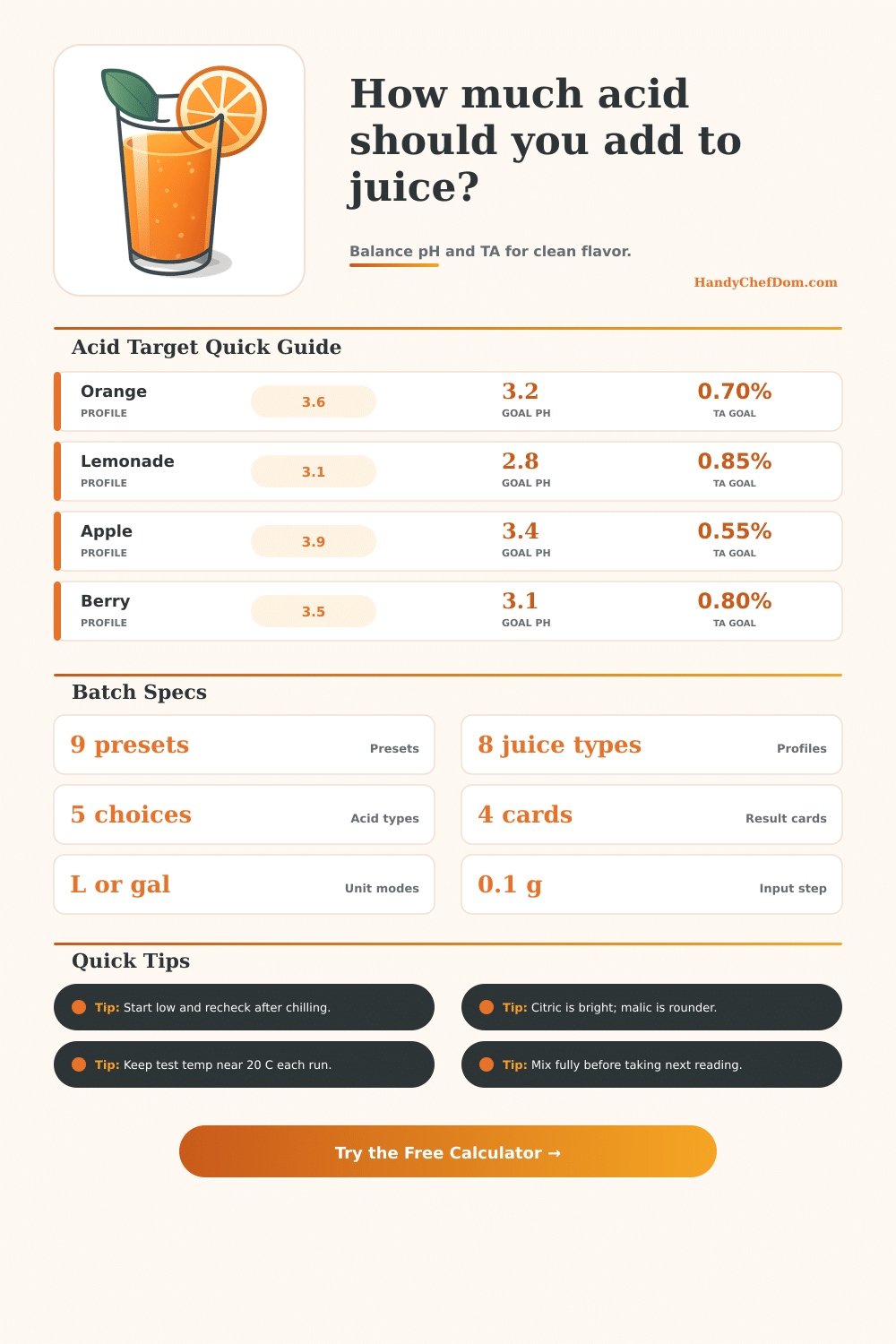
Acid Adjusted Juice Calculator
Estimate acid grams needed to move juice toward a tighter pH and titratable acidity target, with unit switching, blend presets, and planning tables for repeatable batch flavor balance.
Method guide: Adjustment mode computes acid needed from your current test values. Validation mode checks your current dose against profile targets before bottling.
| Profile | Start pH | Target pH | TA target |
|---|---|---|---|
| Orange juice | 3.5-3.8 | 3.1-3.3 | 0.65%-0.75% |
| Lemonade blend | 3.0-3.3 | 2.7-2.9 | 0.80%-0.95% |
| Apple juice | 3.7-4.1 | 3.3-3.5 | 0.50%-0.60% |
| Grapefruit juice | 3.2-3.5 | 3.0-3.2 | 0.65%-0.78% |
| Berry blend | 3.3-3.7 | 3.0-3.2 | 0.70%-0.85% |
| Pineapple juice | 3.4-3.8 | 3.1-3.3 | 0.60%-0.72% |
| Green blend | 3.8-4.2 | 3.4-3.6 | 0.45%-0.55% |
| Tomato mix | 4.1-4.4 | 3.7-3.9 | 0.40%-0.50% |
| Acid type | Relative factor | Sensory note | Typical use |
|---|---|---|---|
| Citric acid | 1.00x | Bright and quick | Citrus style drinks |
| Malic acid | 1.12x | Long tart finish | Apple and berry blends |
| Tartaric acid | 0.92x | Firm structure | Grape and cocktail bases |
| Lactic acid | 1.35x | Soft sourness | Smooth beverage style |
| 50/50 blend | 1.05x | Balanced profile | General batch correction |
| Servings | Pour size | Total juice | Acid add |
|---|---|---|---|
| 4 guests | 240 ml | 0.96 L | 4.8 g |
| 8 guests | 240 ml | 1.92 L | 9.6 g |
| 12 guests | 240 ml | 2.88 L | 14.4 g |
| 25 guests | 240 ml | 6.00 L | 30.0 g |
| Profile | Calories | Carbs | Sugar |
|---|---|---|---|
| Orange juice | 112 kcal | 26 g | 21 g |
| Lemonade blend | 104 kcal | 27 g | 24 g |
| Apple juice | 114 kcal | 28 g | 24 g |
| Grapefruit juice | 96 kcal | 23 g | 19 g |
| Berry blend | 120 kcal | 29 g | 24 g |
| Pineapple juice | 132 kcal | 32 g | 26 g |
| Green blend | 88 kcal | 20 g | 11 g |
| Tomato mix | 44 kcal | 10 g | 7 g |
In order to make juice that taste good, it is necessary to achieve the correct acid balance within the juice. The acid balance in juice will determine the flavors of the juice. If too little acid are added to the juice, the flavor will be flat.
If too much acid is added to the juice, the flavor will be too sharp. The acid balance will affect the flavor of the juice both after it has been chilled, as well as the consistency of the juice flavor when one pours a second glass of juice. In order to determine the correct amount of acid to add to the juice to achieve the necessary acid balance, it is first necessary to understand the difference between pH and titratable acidity (TA).
How to Balance Acid in Juice
PH is a measurement of the strength of the acid in the juice, while TA is a measurement of the total amount of acid that is contained within the juice. Because these two measurements are not always the same, it is important to measure both value of the juice when blending the juice. A calculator can be used to compute the math necessary to determine the amount of acid that should be added to the juice.
To use the calculator, it is necessary to enter the current pH of the juice, the target pH for the juice, the size of the batch of juice that is being blend, and the type of acid that is to be used in the juice. The current pH of the juice is the measurement of the acidity of the juice at the present moment. The target pH is the acidity of the juice that is to be targeted after the juice is blended.
The current pH and target pH will help to provide a general understanding of the acidity of the juice, but the total acidity of the juice (TA) will provide the remainder of the acid measurement for the juice. Juices can have the same pH yet have different TA measurements; the difference in TA measurements will alter the mouthfeel of the juice, as well as the way in which the juice pair with food. The type of acid that is added to the juice will affect the flavor of the juice.
For instance, citric acid will provide a different flavor to the juice then malic acid. Citric acid is best used in juice blends that are to be flavored with citrus fruit, while malic acid is best used in juice blends that are flavored with apples or berries. Tartaric and lactic acid can be used to provide structure or to soften the acid in the juice, respectively.
A 50/50 blend of acids can be utilized in juice blends that are intended to contain brightness from the acid, but not an intense sharpness of the acid taste. Each type of acid has a factor that is applied to the amount of grams of that type of acid that is to be utilized in the juice blend. The volume of juice that is to be blended is another factor that must be considered in the calculation of the amount of acid to be added to the juice.
The amount of acid that is calculated may be appropriate for a small batch of juice, but may not be the proper amount of acid when that juice is multiplied by ten to create a larger batch of juice. The temperature at which the juice is prepared is also important to consider. The chemistry of the juice will change with the change in the temperature in which it is prepared.
Therefore, the juice should of be tested at the same temperature each time it is prepared. Fields for the buffer and loss of juice can be found in the calculator. The buffer accounts for juice blends wherein some of the acid will bind with other ingredients within the juice.
The loss of juice accounts for the amount of juice that remains in the filters of the blend, where it does not get dispensed into the blending tank. These percentages will help to ensure that the calculated amount of acid will not be too low when that acid is actualy added to the blending tank. It is not necessary to add all of the calculated amount of acid to the juice.
The first addition of the acid should be made, but it is necessary to retest the acidity of the juice after it has been mixed. The calculator will provide a projection of the TA and pH levels of the juice if all of the acid is added at once. However, these projections may not accurately reflect the TA and pH levels of the juice if the juice is not mixed even or if the juice is not kept at a stable temperature.
One of the most common mistake in juice blending is adding a large amount of acid to the juice all at once, without tasting the juice prior to the addition of the acid. Another of the most common mistakes is not considering how the sugar content of the juice can change the perception of the acid in the juice. The higher the sugar content of the juice, the soft will be the taste of the same amount of acid.
The reference tables in the acid calculator can provide an idea of the acidity that is required for each type of juice. However, the tables are merely starting points, as juice types require different amounts of acid than other juice types. For instance, orange juice contains a different amount of acid than a green juice blend or a juice blend that includes tomato mix.
Furthermore, the target acidity level for juice blends can also vary depending upon the type of juice blend that is to be made. A brunch time orange juice blend will contain a different amount of acid than a juice blend that is to be used a base for a cocktail. Additionally, a green juice blend that is low in acid will require a different amount of acid than a juice blend that is to be used as a base for a cocktail.
Another reason to use small batches of juice blend is to experiment with the effects of adding acid to a juice blend. For instance, by making small batches of juice and experimenting with the addition of acid, it is possible to learn the amount of acid that each type of juice requires. Therefore, it is necessary to continually measure the juice, add the portion of acid that is calculated for the batch of juice, mix the juice, and measure the juice again.
By creating the batch according to this routine, the difference in the juice after the addition of acid can be tasted. By following this routine, juice that is balanced from the first pour to the last will be created. Furthermore, by using this calculator for juice blends, the guesswork will be eliminated regarding the amount of acid to add to juice blends.