🍫 Chocolate Tempering Calculator
Dial in seed weight, melt phase, cooling endpoint, and working temperature for repeatable gloss and snap across dark, milk, white, ruby, blond, and gianduja batches.
Use this calculator to map a full tempering curve. It estimates seed mass, thermal checkpoints, agitation time, and a practical rewarm ceiling so your batch stays in a stable working window.
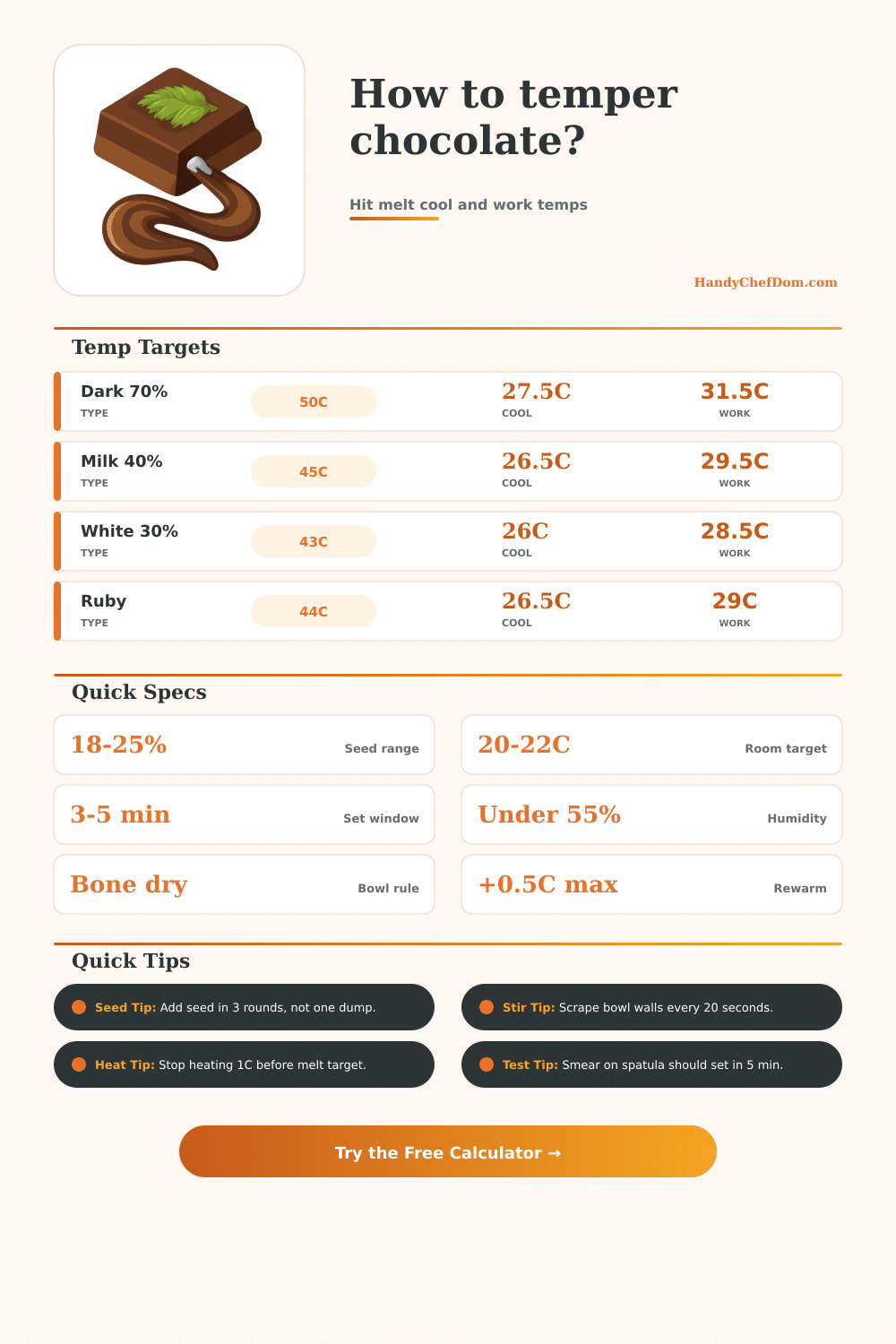
| Chocolate | Melt Full | Cool Phase | Work Range |
|---|---|---|---|
| Dark 70% | 50.0 °C | 27.0–28.0 °C | 31.0–32.0 °C |
| Milk 40% | 45.0 °C | 26.0–27.0 °C | 29.0–30.0 °C |
| White 30% | 43.0 °C | 25.5–26.5 °C | 28.0–29.0 °C |
| Ruby | 44.0 °C | 26.0–27.0 °C | 28.5–29.5 °C |
| Blond | 45.0 °C | 26.0–27.0 °C | 29.0–30.0 °C |
| Gianduja | 44.0 °C | 25.5–26.2 °C | 28.4–29.2 °C |
| Method | Seed Guidance | Best Batch | Control Notes |
|---|---|---|---|
| Seed method | 18–25% | 300 g to 5 kg | Most stable for daily production |
| Tabling + seed | 5–12% | 200 g to 2 kg | Fast cooling, high labor |
| Cocoa silk | 0.8–1.5% | 500 g to 10 kg | Narrowest texture control |
| Sous vide seed | 10–18% | 300 g to 4 kg | Gentle heat, slow response |
| Reseed recovery | 6–10% | Any rescue | Use when shine starts fading |
| Hold and pulse | 2–4% add-back | Service line | Micro rewarm between rounds |
| Condition | Observed Sign | Likely Cause | Quick Correction |
|---|---|---|---|
| Over-temper | Thick flow | Too cool too long | Warm 0.3–0.5 °C and stir |
| Under-temper | Dull finish | Not enough seed | Add 3% seed and mix 2 min |
| Fat bloom risk | Gray haze | High melt overshoot | Remelt fully and restart curve |
| Sugar bloom risk | Rough spots | Humidity spike | Drop RH below 55% quickly |
| Slow set | Soft shell | Warm room | Lower room to 20–21 °C |
| Fast seize | Grainy mass | Water contact | Keep tools fully dry always |
To temper chocolate you must control the temperatures of the chocolate to allow for the development of a stable crystal structures within the chocolate. When you melt chocolate complete, you destroy the crystal structure of the chocolate. Because you have destroyed the crystal structure of the chocolate, you must rebuild that structure.
A stable crystal structure provides chocolate with properties of being glossily and having a clean snap when you break the chocolate. A non-stable structure of the chocolate leads to dull chocolate that is soft to the touch. To rebuild the chocolate crystal structure you can use the seed method.
How to Temper Chocolate and Use a Tempering Calculator
To use this method you must hold back a portion of already-tempered chocolate and stir that portion into the melt chocolate. Using too little already-tempered chocolate will lead to a batch of chocolate that set too slow during the tempering process. Using too much already-tempered chocolate will cause the chocolate to become too thick to use during the tempering process.
You can use a calculator to determine the amount of already-tempered chocolate that should be used based off the size of the batch of chocolate that will be made and the percentage of chocolate that should be seed chocolate. The conditions of the kitchen in which the chocolate is tempered can impact the tempering process. The temperature of the kitchen will impact how quickly the chocolate reaches the target temperature.
If the kitchen is too warm or the temperature is too high, the chocolate will be under-tempered. The humidity level of the kitchen can also impact the chocolate. High humidity levels will slow the setting of the chocolate.
High humidity levels can also cause blooming to occur within the chocolate. You can enter these variables into a calculator to determine what adjustments you must make to the chocolate to account for these variables of the kitchen. The type of chocolate that is to be tempered can also have an impact upon the tempering process.
Each type of chocolate contains different ingredients. For instance, dark couverture chocolate contains more cocoa solids than other types of chocolate and, therefore, require a higher temperature to melt and work. Milk chocolate and white chocolate contain more milk solids and more sugar than dark chocolate and, therefore, have a lower melt point.
Additionally, ruby chocolate and blond chocolate contain different types of crystal than other chocolate, as well. You must select the type of chocolate that is to be used in the calculator to determine the correct working temperature for that type of chocolate. The method in which the chocolate is to be tempered will impact the calculations for that process.
For instance, the seeding method will have different mathematical requirements then the tabling or cocoa butter silk methods. The tabling method will require more effort to temper the chocolate but will allow for the chocolate to reach its target temperature more quickly. Each of these methods will have a certain range for the amount of seed chocolate that must be used.
A good tempering calculator will respect these difference in method so that it does not suggest an amount of seed chocolate that is too much or too little. A good tempering calculator will provide several type of information about the tempering process. For instance, the calculator will provide information about the weight of the seed chocolate that should be used.
The melt base will inform the chocolate temperer of the melting temperature of the chocolate. The work target will show the target temperature of the chocolate once it is tempered. Finally, the stable window will provide information to the chocolate temperer of the length of time that the chocolate will remain in an appropriate range of temperatures.
Each of these variables will change according to each of the other variables that you enter into the calculator. Thus, you can use the calculator to find the appropriate numbers for the specific situation of the chocolate temperer. Errors in the tempering process often results from small deviations from the desired temperatures.
When chocolate is over-tempered it set too quickly and can leave ridges on the chocolate pieces. Under-tempering will result in chocolate that is soft to the touch and does not snap when broken. Often, you can correct these types of errors by making small changes in the temperatures of the chocolate.
A risk indicator in the calculator will warn the chocolate temperer if the amount of seed chocolate, the room temperature, or the humidity level can lead to over-tempering or under-tempering. Other variables in the kitchen should also be considered. For instance, you should consider the dryness of the tools that will temper the chocolate.
Using wet tools can introduce moisture into the chocolate. Additionally, you should consider the temperature of the molds in which you will pour the chocolate. Chocolate that is too hot or too cold in the molds will alter the tempering process.
To test the temper of the chocolate simply spread a thin smear of chocolate on a spatula. If it firm up to the touch and develops a glossy appearance it is in temper. If it is still soft or exhibits streaks it isnt in temper.
By planning the chocolate tempering process you can achieve the same results each time you attempt to temper chocolate.