🍞 Sourdough Starter Ratio Calculator
Plan a 1:1:1, 1:2:2, stiff, or liquid starter feed by target amount, discard, hydration, flour and water additions, and likely peak timing.
Enter the starter in your jar, choose a feeding ratio, then decide whether to feed the retained starter or scale the feed to a target final starter amount.
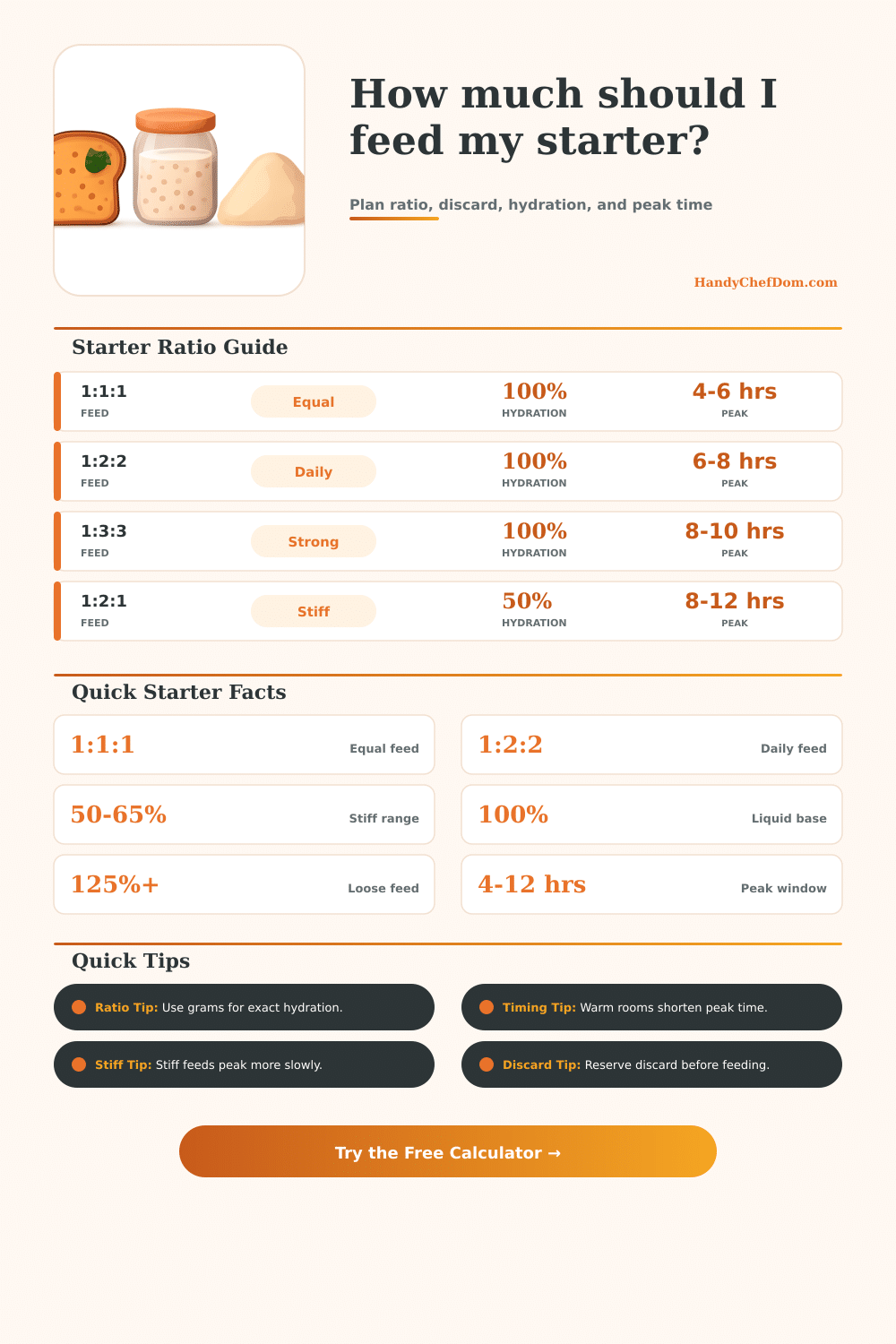
| Ratio | Formula Example | Best For | Typical Peak |
|---|---|---|---|
| 1:1:1 | 25 g starter, 25 g flour, 25 g water | Quick daily refresh | 4-6 hours |
| 1:2:2 | 20 g starter, 40 g flour, 40 g water | Daily counter starter | 6-8 hours |
| 1:3:3 | 15 g starter, 45 g flour, 45 g water | More food, cleaner aroma | 8-10 hours |
| 1:4:4 | 20 g starter, 80 g flour, 80 g water | Levain for dough day | 9-12 hours |
| 1:5:5 | 10 g starter, 50 g flour, 50 g water | Long warm-room hold | 10-14 hours |
| Hydration Style | Water to Flour | Texture | Timing Effect |
|---|---|---|---|
| Stiff starter | 50-65% | Dough-like ball | Slower peak, milder acid |
| Firm starter | 65-80% | Soft paste | Steady rise, easy shaping |
| Liquid starter | 100% | Thick batter | Balanced daily baseline |
| Loose starter | 125% | Pourable batter | Faster spread, softer peak |
| Very liquid starter | 150%+ | Thin batter | Fast activity, short hold |
| Room Temp | Activity Pace | Ratio Choice | Practical Use |
|---|---|---|---|
| 65 F / 18 C | Slow | 1:1:1 or 1:2:2 | Expect a longer rise window |
| 70 F / 21 C | Moderate | 1:2:2 | Good daily maintenance pace |
| 75 F / 24 C | Active | 1:2:2 or 1:3:3 | Reliable dough-day timing |
| 80 F / 27 C | Fast | 1:3:3 or 1:4:4 | Use more food for longer hold |
| 85 F / 29 C | Very fast | 1:4:4 or 1:5:5 | Watch for early collapse |
| Target Starter | 1:1:1 Build | 1:2:2 Build | 1:4:4 Build |
|---|---|---|---|
| 60 g | 20 g + 20 g + 20 g | 12 g + 24 g + 24 g | 7 g + 27 g + 27 g |
| 120 g | 40 g + 40 g + 40 g | 24 g + 48 g + 48 g | 13 g + 53 g + 53 g |
| 180 g | 60 g + 60 g + 60 g | 36 g + 72 g + 72 g | 20 g + 80 g + 80 g |
| 240 g | 80 g + 80 g + 80 g | 48 g + 96 g + 96 g | 27 g + 107 g + 107 g |
| 300 g | 100 g + 100 g + 100 g | 60 g + 120 g + 120 g | 33 g + 133 g + 133 g |
To maintain a sourdough starter, it is important to understand the relationship between your existing sourdough starter and the food that you add to it. The amount of sourdough starter that you will keep, the ratio of the flour and water that you add, and the temperature of the room will impact the rate at which your sourdough starter become active. If you can maintain each of these variable properly, you can create a schedule for your baking activities in accordance with your active sourdough starter.
The calculator will ask for several input from the individual desiring to calculate the amount of food that should be added to the sourdough starter in order to reach a desired outcome. The amount of sourdough starter that is currently in the jar need to be entered into the calculator, as does the hydration percentage of that sourdough starter. Additionally, the user can enter the amount of sourdough starter that is desired at the end of the process, or it is also possible to indicate that the amount of sourdough starter to be feed is the amount that will remain after discarding some of the sourdough starter.
How to Feed and Care for Your Sourdough Starter
Based on these parameters, the calculator can determine the amount of food that will need to be fed to the sourdough starter, the hydration percentage that will result from feeding the sourdough starter with that amount of food, and when the sourdough starter will reach its peak. These outputs are helpful in relation to scheduling the feeding of the sourdough starter. The temperature of the kitchen in which the sourdough starter will be maintained is another variable that will impact the speed with which the sourdough starter becomes active.
In warmer kitchens, the sourdough starter will become active at a faster rate then it would in a cool kitchen. Therefore, an active sourdough starter may reach its peak in five hours in a warm kitchen, but may take eight hours to reach its peak in a cool kitchen. The calculator considers the room temperature in the estimation of the time that it will take for the sourdough starter to peak.
In cool kitchens, lower ratios of sourdough starter to food will be required than in warm kitchens. In warm kitchens, higher ratios will be required. An additional factor that impacts the sourdough starter is the hydration percentage of the sourdough starter.
Sourdoough starters with higher hydration percentages (stiffer sourdough starters) will take longer to become active than liquid sourdough starters with higher hydration percentage of 100%. Therefore, the user can enter the amount of time in which the sourdough starter will peak in the calculator in the desired percentage of hydration for the sourdough starter. The hydration percentage will affect the sourdough starter that is mixed with the other ingredients of the bread.
Discarding a portion of the sourdough starter is another factor in the maintenance of the sourdough starter. The percentage of the sourdough starter that will be discarded can be entered into the calculator, and the amount of sourdough starter that remain in the jar can be calculated. Although there are no strict parameter regarding the percentage of sourdough starter that should be discarded, individuals can either discard a majority of the sourdough starter, or they can choose to keep the sourdough starter.
The amount of sourdough starter that is discarded will impact the amount of sourdough starter that is produced, so calculating this portion of the process ensures that the amount of sourdough starter that is produced will be manageable. The type of flour that is used in feeding the sourdough starter and the strength of the sourdough starter will impact the rate at which it become active. Flours that contain more nutrients for the yeast and bacteria include whole grain flours and rye flour, and will increase the rate of activity of the sourdough starter in comparison to using only white flour.
A sourdough starter that has been refrigerated will become active at a slower rate than a sourdough starter that remains at room temperature, and the amount of time that it will take for the sourdough starter to peak will be reflected in the calculations of the calculator. Many individuals feed their sourdough starter in the same manner each time that they perform the activity. However, depending upon the individual’s need with their sourdough starter, the ratio of sourdough starter to food can be altered.
For example, if the individual wishes to bake bread the following day, a ratio of 1 to 2 to 2 can be used at a moderate temperature. However, if the sourdough starter is to be used in the baking process for a period that is longer than a few days, a higher ratio can be introduced into the calculations of the sourdough starter. A small amount of sourdough starter is typically lost during the feeding of the sourdough starter.
For instance, a portion of the sourdough starter will remain clinging to the sides of the jar in which it is contained, and some of the sourdough starter can be lost while transferring the sourdough starter to the bowl in which the sourdough bread will be mixed. Therefore, a small percentage of sourdough starter can be fed into the calculator in addition to the percentage of sourdough starter that will remain in the jar to ensure that the amount of sourdough starter that is obtained will be the amount that is calculated. The reference tables that are provided on the calculator indicate common ratio for sourdough starter.
For example, a ratio of 1 to 1 to 1 will cause the sourdough starter to become active at a faster rate than a ratio of 1 to 3 to 3, or a ratio of 1 to 4 to 4. Additionally, feeds that contain more liquid will make the sourdough starter active at a faster rate than feeds that contain more stiffly flour. The tables also indicate the impact of the temperature of the kitchen on sourdough starter activity.
For example, ratios of sourdough starter that are used in cool kitchens will require lower ratios than those that are used in warm kitchens. Additionally, the activity of the sourdough starter will be reflected in the estimated time that it will take for the sourdough starter to peak. Therefore, by using the calculator at the beginning of each baking process, the individual can ensure that the sourdough starter is managed in an active manner that is in accordance with the individual’s needs.