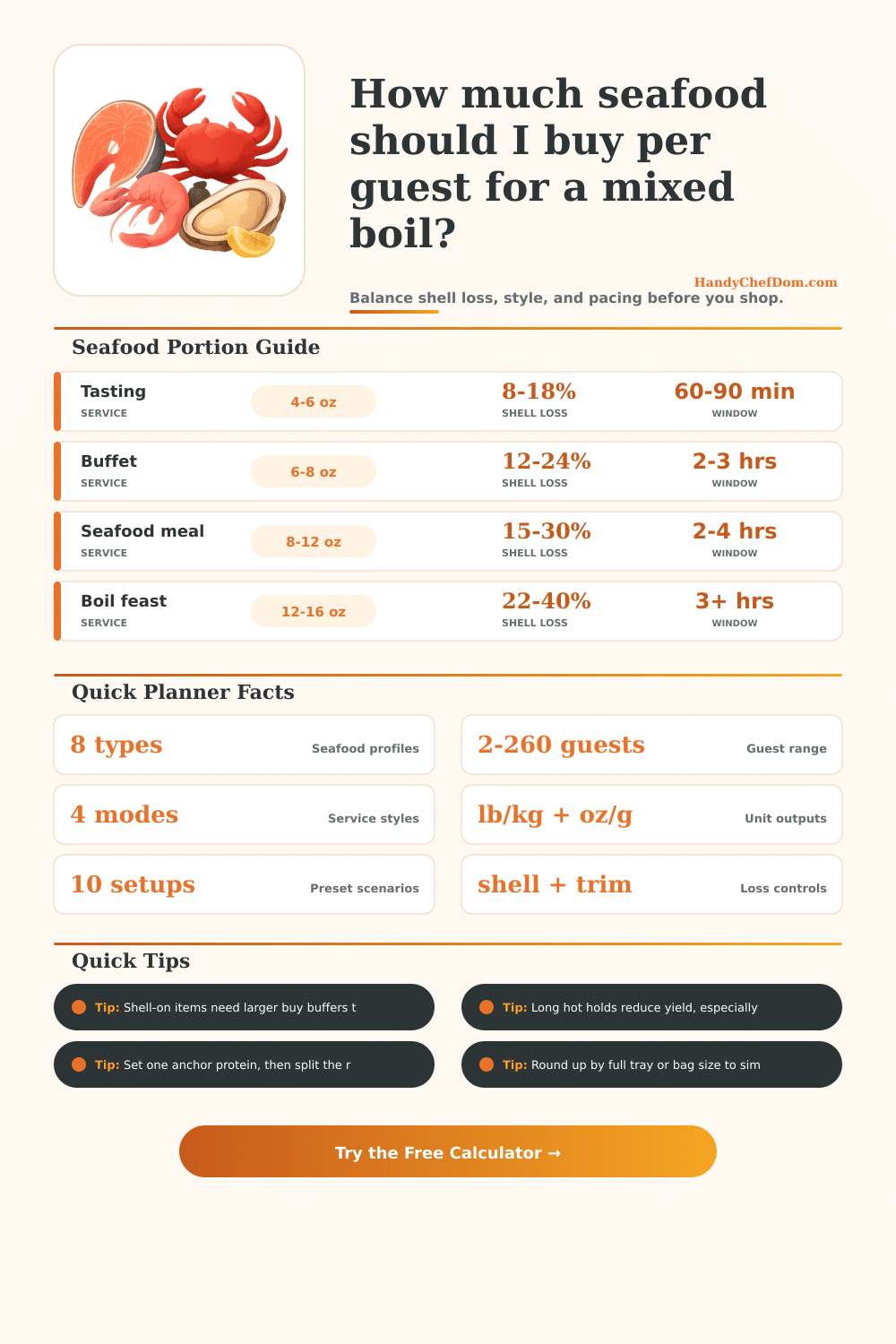
Seafood Per Person Calculator
Project how much fish and shellfish to buy by guest count, menu style, appetite, seafood mix, and prep loss. Get buy weight, edible target, and tray-rounded counts for practical seafood service.
📌Preset Scenarios
⚙Calculator Inputs
Choose your lead seafood item and service style first. Then tune protein share, appetite, hold time, and loss assumptions to match your real line setup.
📐Serving Benchmarks
📑Reference Tables
| Seafood type | Yield | Base oz ea | Best fit |
|---|---|---|---|
| Shrimp (shell-on) | 66% | 8.0 | Boils, platters |
| Salmon fillet | 90% | 7.5 | Plated dinners |
| Cod fillet | 88% | 7.0 | Buffets |
| Snow crab legs | 52% | 12.0 | Feasts |
| Mussels | 44% | 10.5 | Boils, steam pots |
| Calamari rings | 82% | 6.5 | Tasting, buffet |
| Sea scallops | 85% | 6.8 | Plated, tasting |
| Lobster tail | 58% | 9.0 | Premium service |
| Guests | 6 oz ea | 10 oz ea | 14 oz ea |
|---|---|---|---|
| 10 guests | 3.8 lb | 6.3 lb | 8.8 lb |
| 20 guests | 7.5 lb | 12.5 lb | 17.5 lb |
| 35 guests | 13.1 lb | 21.9 lb | 30.6 lb |
| 50 guests | 18.8 lb | 31.3 lb | 43.8 lb |
| 75 guests | 28.1 lb | 46.9 lb | 65.6 lb |
| 100 guests | 37.5 lb | 62.5 lb | 87.5 lb |
| 150 guests | 56.3 lb | 93.8 lb | 131.3 lb |
| 220 guests | 82.5 lb | 137.5 lb | 192.5 lb |
💡Planning Tips
Planning a seafood spread involve some mathematics to figure out the seafood weight that is going to be edible. Many seafood products contains shells and bones that are not edible. If you dont account for this, you could potentially order too little or too much seafood for you spread.
Your goal is to determine how much raw seafood you need to purchase in order to ensure that each guest receive there correct portion of seafood. The calculator included in this article will help you determine how much seafood you should purchase for your spread. In order to use the calculator, you will need to input a few different value.
How Much Seafood to Buy for Your Guests
The first is the number of guest who will attend your spread. The second is the appetite profile of your guests. Appetite profile describe how much food each person will eat.
The third is the menu share, which determine how much of the menu features seafood. The fourth is the duration of the spread. The longer the spread, the more seafood will be required because guests may eat more than once during the spread.
Shell and trim loss are important to consider when planning a seafood spread. For example, if you use salmon for your spread, there is very little trim loss with salmon fillet. In contrast, snow crab legs contains a high amount of shell loss.
When you remove the shells from the crab legs, there is less edible seafood. You must enter the percentage of shell loss into the calculator. Additionally, using a buffer percentage will ensure that there is enough seafood for all guest.
This is especially important in the case that there are more guests than estimated, or if the seafood spread faster than estimated. The calculator will provide three specific output after you have entered your inputs. The first output is the weight of the seafood that you should purchase, also known as the buy weight.
The edible served weight is the total weight of the seafood that will be edible and consume by your guests. The third output is the weight of the seafood that each guest will receive, also known as the per guest amount. This can be used to determine how much seafood to serve each guest.
Another factor that can influence how much seafood you will need to purchase is the style in which you will serve the seafood. For example, if you are having a tasting service, each person will receive small portion of seafood. In contrast, if you are having a plated meal, each person will receive larger portions of seafood.
A buffet also has different requirements than other service style. For example, the seafood buffet will last for a specific amount of time. If the seafood buffet will last for a longer period of time, then more seafood will be required to supply each guest with their portion.
Finally, the variety of seafood you will serve will also have an impact on how much of each seafood you need to purchase. If you serve many different types of seafood, each guest will take a smaller portion of each type of seafood. Thus, if there is more variety in the spread, less of each type of seafood will be required to serve each guest.
The reference tables included in this article can be used to verify the math used to calculate how much seafood you need to purchase. These tables describe the behavior of the different type of seafood that can be used in a spread. Additionally, the tables indicate the yield of each type of seafood.
High yields indicate that most of the seafood is edible, while low yields indicate that a portion of the seafood will be made of shell or bone. These tables can help you understand why certain seafood, like crab legs, require a higher buy weight than seafood like salmon fillet. These tables and the calculator can assist you in purchasing the proper amount of seafood for your spread.
Thus, by using both the calculator and the reference tables for seafood, you can ensure that you purchase the correct amount of seafood, and provide each guest with the correct amount of edible seafood.