🍖 Ham Thawing Time Calculator
Estimate safe refrigerator or cold water thawing time by ham type, bone profile, weight, start state, fridge temperature, deadline, and planning buffer.
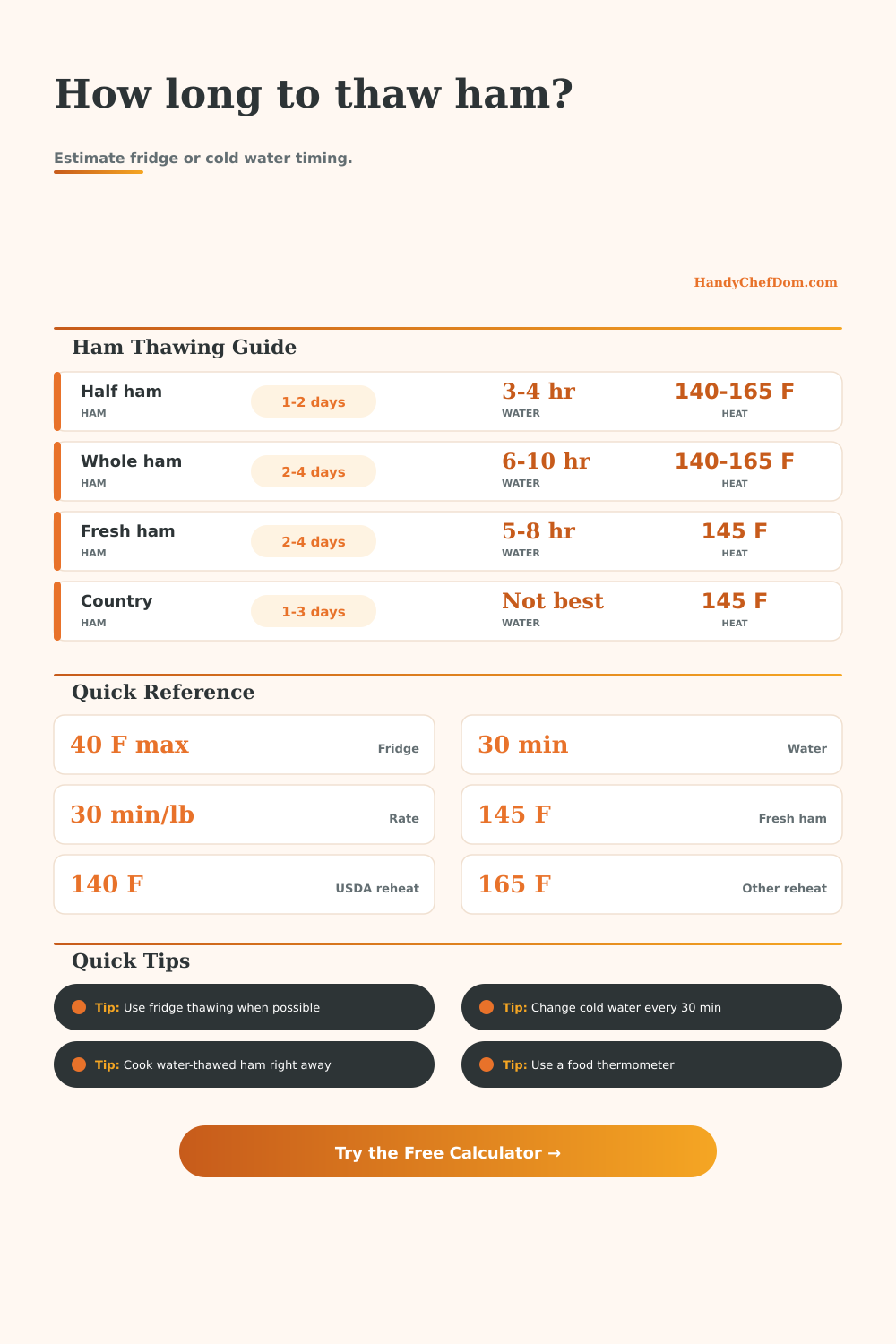
USDA and FoodSafety guidance lists refrigerator, cold water, and microwave thawing as safe methods. This calculator estimates refrigerator and cold water timing from a fully frozen ham and compares the result with your cooking deadline.
| Method | Official Guidance | Calculator Use | After Thawing |
|---|---|---|---|
| Refrigerator | Slow thawing at 40°F or below | Best for whole, half, and country hams | Keep refrigerated until cooking |
| Cold water | Leak-proof wrap, change water every 30 minutes | Fast estimate at 30 minutes per lb | Cook or reheat immediately |
| Microwave | Use appliance instructions | Not timed because ham size varies | Cook immediately |
| Counter or hot water | Not a safe thawing method | Excluded from calculator | Do not use |
| Ham Type | Safe Heat Target | Rest Or Reheat Rule | Calculator Note |
|---|---|---|---|
| Fresh ham, uncooked | 145°F | Rest at least 3 minutes | Must be cooked after thawing |
| Smoked ham, uncooked | 145°F | Rest at least 3 minutes | Treat as uncooked pork |
| Fully cooked, USDA-inspected | 140°F | Reheat if serving hot | Can be eaten cold if labeled ready to eat |
| Fully cooked, other source | 165°F | Reheat to safe serving temp | Includes repacked or uncertain source |
| Leftover cooked ham | 165°F | Reheat leftovers thoroughly | Use food thermometer |
| Frozen Ham Size | Refrigerator Estimate | Cold Water Estimate | Water Changes |
|---|---|---|---|
| 3 to 5 lb boneless | About 1 day | 1.5 to 2.5 hours | 3 to 5 changes |
| 5 to 8 lb half ham | 1 to 2 days | 2.5 to 4 hours | 5 to 8 changes |
| 8 to 12 lb whole ham | 2 to 3 days | 4 to 6 hours | 8 to 12 changes |
| 12 to 16 lb fresh ham | 3 to 4 days | 6 to 8 hours | 12 to 16 changes |
| 16 to 20 lb large ham | 4 to 5 days | 8 to 10 hours | 16 to 20 changes |
| Fridge Reading | Calculator Treatment | Timing Impact | Food Safety Signal |
|---|---|---|---|
| 32 to 36°F | Very cold refrigerator | Adds a small cushion | Safe cold range |
| 37 to 40°F | Standard refrigerator thaw | Uses normal timing | USDA target zone |
| Above 40°F | Temperature warning | Timing is not treated as safe | Correct appliance |
| Unknown | Use appliance thermometer | Calculator uses entered value | Verify before thawing |
| Scenario | Best Method | Typical Timing | Water Changes | Heat Target | Deadline Fit |
|---|---|---|---|---|---|
| 3 lb boneless cooked ham | Refrigerator or cold water | 1 day or 1.5 hours | 3 if cold water | 140°F or 165°F | Same-day backup |
| 7 lb spiral half ham | Refrigerator | 1 to 2 days | 7 if cold water | 140°F USDA inspected | Plan ahead |
| 10 lb whole bone-in ham | Refrigerator | 2 to 3 days | 10 if cold water | Label dependent | Holiday schedule |
| 12 lb fresh uncooked ham | Refrigerator | 3 days or more | 12 if cold water | 145°F plus rest | Start early |
| Country ham before soaking | Refrigerator | Depends on size | Not ideal | 145°F if cooked | Needs extra prep |
| Tight dinner deadline | Cold water finish | Active timing | Every 30 minutes | Use thermometer | Check margin |
So much of the holiday ham shows up as a frozen hunk of flesh that has to be treated gently. It’s in the freezer. Your guests will be here before long, but the main course is still rock-solid. What do you do? Do you rush to a pan of tepid water? Will a couple of days in the refrigerator be enough? Or should you use a cold water bath to speed things up?
Thawing is a delicate balance between food safety and time. How fast can you defrost something without compromising its tenderness, or risking a nasty dish for dinner?
How to Thaw Your Ham Safely and Easily
For example, although refrigeration is the go-to “safe” option (and for good reason), it’s also the slowest way. And slow is good. Slow helps the heat move in evenly from the outside in. This gives those muscle fibers time to get tender again, because meat fibers needs time to relax. It prevents the ham from thawing quickly in one spot and then another. This could cause toughness. It also prevents it from cooking too fast and losing moisture.
That is why the old fridge trick works. It’s a safe place where the whole ham can stay cold enough to stop bacteria from growing, while still letting it cook slowly from the outside to the middle.
The calculator does the math for you. It takes into account not just whether there is bone, but also the overall size and shape of the piece. For example, bone-in halves will stay cold longer than boneless lean spiral slices. Plug in the frozen package weight, including the rind and fat, BEFORE trimming. Those fats and rinds are part of the thermal mass your machine has to contend with. The calculator takes all that physical stuff into consideration so you don’t have to guess how long something might take, such as an eight-pound half ham.
For emergency situations where there’s no time, then thawing in cold water is the way to go, but only if you’re prepared to manage it actively by changing the water every half hour or so. That ensures the outer layer of meat doesn’t warm up into the danger zone while the center is still frozen. This is about five times as fast than just keeping it in the fridge. So instead of waiting 2 days, it takes about 4 hours for an average sized ham. But it’s something you need to monitor while it happens.
There’s no setting-it-and-forgetting-it when it comes to thawing in cold water. You can’t just go run errands, because you have to stay present while it thaws in cold water. The table on the other side of the page breaks all this down. Water scales with weight, which means the amount of water changes depending on how much you have. If it’s a big ole’ fresh ham you’re working on, it doesn’t take long before you’ve changed the water dozens of times. That is fine if you’re saving a lot of time, but it is also a bit mind-numbing.
Knowing the target internal temperature is just as critical as the thawing duration itself. For example, there are a few different ways to finish a ham, depending on what kind of ham it is. If it’s a fully cooked USDA-inspected ham then you’ll only need to reheat until it reaches a temperature of 140 degrees fahrenheit. If it’s a fresh uncooked ham, however, then you’ll want to cook it until it hits 145 degrees and let it rest for at least 3 minutes afterwards. Undercooking your pork, or overcooking it so much that it dries out, can happen if you mix up the two. Luckily, the calculator figures out which is which automatically and adjusts your estimated finish time to match.
It also shows how many extra hours you added to the “buffer zone” so you’re not scrambling when you hear the oven preheat.
There’s also an additional level of nuance in smoked uncooked cuts and country hams. Because these meats are cured, they’re going to absorb water differently from fresh pork during the brine or soak and may behave differently when thawed in water versus the fridge. You can choose those more nuanced profiles with the tool.
For example, because a sliced ham has more surface area (especially one that’s been spiral-sliced), it will thaw quicker than a solid block of ham. That detail helps prevent people from making the mistake of thinking all hams are the same cylinder of meat.
Good ham prep requires more logistics know-how than cooking finesse. Best, you’d like the ham to come up to temperature, then get glazed and roasted… Not dried out in a preheated oven, or sit around in lukewarm water for several hours. If you respect how long your protein takes to cook, it will take away the anxiety. It’s not “I hope I have two hours,” it’s “I can do this on my real schedule.”
The frozen block is a hurdle at the beginning, but the right timing strategy makes it just one more ingredient in a stress-free meal.