Defrost Time Calculator
Estimate safer thaw timing by method, food type, weight, pack style, and thickness, then compare fridge, cold-water, microwave, and combo plans in one view.
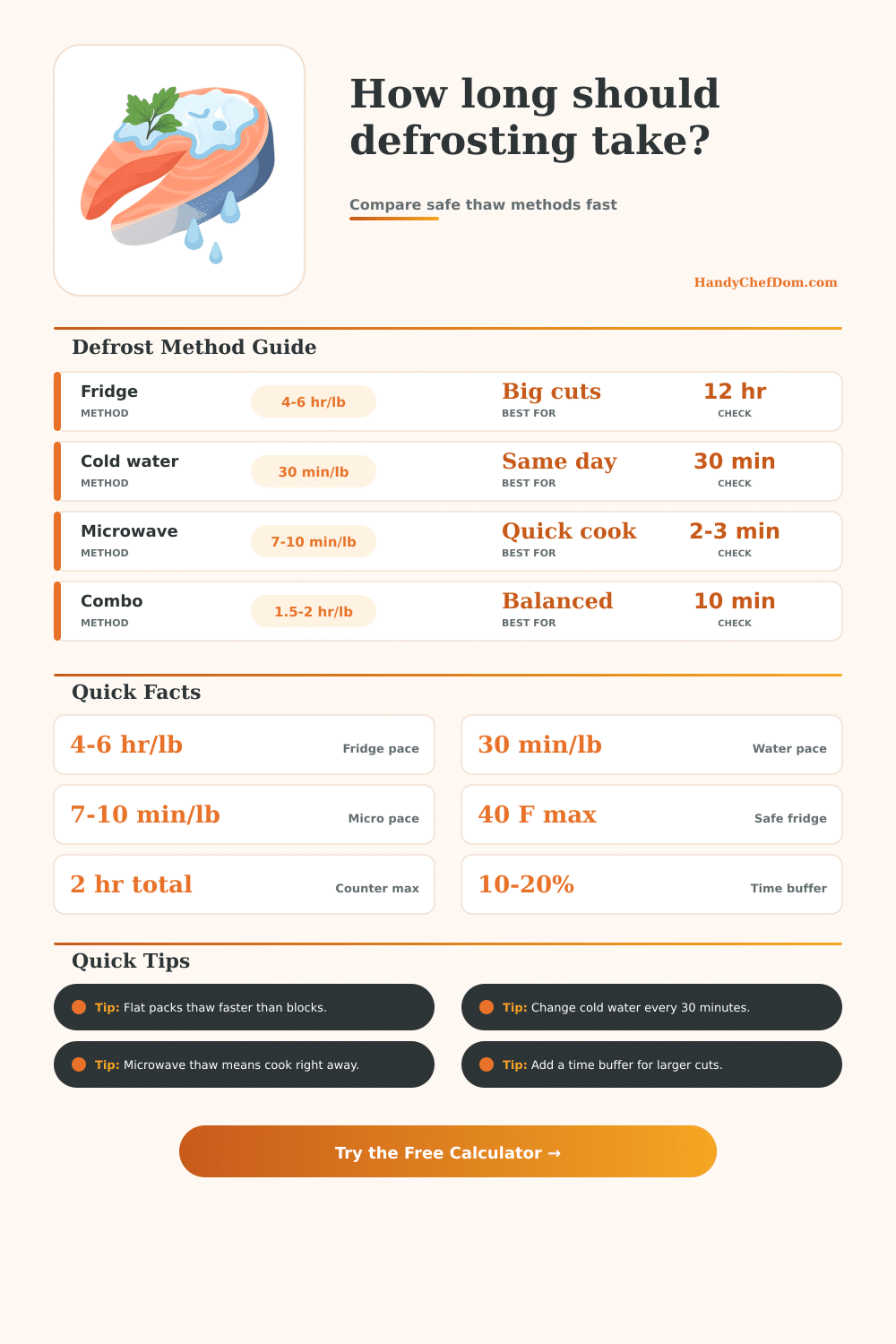
Use fridge or cold-water methods for best control. Microwave thaw is practical for short windows but should be followed by immediate cooking.
| Food Type | Fridge | Cold Water | Microwave |
|---|---|---|---|
| Ground meat | 4.8 hr/lb | 0.50 hr/lb | 0.14 hr/lb |
| Whole poultry cut | 5.6 hr/lb | 0.63 hr/lb | 0.18 hr/lb |
| Poultry pieces | 4.6 hr/lb | 0.47 hr/lb | 0.13 hr/lb |
| Steak or roast | 5.2 hr/lb | 0.58 hr/lb | 0.16 hr/lb |
| Fish fillet | 3.1 hr/lb | 0.34 hr/lb | 0.10 hr/lb |
| Shrimp | 2.7 hr/lb | 0.30 hr/lb | 0.09 hr/lb |
| Bread loaf | 2.2 hr/lb | 0.28 hr/lb | 0.08 hr/lb |
| Cooked leftovers | 2.4 hr/lb | 0.33 hr/lb | 0.10 hr/lb |
| Pack Shape | Factor | Behavior | Best Use |
|---|---|---|---|
| Thick block | 1.24x | Slow center thaw | Overnight fridge |
| Flat pack | 0.90x | Even thaw path | Cold water or fridge |
| Loose pieces | 0.78x | Large surface area | Quick same-day use |
| Vacuum pack | 1.05x | Tight thermal mass | Cold water + checks |
| Foam tray | 1.00x | Baseline behavior | Any method |
| Thickness | Factor | Risk | Plan Note |
|---|---|---|---|
| Under 1 in | 0.82x | Low center risk | Short checks |
| 1.0-1.5 in | 0.96x | Balanced thaw | Default baseline |
| 1.6-2.0 in | 1.07x | Slow middle | Add buffer |
| 2.1-3.0 in | 1.22x | Higher edge gap | More turns |
| Over 3 in | 1.38x | High unevenness | Prefer fridge |
| Method | Temp Target | Check Cycle | Cook-By Rule |
|---|---|---|---|
| Fridge thaw | 34-40 F | 12 hour check | Cook in 24-48h |
| Cold-water thaw | 55-65 F water | 30 min change | Cook right away |
| Microwave thaw | 30-40% power | 2-3 min turn | Cook right away |
| Combo thaw | Fridge + finish | 10 min checks | Cook same day |
Thawing frozen meat require a plan because the process of thawing take a specific amount of time depending on several variable. The variables includes the weight of the meat, the thickness of the meat, and the packaging style of the meat. People often under estimate the amount of time it take to defrost meat.
Additionally, people often dont account for how the thickness of the meat may impact the defrosting time. The calculator ask for specific inputs from the individual to calculate the defrosting time of the meat. These inputs includes the type of food, the weight of the food, the thickness of the food, and the pack style of the food.
How to Defrost Meat Safely
For instance, flat packs of fish will defrost more fast than dense roasts of the same weight. Thick blocks of ground meat may cause the center of the meat to not defrost as quick as the outer edges because the thick ground meat act as an insulation layer around the center of the meat. The method in which you defrost the meat will change the time that the meat will take to defrost.
The refrigerator method is considered the safest method of defrosting. However, cold water will take less time than defrosting in the refrigerator. However, you must change the water every thirty minutes.
Microwave defrost take the least amount of time but may lead to the outer edges of the meat being cooked. A combination of refrigerator and microwave method may work best for individuals that are rushing to prepare dinner. The thickness and the pack shape of the meat will change how fast the meat thaws.
For instance, a two-pound roast that is two inches thick will take more time to defrost than two pound of thin steak cuts. Additionally, packs that contain loose pieces of meat will defrost faster than vacuum-sealed blocks of meat. The safety of the meat is a primary concern during the defrosting process.
If you defrost the meat too quick, the meat may pose a health risk to the individual. The temperature of the refrigerator can change the rate at which the meat thaws. For instance, if the refrigerator is loaded with other item in the refrigerator, the temperature may rise from the other foods.
Therefore, the calculator allow for a buffer percentage to the defrosting time to allow for these variables. Some of the most common mistake when defrosting meat include leaving the meat on the counter and using the microwave on high power. Leaving the meat on the counter can cause the outer edges of the meat to reach dangerous temperatures.
High power on a microwave can cause the outer edges of the meat to cook while the center of the meat remain frozen. Planning the dinner that will follow the defrosting of the meat is essential. Poultry and ground meats must be cooked quickly after thawing.
This is because poultry and ground meats has high moisture content and high surface area which allow for bacteria to grow on the meat. While roasts and whole cuts of meat may not need to be cooked as quick, they still fall within a time window during which they should of been cooked. The calculator includes cook-by notes for these meat.
The personal routine that you follow in your kitchen will dictate the thawing method that works best for you and your kitchen. If you can sit down with your meat every thirty minutes to change the cold water, you may want to use that method for your meat. However, if you are not in the kitchen for many hours, the refrigerator method may work best for you.
The reference table allow you to see how different types of food and different pack style can impact the base rate of defrosting. You can use these tables to see trends in the defrosting time of meat. For instance, fish and shrimp product will defrost faster than poultry products.
Additionally, flat packs of meat will defrost faster than thick block of meat. Using the meat defrosting calculator will eventually give you an intuition for your kitchen and your meat thawing process. For instance, you may notice that your refrigerator is not often at the temperature recommend by the calculator.
Additionally, you may find that your microwave require more time than the calculator estimate due to the wattage of your microwave. Overall, the value of the calculator is that it present a plan for defrosting your meat. Additionally, it account for the safety factor of your meat while you are planning your dinner.