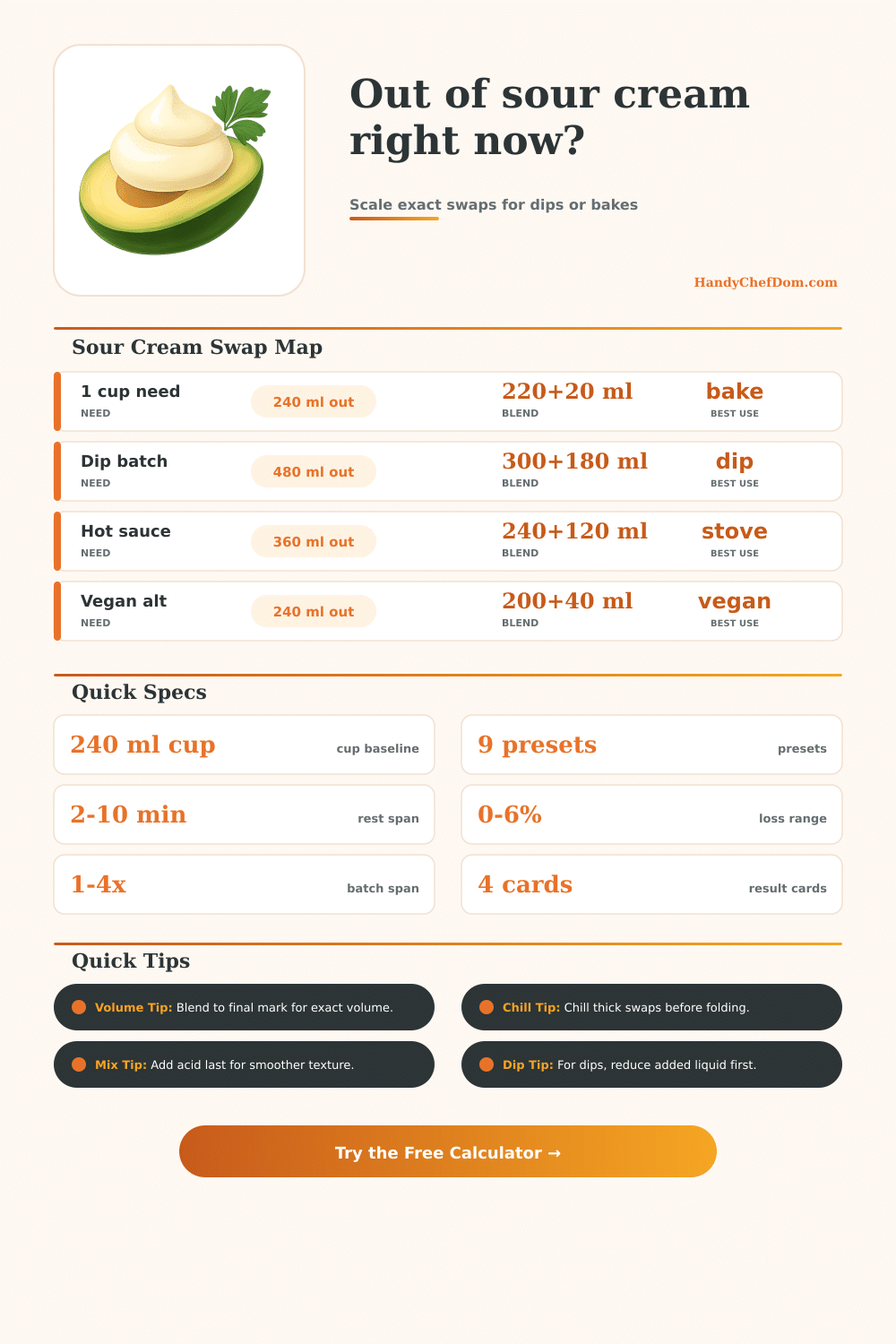
Sour Cream Substitute Calculator
Convert any sour cream amount into a practical swap with controllable tang, thickness, heat behavior, and batch scaling for bakes, dips, and pan sauces.
| Blend | Per cup formula | Rest time | Best for |
|---|---|---|---|
| Greek yogurt + cream | 220 ml + 20 ml | 4 min | Baking |
| Creme fraiche | 240 ml straight | 0 min | Hot sauce |
| Buttermilk + butter | 200 ml + 40 ml | 6 min | Cakes |
| Cottage cheese + milk | 180 ml + 60 ml | 5 min blend | Cooked dips |
| Cream cheese + yogurt | 140 ml + 100 ml | 8 min soften | Cheesecake |
| Mayo + plain yogurt | 120 ml + 120 ml | 2 min | Cold dip |
| Coconut yogurt blend | 210 ml + 30 ml | 3 min | Dairy free |
| Cashew cream + lemon | 200 ml + 40 ml | 10 min | Vegan sauce |
| Use mode | Tang factor | Texture tweak | Stability note |
|---|---|---|---|
| Baking | 1.00x | Keep standard | Very stable |
| Cold dip | 1.10x | Go dense | Chill to set |
| Hot sauce | 0.95x | Light target | Whisk low heat |
| Dressing | 1.15x | Light target | Add water slow |
| Batch plan | Total needed | Primary part | Secondary part |
|---|---|---|---|
| Small bake | 240 ml | 220 ml | 20 ml |
| Family dip | 480 ml | 360 ml | 120 ml |
| Party tray | 960 ml | 720 ml | 240 ml |
| Event prep | 1440 ml | 1080 ml | 360 ml |
| Measure | Imperial | Metric | Kitchen use |
|---|---|---|---|
| 1 tbsp | 1 tbsp | 15 ml | Tang add |
| 1/4 cup | 4 tbsp | 60 ml | Small dip |
| 1/2 cup | 8 tbsp | 120 ml | Sauce add |
| 1 cup | 16 tbsp | 240 ml | Main swap |
Sour cream is a multi-functional ingredient due to sour cream’s ability to contribute moisture, acidity, protein, and fat to an recipe. The acidity of sour cream help to balance the richness of a product, the protein in sour cream help to structure a products batter, and the fat content of sour cream helps to ensure that a baked product remain tender. Using a different ingredient to replace sour cream will alter the acidity, protein, and fat content of the product.
This alteration in the composition of the product can lead to changes in how the product react to baking or cooking processes. The calculator allow cooks and chefs to determine what ingredient to use as a replacement for sour cream. The amount of sour cream that will be used in the recipe, the type of food that is being made, and the thickness and tanginess of the replacement ingredient for sour cream are all feature that determine the best replacement for sour cream.
How to Replace Sour Cream in Recipes
Each of these ingredients is important to the recipe, as different types of food require different texture and levels of acidity. For instance, a replacement ingredient that is dense in texture work well for products like taco dips, but may be too dense for a dessert like a muffin. Conversely, a thin replacement ingredient is suitable for products like pan sauces, but may not be suitable for a dessert like a cheesecake.
Many people turn to another primary ingredient as a replacement for sour cream. In addition to considering these primary ingredients, though, the secondary ingredients within that replacement product should also be considered. For instance, Greek yogurt contain the appropriate protein and tang in yogurt replacements, but is too lean to use as a direct replacement for sour cream.
Cream can be added to Greek yogurt to balance the fat content of the Greek yogurt to that of sour cream, which will allow the replacement for sour cream to perform its intended function within the recipe. Creme fraiche also contains the proper amount of fat to act as a replacement for sour cream, as well as additional cooking cultures that enable the sauce to hold up well to high heat. Cottage cheese can also be used as a replacement for sour cream; however, you must blend the cottage cheese with milk to provide body to the sauce and the cook must allow the cottage cheese to rest until the curds is smooth.
Each of these alternatives is an essential ingredient in creating a proper replacement for sour cream. Additionally, the effects of heat on the proteins within the replacement ingredient for sour cream should be considered. For example, if using yogurt or cottage cheese to replace sour cream in a hot sauce, the proteins will begin to tighten together if the heat of the sauce are too high.
To avoid this behavior of the protein, the tang setting of the replacement should be lowered. Reducing the tang of the sauce will reduce the reaction of the proteins to the heat of the sauce, and will help to prevent curdling of the replacement for sour cream. Another factor to consider for the alternative ingredients is texture.
For instance, a replacement for sour cream that is light in texture and pourable will thicken if allowed to cool. A dense replacement will loosen once it reach the temperature of the product. An ingredient rest time is included in the calculator to ensure that the alternative ingredient has rested to allow it to reach the proper texture.
Omitting the rest time may lead to the alternative ingredient appearing correct to the product when poured into the cooking vessel, but may feel incorrectly once the product is consumed. Scaling a recipe to prepare larger batches of a product may require the doubling of the quantities for each ingredient. However, you should not double the amount of the secondary fat and liquid ingredient in the recipe; doubling of the ingredients will lead to the potential of creating a watery replacement for sour cream.
The batch multiplier in the calculator will adjust both the primary and secondary ingredients so that the fat and acid levels of each product remains correct. There are a variety of factors that may impact the outcome of a recipe using a replacement for sour cream. Factors like the fat content of the yogurt, the temperature of the ingredients, and the humidity in the kitchen can all play a role in the outcome of the recipe.
Using chilled ingredients will allow the fat in the replacement to remain emulsified. Additionally, acid should be added to the product at the end of the cooking process so that it does not play a role in the setting of the proteins in the recipe. The comparison grid allows individuals to compare the effectiveness of different ingredients as a replacement for sour cream.
For instance, Greek yogurt is effective in baking products or dips. Creme fraiche is effective in situations where the product is exposed to high heat. Cashew cream is effective in vegan products if the lemon juice is adjusted to provide the proper tang to the product.
No single ingredient is the best in each category, so the sour cream replacement tool can be used to determine the best alternative to sour cream for each individual situation. The reference tables allow cooks and chefs to determine which ingredient should be used as a replacement for sour cream based off the volume of sour cream that is to be used in the recipe. For instance, recipes for baking products may allow for various texture levels in the finished product, while cold dips require a different texture than products that is consumed at room temperature.
Considering each ingredient as a combination of fat, acid, and protein will allow cooks and chefs to prepare the best replacement for sour cream. You should of checked the texture first. It’s actualy very simple.
It’s also helpful to note that some people prefer more creaminess. One could say that the texture matters more then the acidity. The furnitures in the kitchen might be moddern, but the recipe is classic.
You’ll find that most people dont mind a little extra tang. If you use too much, the texture might feel a bit strange. It’s a lot of work, but worth it.