🥚 Protein in Egg Yolk Calculator
Estimate yolk protein from whole yolks, liquid yolk grams, cooked yield, recipe use, serving count, and fat-to-protein ratio.
Enter counted yolks, liquid yolk grams, or both. The calculator treats liquid yolk as raw yolk weight, then applies the selected cooked yield and recipe-use retention.
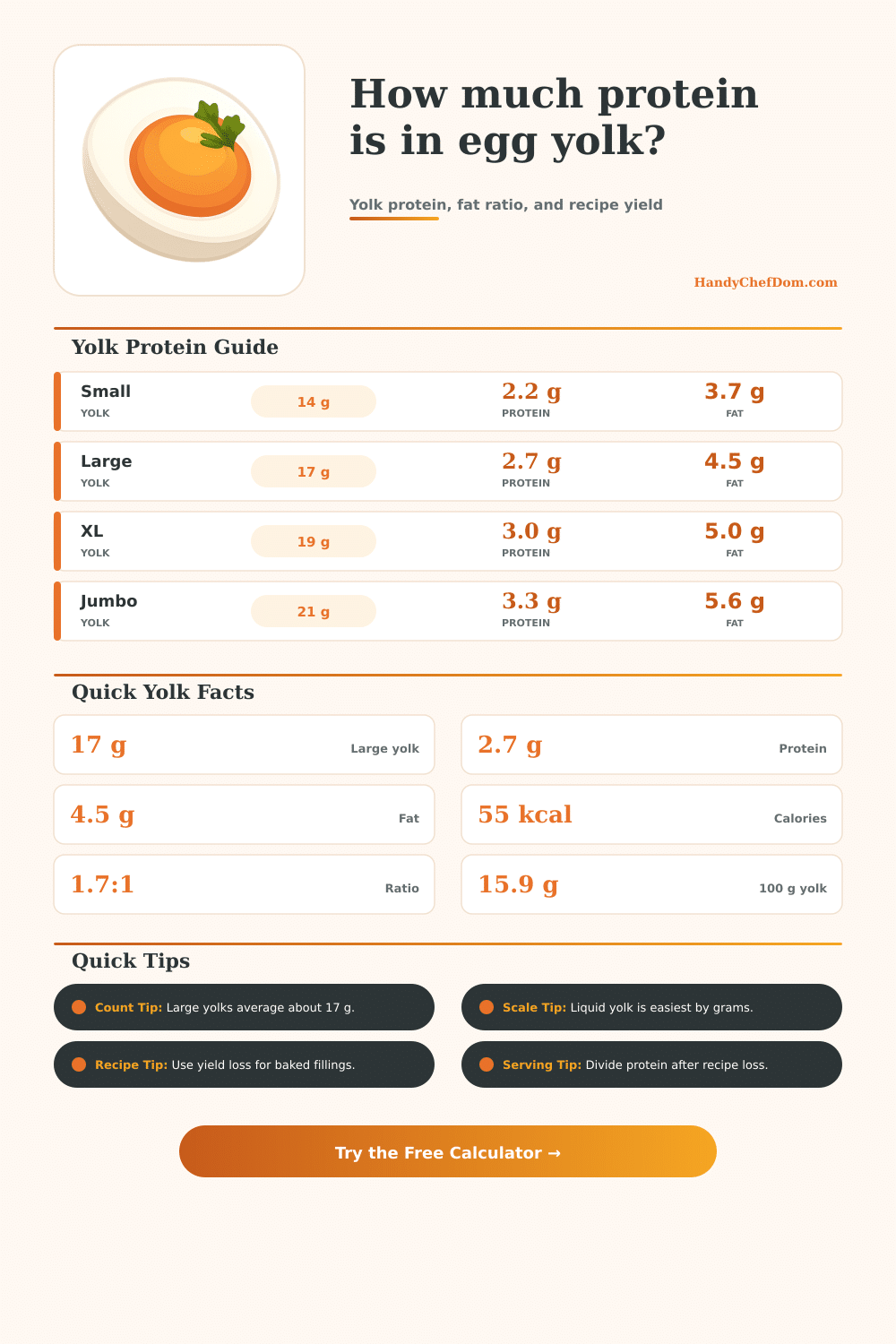
| Egg size | Avg yolk weight | Protein | Fat | Calories |
|---|---|---|---|---|
| Peewee chicken | 11 g | 1.7 g | 2.9 g | 35 kcal |
| Small chicken | 14 g | 2.2 g | 3.7 g | 45 kcal |
| Medium chicken | 16 g | 2.5 g | 4.2 g | 51 kcal |
| Large chicken | 17 g | 2.7 g | 4.5 g | 55 kcal |
| Extra-large chicken | 19 g | 3.0 g | 5.0 g | 61 kcal |
| Jumbo chicken | 21 g | 3.3 g | 5.6 g | 67 kcal |
| Yolk state | Yield factor | Best entry | Protein note | Weight note |
|---|---|---|---|---|
| Raw or stirred | 100% | Count or grams | No yield loss | Original weight |
| Soft-cooked | 98% | Counted yolks | Nearly unchanged | Small moisture loss |
| Hard-cooked | 95% | Counted yolks | Protein retained | Firmer yolk weight |
| Baked filling | 92% | Recipe batch | Use recipe loss | Custard evaporation |
| Cured or grated | 55% | Scale grams | Concentrated | Water removed |
| Recipe use | Retention | Typical yolks | Protein focus | Yield reminder |
|---|---|---|---|---|
| Custard or creme base | 98% | 4 to 8 | Portion protein | Allow mild loss |
| Fresh pasta dough | 100% | 3 to 6 | Batch protein | Little discard |
| Aioli or emulsion | 100% | 1 to 3 | High ratio | Usually all used |
| Ice cream base | 99% | 4 to 10 | Per scoop split | Strain loss small |
| Pastry cream filling | 97% | 4 to 8 | Slice labels | Pan scrape loss |
| Enriched dough | 96% | 2 to 8 | Loaf protein | Bowl residue |
| Fruit curd filling | 96% | 3 to 8 | Tart portions | Strain or pan loss |
| Sauce or carbonara | 95% | 1 to 4 | Plate protein | Clinging loss |
| Yolk amount | Approx protein | Approx fat | Approx calories | Fat:protein |
|---|---|---|---|---|
| 1 large yolk | 2.7 g | 4.5 g | 55 kcal | 1.7:1 |
| 2 large yolks | 5.4 g | 9.0 g | 109 kcal | 1.7:1 |
| 4 large yolks | 10.8 g | 18.0 g | 218 kcal | 1.7:1 |
| 6 large yolks | 16.2 g | 27.1 g | 327 kcal | 1.7:1 |
| 100 g liquid yolk | 15.9 g | 26.5 g | 321 kcal | 1.7:1 |
| 250 g liquid yolk | 39.7 g | 66.4 g | 803 kcal | 1.7:1 |
Egg yolks contains protein. Egg yolks also contain fats. The protein content within the egg yolks within a recipe, however, is dependent upon the size of those egg yolk.
For instance, if eggs of different size are used within a recipe, the amount of protein that the yolks will contribute will be different from recipe to recipe. Small egg yolks may weighs eleven grams, yet large egg yolks may weigh twenty-one grams. Thus, the total amount of protein within a recipe that employ egg yolks will also differ.
How to Calculate Protein in Egg Yolks
The total amount of protein within the egg yolks within a recipe can be calculate by entering the size of the egg yolks into the calculator, as well as by deciding whether the protein of the individual egg yolk will be counted or weighed. Counting the individual yolks is one method of calculating the protein within the yolks, but weighing the liquid yolk is another method. The liquid yolks can be of any size, hence the difficulty in counting them.
Weighing the liquid yolks, then, is a more accurately method for those that use large batches of egg yolks in there recipe. Using the incorrect method within the calculator may lead to under-counting or over-counting of the protein contribution of the egg yolks. The cooking processes that the egg yolks will undergo can alter their weight and the total amount of protein within the recipe that use those egg yolks.
For instance, baking custard products will lead to the egg yolks losing some of their moisture, which will lead to a loss of weight of those yolks and the protein within them. Products like fresh pasta dough, however, will lose less of its moisture during the cooking process. These factor can be entered into the calculator to calculate how much protein will remain in the finished dish.
The ratio of the fat to the protein within egg yolks is another important measurement of the yolks. The fat to protein ratio within egg yolks is 1.7 to 1. Recipes may require the use of egg yolks with specific ratio of fat to protein; however, adding cream or butter to the recipes will change the ratio of fat to protein of the egg yolks.
This ratio can be entered into the tool to compare the current ratio of fat to protein of the egg yolks to the target ratio. Aside from the fact that recipe loss can be account for in the calculator, the protein within the egg yolks must also be accounted for. Loss of the yolks to the strainer or mixing bowl will lead to a loss of the protein within those yolks.
Any loss of protein of less than five percent, for instance, will change the total amount of protein that each person who taste the dish will experience. Accounting for this loss will allow the chef to determine if additional egg yolks must be added to the recipe to provide the necessary protein for each person who tastes the recipe. The protein within the egg yolks can be compared to the protein content of the egg whites.
Egg whites contains more protein per calorie than egg yolks, and they contain almost no fat. Because egg yolks and egg whites are often combined in recipes, it is also possible to calculate the amount of protein that each of these component will contribute to the recipe. By knowing the amount of protein in each of these ingredients, cooks can make informed decision regarding the creation of their recipe.
The total amount of protein that is counted within the recipe can also determine whether or not the recipe will meet a specific target of protein in the recipe. Furthermore, the total amount of protein within the recipe can reveal the equivalent number of large egg yolks that the recipe contains. This is particularly helpful for those who wish to substitute liquid egg yolks for individual egg yolks.
Because egg yolks of different sizes contains different amounts of protein, a calculator that determines the protein content of each type of yolk allows cooks of all skill levels to ensure that there recipes contain the apropiate amount of that protein.