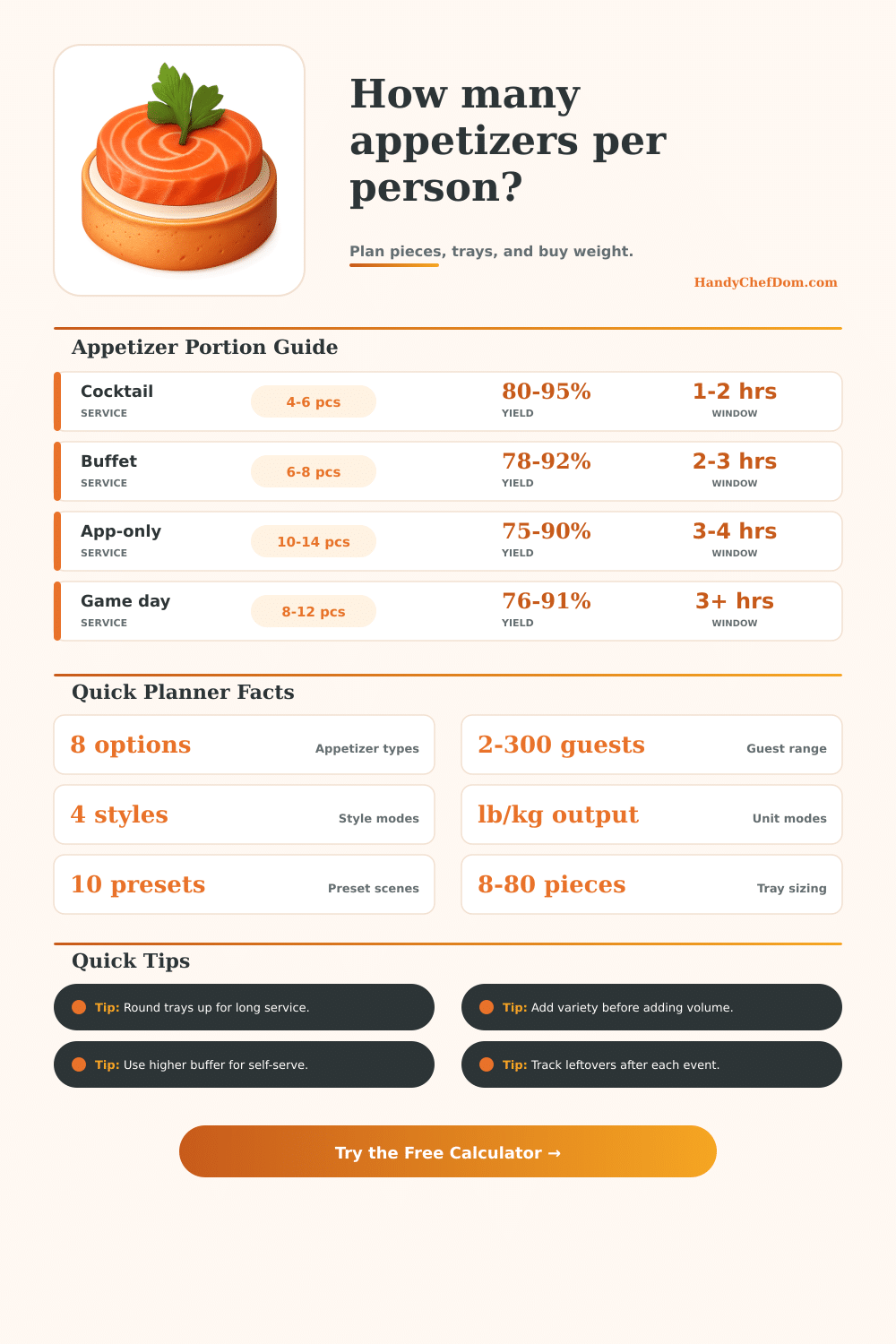
Appetizer Per Person Calculator
Estimate appetizer pieces per guest, rounded tray counts, and buy weight using event style, appetizer density, duration, variety count, and service buffer for practical event planning.
📌Preset Scenarios
⚙Calculator Inputs
Start with appetizer type and event style. Then tune role, duration, and variety to reflect how guests actually move through an appetizer spread.
📐Serving Benchmarks
📑Reference Tables
| Appetizer type | Piece wt | Yield | Best use |
|---|---|---|---|
| Chicken wings | 2.2 oz | 81% | Game day trays |
| Mini sliders | 2.5 oz | 90% | Buffet stations |
| Shrimp cocktail | 1.0 oz | 92% | Cocktail hour |
| Spring rolls | 1.6 oz | 88% | Mixed service |
| Bruschetta | 1.4 oz | 85% | Passed bites |
| Mini quiche | 1.8 oz | 89% | Holiday spreads |
| Veggie cups | 2.8 oz | 95% | Balanced menus |
| Cheese cubes | 0.5 oz | 98% | Snack boards |
| Guests | 5 pcs ea | 8 pcs ea | 12 pcs ea |
|---|---|---|---|
| 10 guests | 50 pcs | 80 pcs | 120 pcs |
| 20 guests | 100 pcs | 160 pcs | 240 pcs |
| 35 guests | 175 pcs | 280 pcs | 420 pcs |
| 50 guests | 250 pcs | 400 pcs | 600 pcs |
| 75 guests | 375 pcs | 600 pcs | 900 pcs |
| 100 guests | 500 pcs | 800 pcs | 1200 pcs |
| 150 guests | 750 pcs | 1200 pcs | 1800 pcs |
| 200 guests | 1000 pcs | 1600 pcs | 2400 pcs |
📊Nutrition Snapshot
💡Planning Tips
When planning an appetizer spread, you have to calculate the amount of food that you will need. An incorrect amount of foods will result in empty trays or food that people dont touch at the event. You must consider how much food people will consume at different events and how long the food will sit out.
People has different appetites at different events. Some events feature appetizers as the main event and others feature appetizers as the food to be eaten before the main meal of the event. The calculator ask for the number of guests that will attend the event and the style of the event to determine the amount of food that will be needed for the appetizers.
How to Plan the Right Amount of Appetizers
These two piece of information are crucial to determining the amount of food that will be needed for the appetizer spread. For example, if the event features drinks all night long, there will be fewer appetizer pieces required per person than if there were only an appetizer only meal. Another example is if some of the appetizers is for the lighter eaters and some for the heartier eaters.
This would allow the caterer to account for the different appetites without having to guess at how much of each appetizer will be consumed. The length of the event will play a crucial role in the calculation of the amount of food that will be needed for the appetizer spread. If the appetizers will be visible for three or four hours, many of the guests will graze at the appetizer spread and return to the food during the long event.
The calculator will ask for the length of the event so that the calculation of the amount of food can account for the length of the event. Additionally, the number of other food choices will affect how many appetizer pieces will be needed for each item. If there are many different food choices, the portion of the appetizer that will be required for each individual appetizer will be lesser than if there were fewer food choices.
The percentage of food that will be wasted during the spread will vary with how the appetizers will be served. If the appetizers will be served in a self serve style, there will be more food wasted than if the guests pass the appetizers between them. Therefore, the calculator will ask for the percentage of food that will be wasted.
The calculator will add a buffer to the amount of food calculated to account for food spreads that use self serve service for appetizers. The amount of food will be rounded up to the nearest number of food trays because the food is sold in trays and an extra portion is needed in case the appetizers need to be replenished during the spread. The weight of each piece of appetizer will affect the total weight of the food that will be ordered for the appetizer spread.
Additionally, the yield of the appetizer will also affect the total weight. For example, if the appetizer is chicken wings, there will be a lower edible yield of the appetizer than if the appetizer was cheese cube. This is due to the weight of the bones and cartilage in the chicken wings.
An understanding of the edible weight of the appetizer will help the caterer understand why the buy weight of the appetizer may change for the same number of pieces. Appetizers can be categorized differently. For example, some of the appetizers may be feature items and some may be support items for the appetizer spread.
If the caterer selects the feature item for the appetizer spread, the calculator will increase the number of pieces of that selected appetizer so that it does not run out before the support items for the appetizer spread. The number of varieties of the appetizers will also affect the number of pieces of each appetizer that will be needed. If the guests are to pass the appetizers on trays, the guests will sample the appetizers differently than if the appetizers are to be placed on a buffet or grazing table for the guests.
This will affect the number of pieces of each appetizer that will be needed for the spread that features these appetizers. The temperature of the appetizers will affect how long they are visible and enticing for the guests. Hot appetizers will lose their appeal more faster than the appetizers that are to be served at room temperature.
Cold appetizers will maintain their appeal but may look tired after being displayed in the room. These factors will play a role in the outcome of the appetizer spread but will not affect the amount of food that is ordered for the spread. The output of the calculator will help the caterer to make decisions about how many tray of each appetizer will be prepared and how much the appetizer will weigh.
For instance, the caterer can decide to order an extra tray of food just in case, or the caterer can decide to reduce the amount of one of the appetizers to save money. Furthermore, the breakdown of the calculation will allow the caterer to adjust the variables to find the perfect amount of each appetizer. The most important of all the variables is the role that the appetizers will play at the event.
If the appetizers are to be the main event at the party, there will be a higher number of pieces of each appetizer required than if the appetizers are only meant to fill the gap between the start of the party and the beginning of the dinner meal. The calculator allows the caterer to set each of these scenario to help determine what the appetizer spread should weigh and contain.