🍅 Tomato Paste for Mexican Rice Calculator
Estimate tomato paste, broth and water split, cooked yield, pan fit, and altitude-adjusted liquid for Mexican rice batches from weeknight sides to party pans.
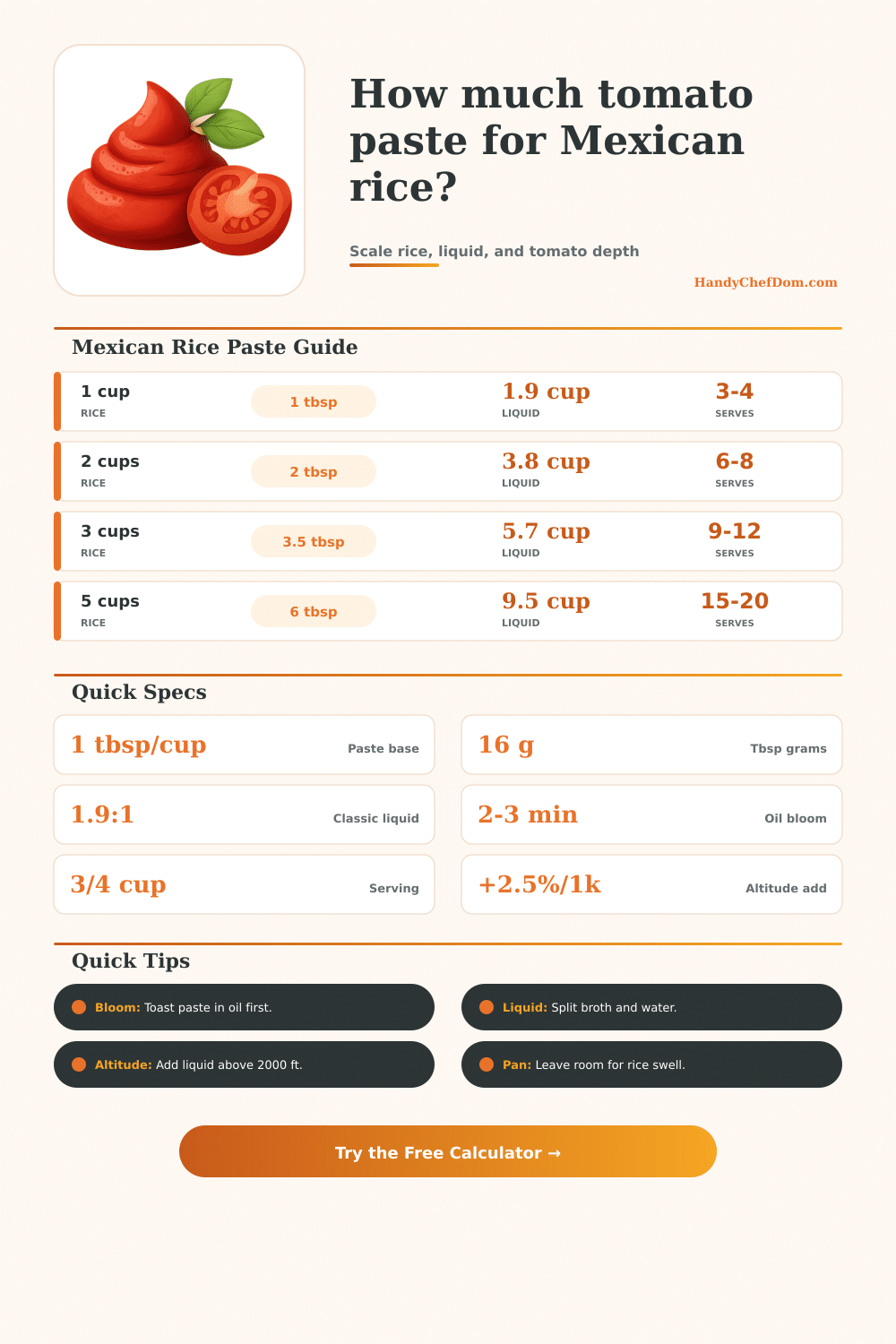
A practical Mexican rice baseline is about 1 tablespoon tomato paste per cup of uncooked long-grain rice, with the exact amount changing by tomato intensity, onion and garlic, oil bloom, liquid ratio, pan evaporation, reduction, and altitude.
| Uncooked Rice | Light Tint | Classic Rice | Deep Red | Best Use |
|---|---|---|---|---|
| 1 cup | 0.75 tbsp | 1 to 1.25 tbsp | 1.5 tbsp | Dinner for 3-4 |
| 2 cups | 1.5 tbsp | 2 to 2.5 tbsp | 3 tbsp | Family taco night |
| 3 cups | 2.25 tbsp | 3 to 3.75 tbsp | 4.5 tbsp | Meal prep bowls |
| 4 cups | 3 tbsp | 4 to 5 tbsp | 6 tbsp | Potluck side |
| 5 cups | 3.75 tbsp | 5 to 6.25 tbsp | 7.5 tbsp | Party pan |
| 8 cups | 6 tbsp | 8 to 10 tbsp | 12 tbsp | Buffet batch |
| Rice Style | Base Liquid | Cooked Yield | Altitude Cue | Tomato Paste Note |
|---|---|---|---|---|
| Long-grain white | 1.85 to 1.95 cups | 3.1 cups | Add after 2000 ft | Classic 1 tbsp per cup |
| Jasmine rice | 1.70 to 1.80 cups | 3.0 cups | Use modest reserve | Keep paste slightly lighter |
| Medium-grain white | 1.80 to 1.90 cups | 3.0 cups | Watch stickiness | Classic amount works |
| Parboiled rice | 2.00 to 2.10 cups | 3.2 cups | Handles extra liquid well | Can take bolder tomato |
| Brown rice | 2.25 to 2.40 cups | 3.4 cups | Add time and liquid | Use paste, not tomato sauce |
| Pan | Comfortable Rice | Good Batch Size | Evaporation Behavior | Calculator Cue |
|---|---|---|---|---|
| 10 inch skillet | 1 to 1.5 cups dry | 4-5 side servings | Fast evaporation | Use normal or wide-pan loss |
| 12 inch skillet | 2 to 2.5 cups dry | 6-9 side servings | Even tomato bloom | Classic family setting |
| 3 qt saucepan | 2 to 3 cups dry | 8-10 side servings | Lower evaporation | Use covered tight loss |
| 5 qt Dutch oven | 4 to 5 cups dry | 14-18 side servings | Steady covered simmer | Good for party rice |
| Half hotel pan | 6 to 8 cups dry | 22-30 side servings | Wide surface | Increase loss setting |
| Per Cup Rice | Light | Classic | Bold | Why It Matters |
|---|---|---|---|---|
| Onion | 2 tbsp | 4 tbsp | 6 tbsp | Sweetness balances tomato paste |
| Garlic | 0.5 clove | 1 to 1.5 cloves | 2 cloves | Garlic makes deep paste taste savory |
| Oil | 0.75 tbsp | 1 to 1.25 tbsp | 1.5 tbsp | Enough oil blooms paste evenly |
| Bloom time | 1 minute | 2 to 3 minutes | 4 to 5 minutes | Longer bloom reduces raw tomato edge |
| Reduction | 4 percent | 8 percent | 12-16 percent | More loss concentrates salt and tomato |
Mexican rice’s small secret is getting the tomato paste just right, because it will determine if your rice is balanced or simply red. Add too little and the rice won’t stand out in the meal, add too much and the tomato takes over leaving a sharpness no salt can tame. How much do you need? It’s not as easy as a one-to-one ratio (though that’ll usually be close), since it also depends on other things in the meal.
Onions acts as a flavor bridge. Garlic act as a flavor bridge. Toasted rice act as a flavor bridge. Tomato paste adds flavor, color, and acidity. The tomato paste does double duty: It provides acidity that prevents the rice from being flat-tasting and it bridges flavors of the garlic, onion, and toasted rice. Because the paste is concentrated, a small change in quantity shift the whole balance. That means if you add just a little too much or not enough, the entire balance will shift.
How to Get the Tomato Paste Amount Right
Even more importantly, the amount you add depend on how long you let it bloom in oil prior to adding liquid. A longer bloom time will deepen its color and soften its raw canned flavor, meaning you may be able to get away with more paste without a bitter dish.
Altitude and liquid-to-rice ratio matter more then most people expect. Rice will require additional water to reach doneness at higher altitudes, but unless you compensate for that extra liquid, the tomatoes won’t get any tastier, they’ll just be diluted. Enter your target evaporation rate (depending on how well your lid fits), your pot shape/type, and your elevation, and the calculator does the rest. It’s based off the fact that no two kitchens are alike. A loosely covered Dutch oven will retain less steam than a large, well-fitting skillet lid. This results in a different end product, both in texture and tomato punch.
There’s another input to consider: How many onions (and other aromatics) do you intend to include? More onion or garlic makes it savorier and sweeter which lets the tomato flavor sit comfortabley in the backseat. This input adjusts the recommended paste amount accordingly… Instead of just going with a baseline default number. Likewise, you can adjust the broth percentage. Adding more broth adds more flavor and salt, which makes even small amounts of paste taste stronger then they would in a version made with only water.
Most errors arise from neglecting the paste at the beginning or making it an afterthought. Some people bloom the paste with the rice; others stir it into liquid and end up with a brighter flavor, even metallic, as a result. Still others proportion the paste linearly according to volume of rice but fail to account for the fact that bigger is not necessarily better. A bigger batch requires a wider pan. This leads to a greater amount of evaporating moisture, which concentrates the tomato and salt alike. Correct small things early to avoid having to correct them big-time later on.
I’ve included some reference tables on the page that show how different tomato intensities and rice styles line up with various serving quantities and pan sizes. These aren’t intended as a replacement for your own palate; rather, they’re just a solid starting point if you happen to be attempting a new pan size or preparing this for a different quantity of people. From there, you can tweak the inputs to the calculator to reflect the meal you’d like to end up making after understanding how the variables play off each other.
And that’s where the real value of this tool comes into play: It maintains the same ratio of tomato paste to the rest of what you’re already working out. It doesn’t stop your tasting and tweaking at the stovetop; it just starts you nearer to there than making things up from scratch every time.
You should of used it sooner.