Party Food Quantity Calculator
Plan party portions with a calculator built for real hosting: guest mix, appetite, event length, serving style, children, waste buffer, and the food category all shape the final amount.
Start with a common party scenario or enter your own details. The calculator translates guests into practical portions, trays, pans, pieces, pounds, and metric equivalents.
Your party food estimate
Best when food is not the center of the event.
Balanced planning for a normal party table.
Use when guests expect this food to be filling.
Adds grazing portions after the first few hours.
| Food category | Light snack | Main role | Party note |
|---|---|---|---|
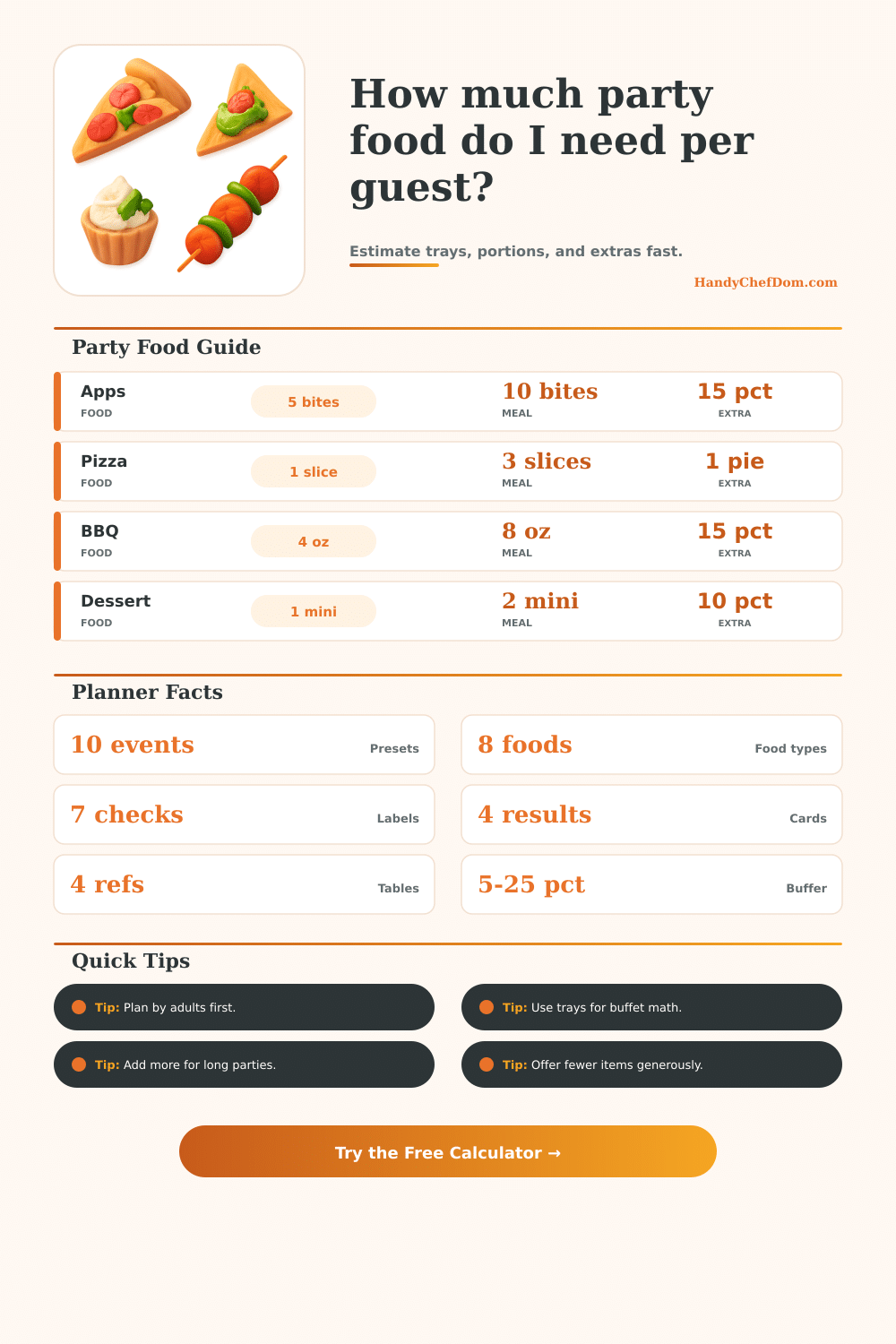
| Mixed appetizers | 5 to 6 bites | 10 to 12 bites | Count bite-size pieces, not tray count, for the cleanest estimate. |
| Chips and dips | 1.5 oz chips | 3 oz chips | Add dip at about one quarter cup per guest for a snack table. |
| Pizza slices | 1 to 2 slices | 3 slices | Assumes a large pizza has 8 slices and people mix with sides. |
| Sliders or sandwiches | 1 piece | 2 pieces | Use half-size sandwiches when other hearty foods are present. |
| BBQ main protein | 4 oz cooked | 8 oz cooked | Use cooked edible weight for the serving estimate. |
| Pasta or grain salad | 0.5 cup | 1.25 cups | Best as a filling side or vegetarian-friendly main option. |
| Green salad | 1 cup | 2 cups | Leafy salads look large but compress quickly on plates. |
| Dessert bites | 1 to 2 minis | 3 minis | Offer extra if dessert is the featured part of the party. |
| Party unit | Typical yield | Metric equivalent | Calculator use |
|---|---|---|---|
| Appetizer tray | 24 bites | about 24 pieces | Rounds bite counts into practical trays for ordering or prep. |
| Large pizza | 8 slices | about 1.1 kg pie | Converts slice needs into whole pizzas with a small cushion. |
| Slider tray | 12 sliders | about 1.4 kg tray | Useful for sandwiches, mini rolls, and small handheld portions. |
| BBQ tray | 3 lb cooked | about 1.36 kg | Rounds cooked protein into party-size serving pans. |
| Side pan | 12 cups | about 2.8 liters | Works for pasta salad, grain salad, and scoopable sides. |
| Green salad bowl | 16 cups | about 3.8 liters | Rounds leafy volume into large serving bowls. |
| Dessert platter | 36 mini bites | about 36 pieces | Rounds small sweets into shareable dessert platters. |
| Group size | Appetizer bites | Pizza slices | BBQ cooked weight |
|---|---|---|---|
| 8 guests | 48 to 80 bites | 16 to 24 slices | 3 to 4 lb for a meal role. |
| 12 guests | 72 to 120 bites | 24 to 36 slices | 5 to 6 lb for a meal role. |
| 20 guests | 120 to 200 bites | 40 to 60 slices | 8 to 10 lb for a meal role. |
| 30 guests | 180 to 300 bites | 60 to 90 slices | 12 to 15 lb for a meal role. |
| 50 guests | 300 to 500 bites | 100 to 150 slices | 20 to 25 lb for a meal role. |
| 80 guests | 480 to 800 bites | 160 to 240 slices | 32 to 40 lb for a meal role. |
| Food | Serving basis | Calories | Macro note |
|---|---|---|---|
| Mixed appetizers | 8 bites | 320 | Varies widely by filling, pastry, and dips. |
| Chips and dips | 3 oz chips plus dip | 430 | Mostly carbohydrate and fat, with modest protein. |
| Pizza slices | 3 large slices | 840 | Higher carbohydrate with moderate protein and fat. |
| Sliders or sandwiches | 2 small pieces | 520 | Balanced if meat, bread, and cheese are included. |
| BBQ main protein | 8 oz cooked | 560 | Protein-heavy, fat varies by cut and sauce. |
| Pasta or grain salad | 1.25 cups | 360 | Mostly carbohydrate unless beans, cheese, or meat are added. |
| Green salad | 2 cups dressed | 180 | Lower energy unless creamy dressing or toppings are heavy. |
| Dessert bites | 3 mini sweets | 300 | Mostly carbohydrate and fat in small portions. |
Planning a party require determining the correct amounts of food to purchase to ensure there is neither too much food nor too little food for the guest. Having too much food lead to wasted food, while having too little food mean the guests will not have enough to eat. The food calculator aim to help with this by asking for a few specific input of the party setup to calculate the amount of food that is needed.
The first of the inputs that the food calculator will ask for is a guest count. However, this is not the only input that will be required. It is important to also account for the number of adults and children that will be attending the party because the children will eat different amount of food than the adults.
How to Use the Party Food Calculator
By using the food calculator, the calculator will provide only a fraction of the portion of food for each child that will attend the party. Another important input is the event’s duration. The longer the party is likely to last, the more food will be consume.
Therefore, the food calculator will ask for the duration of the party. Based off this input, the calculator will determine how much food is required for the duration of the party. Food will be calculate for each hour the party will last so that there is enough food for all the guest throughout the party.
Appetite levels are another variable that the food calculator will ask of. The food calculator will ask for the appetite levels of the guests attending the party. For instance, if most of the guests are teenagers, they will have a more higher level of appetite than a group of light eater.
By entering the appetite level, the food calculator can determine how much food is needed to feed each guest based on they’re appetite. Another variable that the food calculator will ask of is the type of serving for the food items. For instance, if the food items will be snacks, there will be a different amount of food needed for the snack table compared to a main dish that will be served during the dinner portion of the party.
By entering the serving for each food item, the food calculator will determine how much of each food item will be needed for the party. Food variety will be asked of the food calculator because fewer guest will take a full serving of each food item if there are various food choices for them. By using the food calculator and entering the number of food choices that will be at the party, the food calculator will determine how much of each food item is needed for the guests.
The food calculator will display the amount of each food item that should be purchase for the party in the units in which the food will be purchased. For instance, instead of asking for the amount of pizza dough for each recipe for each type of pizza, the food calculator will provide an answer in the number of pizzas that need to be purchased. The food calculator will also provide a breakdown of how it arrived at the number of each food item that is needed for the party.
Food calculators account for the fact that parties with various food choices need less of each food item than a party with fewer food option. Food calculators will also account for the number of adults and children by only purchasing portion of food for the children. Food calculators allow for all of these variable to be seen and accounted for by allowing the host to adjust each variable to reflect what they would like to prepare for the party.
An unexpected change may occur at the party that will alter the amount of food that the guests will eat. For instance, some guest may show up late or leave the party early. Therefore, the food calculator will also ask for the percentage of food that must be purchased as a buffer in the case of guest coming late or leaving the party early.
The food calculator will help to ensure that there is enough food for the guests who will attend the party. If there is not enough food, the party may become tense and uncomfortably for the guests. However, by using the food calculator, the calculator will calculate the amount of food that will be prepared and served so as to remove any uncertainty in the outcome of the party.