Cooking Time Per Pound Calculator
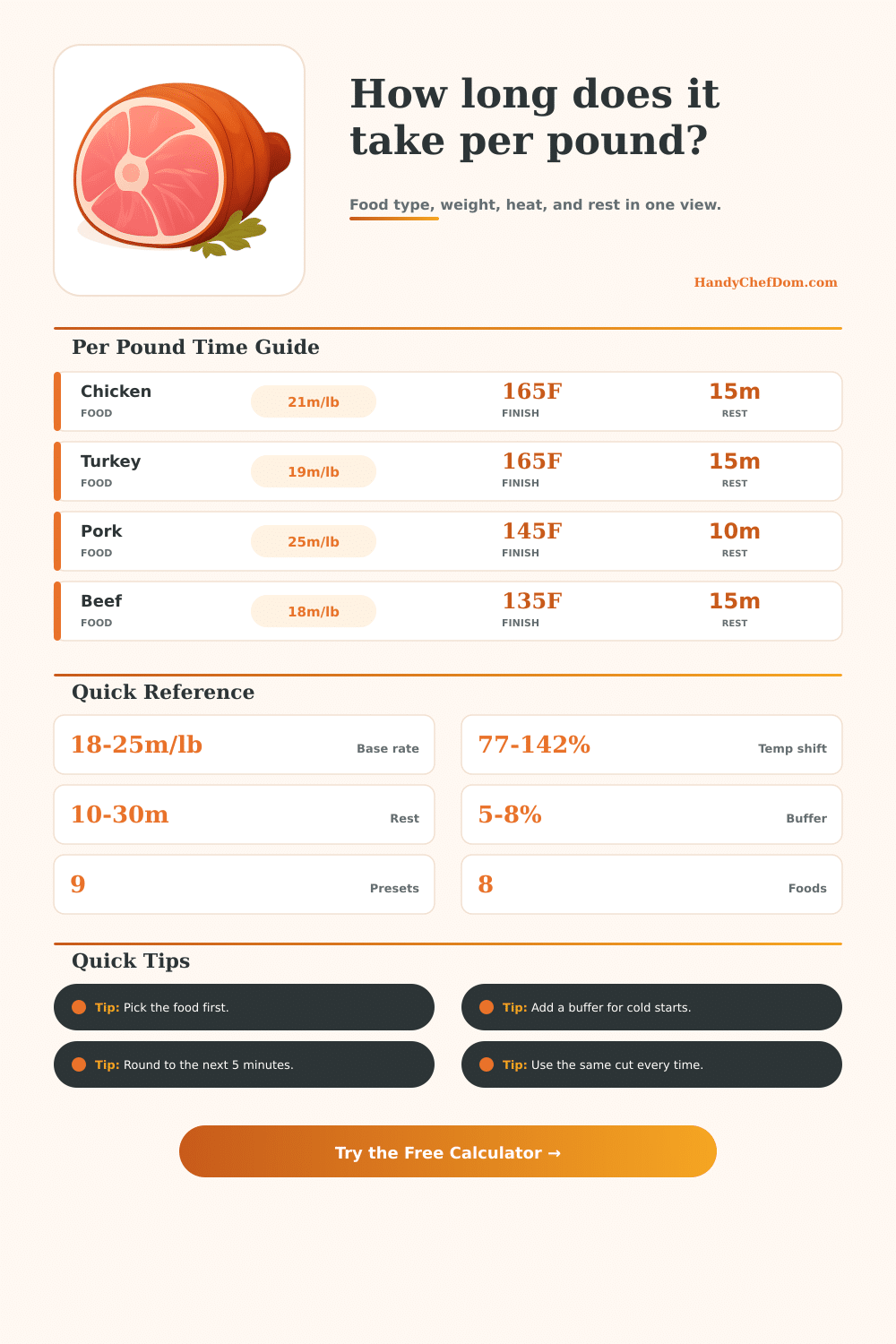
Scale roast timing by food type, weight, heat, and rest so dinner planning feels steadier and less guessy.
Choose the food, weight, oven heat, start state, rest time, and buffer. The calculator turns those inputs into a realistic cook window and yield estimate.
| Food | Rate | Yield | Rest |
|---|---|---|---|
| Chicken | 21m/lb | 67% | 15m |
| Turkey | 19m/lb | 74% | 15m |
| Pork | 25m/lb | 72% | 10m |
| Beef | 18m/lb | 68% | 15m |
| Weight | Chicken | Pork | Beef |
|---|---|---|---|
| 1 lb | 22m | 25m | 18m |
| 2 lb | 44m | 50m | 36m |
| 3 lb | 66m | 75m | 54m |
| 5 lb | 110m | 125m | 90m |
| Raw | Cooked | Servings | Note |
|---|---|---|---|
| 2 lb | 1.3 lb | 4 | snack |
| 4 lb | 2.7 lb | 8 | dinner |
| 6 lb | 4.0 lb | 12 | platter |
| 8 lb | 5.3 lb | 16 | crowd |
| Food | Rest | Slice | Cue |
|---|---|---|---|
| Chicken | 15m | 10m | juicy |
| Turkey | 15m | 15m | even |
| Pork | 10m | 10m | tidy |
| Beef | 15m | 15m | pink |
Use this cooking time per pound calculator to estimate roast time, rest time, servings, and cooked yield from food type, weight, oven heat, and batch size in one clean view.
Cooking large cuts of meat requires an understanding of three main factors: cooking time, the type of meat, and the weight of the meat. Cooking time change based on the type of meat that is being cooked and the weight of that cut of meat. Different type of meat must cook at different rates due to the structure of the meat.
For instance, poultry cooks differently than beef due to the structure of the muscles in that type of meat. Pork take longer to cook due to the way that the muscle lose moisture during the cooking process. Finally, beef often takes less time to cook to reach the desired doneness by using a lower heat setting to allow for the formation of a pink center in the cut of meat.
How to Cook Big Pieces of Meat
The weight of the meat is another primary factor in determining the cooking time for that cut of meat. If the weight of the meat are doubled, then the cooking time will not double as well because the heat must travel from the outside of the meat to the inside of the meat to cook the cut of meat. An eight-pound roast will likely take longer to cook than a four pound roast.
In addition, you will need to increase the cooking time by five to eight percent to account for the fact that the meat will start at a colder temperature from the refrigerator than if you took the cut of meat from the fridge. The temperature at which the meat is cooked in the oven will also impact the rate at which the meat cooks. If the oven temperature is high, such as 400 degrees, the meat will cook at a faster rate.
If the temperature setting on the oven is lower, such as 250 degrees, the cooking time will increase as that lower heat will melt the collagen in the meat to a more soft texture. Many cooks will use 325 degrees as the cooking temperature for chicken to allow for the roasting of the chicken without the chicken drying out as well as for beef to allow for the beef to be forgiving of any inaccuracies in the cooking temperature. After the meat has been cooked, you must allow it to rest to redistribute the Juices in the meat.
If the meat is not rested, the juice will exit the meat onto the plate when the meat is sliced. Chicken and turkey should be allowed to rest for fifteen minutes after cooking so that they can be evenly sliced. Brisket require a longer resting period for the fat to settle.
The internal temperature of the meat will continue to cook after the meat is taken from the oven, so the cooking time must be allowed for this carryover cooking. In addition to cooking the meat, the weight of the cooked meat will be less than the raw weight of that meat. Chicken will lose a significant amount of weight during the cooking process due to the loss of water and fat from the chicken.
The number of meals that can be prepared with the raw weight of chicken will be less than the raw weight suggest. Therefore, the number of meal should be calculated based off the cooked weight of the meat instead of the raw weight. There are a few common mistake in cooking large cuts of meat.
One common mistake is to rely on the cooking times listed on the packaging of the meat. The cooking times for meat packages are often inaccurate due to the fact that each oven will heat the meat differently in the oven. Another common mistake is to ignore the carryover cooking of the meat which may lead the meat to go from medium rare to medium if the carryover cooking is not account for in the cooking time.
Finally, cooks may not account for the fact that the meat will cook differently on the plate than on the other side of the roast due to the evenness of the cooking in the oven. To avoid these cooking mistakes, cooks should of always round the cooking time up to the next five minutes to account for these possible errors.