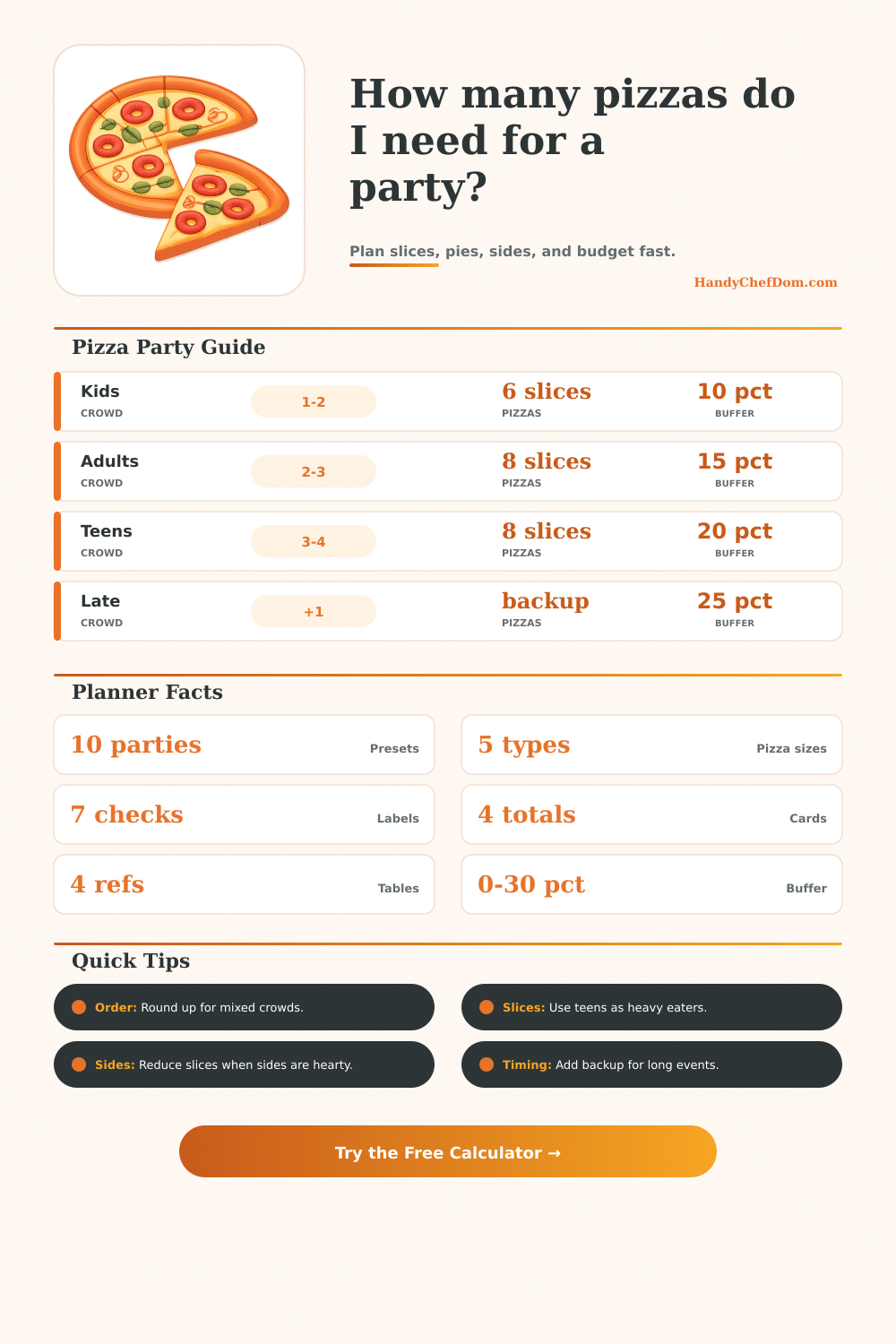
Pizza Party Calculator
Plan pizza for birthdays, game days, office lunches, teen sleepovers, and open-house parties. This calculator turns guest mix, pizza size, sides, appetite, timing, toppings, and buffer into whole pizzas, slices, backup slices, and a practical budget range.
Start with a common pizza-party scenario, then adjust the guest mix. The calculator treats kids, adults, and teens differently because a teen-heavy game night can eat very differently from a kids birthday lunch.
Your pizza party estimate
Best when salad, snacks, or dessert carry part of the meal.
Balanced plan when pizza is the center of the party.
Heavier order for sports nights, sleepovers, and late arrivals.
Pizza subtotal plus delivery, tax, and tip divided by guests.
| Pizza size | Typical cut | Best for | Planning note |
|---|---|---|---|
| Personal 8 inch | 4 slices | Boxed lunches, individual orders, dietary restrictions | Great for exact headcounts but harder to share casually. |
| Medium 12 inch | 8 slices | Small groups, mixed toppings, kids parties | Useful when guests want several topping choices. |
| Large 14 inch | 8 slices | Most pizza parties and delivery orders | The default calculator choice because many shops cut large pies into 8 slices. |
| Extra large 16 inch | 10 slices | Teen crowds, offices, game days | Often better value, but confirm the actual cut before ordering. |
| Party sheet | 24 squares | Fundraisers, schools, large open houses | Square slices make portion control easier for buffet tables. |
| Guest type | Snack pizza | Main meal | Only food | Host note |
|---|---|---|---|---|
| Young kids | 1 slice | 1.5 slices | 2 slices | Cutting slices smaller can reduce waste at birthday parties. |
| Adults | 1.5 slices | 2.8 slices | 3.2 slices | Adults vary widely, so sides and timing matter. |
| Teens or athletes | 2 slices | 3.5 slices | 4 slices | Add a larger buffer when teens arrive after practice or games. |
| Late-night guests | 2 slices | 3 slices | 3.8 slices | People eat more if pizza appears after hours of snacking. |
| Mixed crowd | 1.5 slices | 2.5 to 3 slices | 3 to 3.5 slices | Use weighted guest math instead of one flat average. |
| Party setup | Slice adjustment | Suggested buffer | Why it matters |
|---|---|---|---|
| No sides | Add 8 to 12 percent | 15 to 25 percent | Pizza carries the whole meal and seconds happen quickly. |
| Light sides | No major change | 10 to 15 percent | Chips, fruit, or dessert help but do not replace slices. |
| Hearty sides | Reduce 8 to 15 percent | 8 to 12 percent | Wings, pasta salad, and sandwiches lower pizza demand. |
| Buffet with pizza | Reduce 18 to 25 percent | 5 to 10 percent | Pizza becomes one station instead of the full meal. |
| Long event | Add 6 to 18 percent | 15 to 30 percent | Guests graze, return for late slices, and feed new arrivals. |
| Order size | Cheese | Pepperoni or meat | Veggie or specialty | Dietary note |
|---|---|---|---|---|
| 3 to 5 pizzas | 1 to 2 pies | 1 to 2 pies | 1 pie | Ask about gluten-free or dairy-free needs before ordering. |
| 6 to 9 pizzas | 2 to 3 pies | 3 to 4 pies | 1 to 2 pies | Keep at least one simple cheese pizza untouched for kids. |
| 10 to 15 pizzas | 3 to 4 pies | 5 to 7 pies | 2 to 4 pies | Label boxes clearly so specialty slices do not disappear first. |
| 16 to 25 pizzas | 5 to 7 pies | 8 to 12 pies | 3 to 6 pies | Split delivery into waves if oven space or table space is tight. |
| 26 or more pizzas | 25 to 30 percent | 45 to 55 percent | 20 to 25 percent | Confirm bulk order timing and box labeling with the pizza shop. |
How this pizza party calculator thinks
The calculator does not simply multiply every person by three slices. It builds a weighted crowd first: kids count lower, teens count higher, and adults stay near the baseline. Then pizza role, appetite, event length, side dishes, crust style, party mode, buffer, and leftover goal adjust the slice target before it rounds up to whole pizzas.
That round-up is important. If 63 slices are needed and the pizza size has 8 slices, ordering 7 pizzas gives only 56 slices, so the practical order is 8 pizzas. The budget card then uses the whole-pizza count, your average pizza price, and your delivery, tax, and tip percentage so the estimate reflects the order you will actually place.
When you are planning a pizza order for a group of peoples, you need to determine the number of pizzas that the group will eat. For many peoples, planning a pizza order is difficult because each group dont eat the same amount of food. For example, some people will eat more slice of pizza than others, and some people may show up to an event later in the day than others.
If you do not take these difference into account, you may end up with either too much or too little pizza for the group. The types of people that you are planning the order for will impact the number of pizzas that is needed. For instance, children often eat less pizza than adults, but they often leave behind half eaten slices of pizza.
How Many Pizzas to Order for a Group
Teenagers and athletes typically eat more pizza than adults or children. Adults may eat either more or less pizza, depending on whether there are other foods to eat at the same time as the pizza. It is helpful to use a calculator to account for these different types of people that will be eating the pizza.
By adjusting for the different types of individuals in the group, it is more easier for the organizer to plan for the order. The length of the event will impact the amount of pizza that the group will eat. For instance, an event that lasts for only a few hour may require only one round of pizza ordering, but an event that lasts for several hours may require multiple round of ordering pizza.
If the event lasts for a long period of time, some pizzas can be ordered with delayed delivery to ensure that the pizza remains fresh throughout the event. Additionally, the type of food that will be served alongside the pizza can impact the amount of pizza that the group will eat. For instance, if the event also includes food like pasta salad, the group will eat less pizza.
If the only food at the event is chips and drinks, though, the group will eat more pizza. The size of the pizzas can have an impact on the order that is placed. Large pizzas that are divided into eight slices are often helpful for dividing the costs among the group.
Extra-large pizzas may be more cost effective, but can be difficult to eat if each person in the group want to try different pizzas. Personal-sized pizzas may be helpful for knowing the number of people in the group, or for providing dietary option to each individual in the group. However, the personal-sized pizzas do not allow for the sharing of the pizza with others in the group.
The size of the pizza can be adjusted to account for the way that the individuals in the group will eat. The type of crust for the pizza can impact the amount of pizza that the group will eat. Thin crust pizzas tend to be eaten more quickly than deep dish pizzas.
Additionally, pizzas that include premium meat may be satisfying for the individuals in the group quicker than pizzas that contain only cheese toppings. It is often best to order different types of pizzas, such as plain cheese pizzas and meat pizzas, to accommodate for those who like each type of food. A calculator can help account for each of these factors to ensure that there is enough pizza of each type order.
Budget is one more factor to consider once you have determined the total number of pizza slices that will be needed. The cost of the pizzas includes the delivery fees, taxes, and tips. The cost per person can be calculated by dividing the total cost of the pizza order by the number of people in the group.
Ordering large pizzas with good toppings may end up being less costly per person than ordering a large number of small pizzas later during the event. A planning tool can assist the individual in determining these costs, and make the ordering decision. Common mistake when ordering pizzas include ordering exactly the number of pizzas calculated by a mathematical equation.
The calculation will not always represent the number of pizzas that the group of individuals will eat. For instance, if the calculation represents that the group will need seven and a half pizzas, it is best to round to eight pizzas for the group. Providing extra pizza ensures that there is enough for individuals who arrive late to the event, or those who would like a second portion of pizza.
This small amount of extra pizza will provide enough leftovers for the group without providing too much leftover pizza that sits in the refrigerator. A planning tool is helpful for calculating the number of pizzas that will be eaten by a group. The planning tool can calculate the number of pizzas that the group will eat based off the different characteristic of the individuals who will eat the pizzas.
The individual will still have to make the final decision regarding the number of pizzas to order, but the planning tool will ensure that the individual doesnt have to perform the calculation each time the guests are arriving. To successfully order pizza for a group of individuals, the amount of food should be matched to the number of individuals in the group, accounting for the way in which the individuals will eat, and providing enough extra food to ensure that no individual in the group run out of pizza.