🦃 Stuffed Turkey Convection Oven Time Calculator
Plan roast time, stuffing load, and rest windows for a convection bird without guessing the finish.
The calculator uses a convection-adjusted roast pace, then adds stuffing, chill, altitude, and rest so the schedule stays realistic.
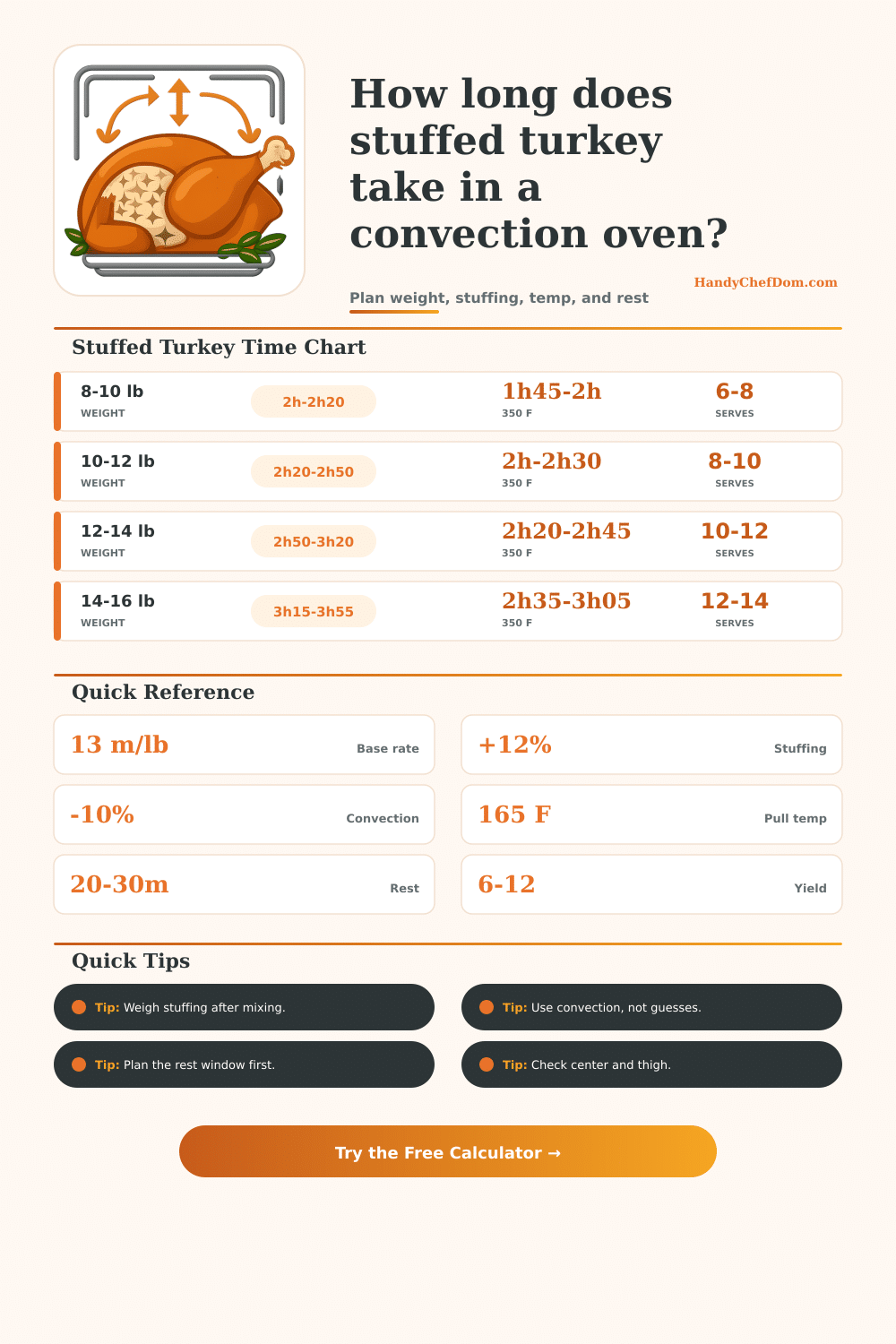
| Weight | 325 F | 350 F | Serves |
|---|---|---|---|
| 8-10 lb | 2h-2h20 | 1h45-2h | 6-8 |
| 10-12 lb | 2h20-2h50 | 2h-2h30 | 8-10 |
| 12-14 lb | 2h50-3h20 | 2h20-2h45 | 10-12 |
| 14-16 lb | 3h15-3h55 | 2h35-3h05 | 12-14 |
| Mode | Factor | Effect | Watch |
|---|---|---|---|
| True conv | 0.89x | Fast air | Check early |
| Conv roast | 0.88x | Fastest | Brown fast |
| Fan assist | 0.92x | Gentle fast | Steady heat |
| Conventional | 1.00x | Baseline | Slowest |
| Load | Fill | Add Time | Fit |
|---|---|---|---|
| Light | 0.75-1.0 | 8-10m/lb | Loose fill |
| Standard | 1.0-1.5 | 10-12m/lb | Classic |
| Generous | 1.5-2.0 | 12-14m/lb | Tighter |
| Packed | 2.0+ | 14-16m/lb | Slow core |
| Bird | Yield | Guests | Rest |
|---|---|---|---|
| 8-10 lb | 5-6 lb | 6-8 | 20 min |
| 10-12 lb | 6-7 lb | 8-10 | 22 min |
| 12-14 lb | 7-8 lb | 10-12 | 25 min |
| 14-16 lb | 8-9 lb | 12-14 | 30 min |
Cooking a turkey in a convection oven can require some careful timing. Convection ovens uses a fan to circulate hot air around the turkey. Because the hot air is circulating around the turkey, convection ovens will cook a turkey about ten percents faster than conventional ovens.
However, the stuffing inside the turkey could play a factor in cooking time. Cooking time will be longer for turkeys that are stuffed because the heat have to travel through the stuffing to reach the center of the turkey. The temperature of the turkey could also play a factor in cooking time.
How to Cook a Turkey in a Convection Oven
If you take the turkey from the refrigerator, it will generaly take longer to cook the turkey because the air will have to heat the turkey to make the turkey cook. Altitude could also play a factor in cooking time because thinner air at higher altitude can change how the heat circulates around the turkey. For example, a twelve pound turkey cooked in a true convection oven at 350 degrees Fahrenheit would take around thirteen minutes per pound to cook.
However, if the turkey is stuffed, it will take longer. For example, if the turkey is lightly stuffed, it may need eighteen to twenty minutes of additional cooking time per pound of stuffing. However, if the stuffing is packed tight into the turkey, it may need to cook for twenty to twenty-two minutes per pound of stuffing.

Given the cooking time of the turkey, it is important to allow time for the turkey to rest after removing it from the oven. Twenty to thirty minutes of resting time after removing the turkey from the oven allow the juices to redistribute within the turkey. If you do not allow the turkey to rest, the juices will escape from the turkey once it is sliced.
Finally, the style of the turkey can play a factor in cooking time. For instance, a deeply stuffed turkey may take eight percent longer to cook than a whole stuffed turkey. Turkey crowns will cook faster than a whole turkey, and turkey breasts will cook even faster than turkey crowns.
Additionally, the weight of the cooked turkey will be less than the raw weight of the turkey. For instance, the yield of turkey will be around sixty percent of the raw weight of the turkey. A whole turkey that weighs fourteen pounds will yield enough turkey meat to feed ten to twelve people who eats a standard portion of turkey.
The mode of the oven will also play a factor in the cooking time of the turkey. True convection modes will cook the turkey the fastest because the true convection mode will move the hot air most evenly around the turkey. Convection roast modes will cook the turkey quickly, but not as quickly as a true convection oven because the convection roast mode will focus the hot air on browning the skin of the turkey.
Conventional modes will take the longest to cook the turkey because conventional ovens do not use a fan to move the air around the turkey. Additionally, cooking time may also be impacted by the starting temperature of the turkey and the oven. If the turkey starts at a cooler temperature than the oven, it may take approximately six percent longer to cook the turkey.
Food safety is also important to consider when cooking a turkey. You should not estimate the weight of the stuffing, but measure it with a scale. Additionally, you should use a meat thermometer to check the cooking temperature of the turkey.
The thermometer should be inserted into the thickest part of the turkey’s thigh and into the center of the stuffing. If the temperature of the turkeys breast measures 160 degrees Fahrenheit, the turkey is safe to eat because the temperature will reach 165 degrees Fahrenheit while the turkey is resting. However, the temperature of the stuffing must also reach 165 degrees Fahrenheit for it to be deemed safe to eat.
Using the correct equipment will aid in the cooking of the turkey. Using a deep roasting pan will catch the juices that will drip from the turkey while resting in the roasting pan. Using a wire rack will allow the hot air to circulate under the turkey so that it fully cooks.
If the skin of the turkey begins to brown too quickly while roasting, cover the skin with foil to prevent it from cooking too quickly. Using these cooking tools will give you more control over the cooking process of the turkey. It is also important to include a buffer time in the cooking process of the turkey.
For instance, a buffer of five to twelve percent of the estimated cooking time will allow for issues that may arise during the cooking of the turkey. For instance, if the turkey is wetter than expected, it may take longer to cook. By including this buffer time, the turkey will be fully cooked.
Finally, calculate how many servings of turkey will be needed for the number of people who will eat the turkey. If the people who will eat the turkey are light eaters, they will eat around 170 grams of turkey meat each. However, if the people who will eat the turkey are hearty eaters, they will eat around 283 grams of turkey meat each.
By calculating the number of servings, you can ensure that there is enough turkey meat for each person who will eat the turkey.