🍮 Gelatin Conversion Calculator
Convert sheets, powder, bloom strengths, package sizes, hydration water, and liquid firmness for panna cotta, mousse, gummies, glazes, and molded desserts.
Use recipe conversion when a recipe already lists gelatin. Use liquid design when you know the liquid volume and want a soft, sliceable, or firm set.
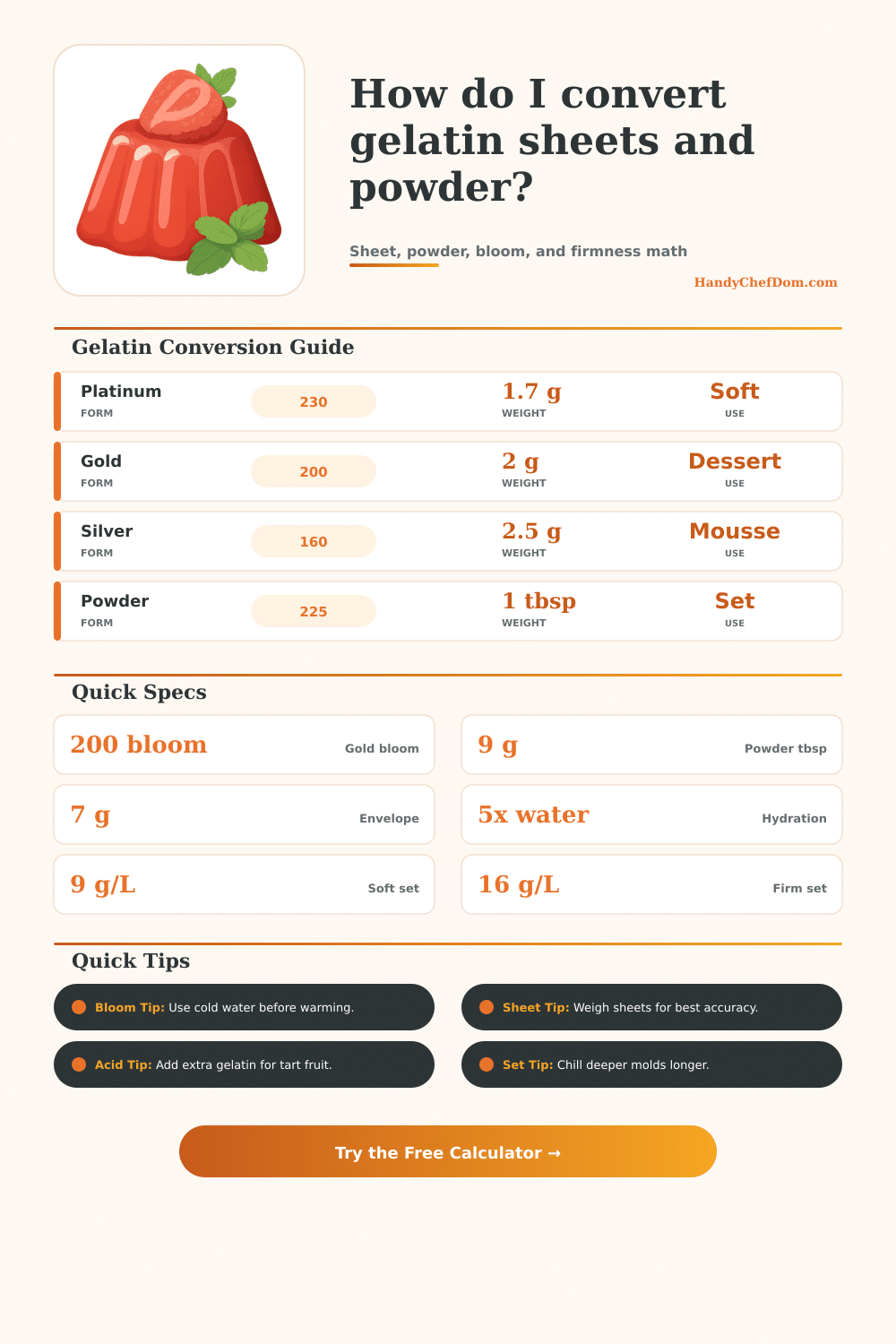
| Gelatin form | Typical bloom | Typical weight | Conversion note |
|---|---|---|---|
| Platinum sheet | 230 bloom | 1.7 g each | High strength, thin sheet |
| Gold sheet | 200 bloom | 2.0 g each | Common pastry standard |
| Silver sheet | 160 bloom | 2.5 g each | Softer but heavier sheet |
| Bronze sheet | 140 bloom | 3.3 g each | Lower bloom, more grams |
| Titanium sheet | 120 bloom | 5.0 g each | Large low bloom sheets |
| Powder gelatin | 200-250 bloom | 7 g envelope | Weigh when possible |
| Liquid firmness | Gelatin per liter | Best for | Texture cue |
|---|---|---|---|
| Soft spoonable | 8-10 g | Panna cotta | Wobbly and tender |
| Classic dessert | 11-13 g | Cups and glasses | Clean spoon set |
| Sliceable layer | 14-16 g | Cakes and bars | Holds a cut edge |
| Molded dessert | 17-20 g | Ring molds | Releases cleanly |
| Firm gummy style | 28-40 g | Chewy slabs | Dense and bouncy |
| Powder measure | Approx grams | Envelope share | Hydration at 5x |
|---|---|---|---|
| 1 teaspoon | 3.0 g | 0.43 envelope | 15 g water |
| 2 teaspoons | 6.0 g | 0.86 envelope | 30 g water |
| 1 tablespoon | 9.0 g | 1.29 envelopes | 45 g water |
| 1 envelope | 7.0 g | 1 envelope | 35 g water |
| 2 envelopes | 14.0 g | 2 envelopes | 70 g water |
| Liquid type | Adjustment | Reason | Example |
|---|---|---|---|
| Plain dairy or water | 1.00x | Neutral set | Milk jelly |
| Acidic fruit | 1.15x | Weaker gel | Lemon cream |
| Alcohol base | 1.20x | Slower set | Cocktail jelly |
| Rich custard | 0.95x | Fat supports texture | Bavarian cream |
| High sugar glaze | 0.90x | Syrup adds body | Mirror glaze |
Gelatin is the structural ingredient used in various types of dessert. Gelatin provide the texture and firmness for the desserts that contain gelatin. Gelatin is available in various forms (sheets or powder) and bloom strength.
Because the sheets and powders contain different amount of gelatin, a conversion tool is necessary to ensure that the dessert contain the appropriate amount of firmness from the gelatin ingredient. Using to much or too little gelatin can result in a soft or too rubbery dessert. Gelatin sheets and powder is manufactured in different ways, which alters the way that each type of gelatin react to liquid.
How to Measure and Convert Gelatin
The manufacturer dries gelatin sheets in thin layer to allow for even release of the gelatin when melting the sheets. In contrast, the manufacturer produces gelatin powder in granules, which require time in cold water to “bloom” before being heated. Due to these different manufacturing process, gelatin sheets cannot be directly substituted for powder amounts without using the conversion tool to calculate how much powder is needed.
The calculator is designed to make this calculation automatically, as the amount of each type of gelatin contain a different density than the other. Bloom strength describe the firmness of the setting of the gelatin. A higher bloom strength will result in the gelatin setting more firm.
To use a higher bloom strength (more firm setting), less of the ingredient are required. However, to use a lower bloom strength, more weight of the ingredient is required. Various factors can interfere with the setting of the gelatin.
Factors like sugar, acid, and alcohol can interfere with the function of the gelatin. To account for these factors, the calculator allows for the user to select the type of liquid use in the recipe, which automatically adjusts the amount of gelatin required to account for these interfering factors. Many recipes use volume measurement (in units like tablespoons or envelopes) to describe the amount of gelatin required.
Volume measurements are not accurate in the amount of gelatin that each brand contain. For accuracy in the amount of gelatin required, weight should be used. The calculator allows for the user to input the number of grams per tablespoon of the gelatin and the size of the envelope of the brand of gelatin being use in the recipe.
Hydration is a step required to dissolve the gelatin (sheets or powder). Powder require 5 times the weight of cold water to bloom, while sheets only require a brief soak in water. In both cases, the same amount of dry gelatin are contributed to the dessert.
In both cases, the water and gelatin weights is calculated in the recipe. The depth of the mold in which the dessert is prepared impact the ability of the gelatin to set. Shallow molds allow for the gelatin to set quickly, while deep molds require more time for the gelatin to set.
Deep molds also contain more mass of the dessert, which require more firmness from the gelatin in order to allow the dessert to be unmolded. Mold depth should be accounted for in the recipe to determine how much gelatin is required to allow the mold to properly set and unmold. In addition to mold depth, the user should also indicate whether the dessert that is to be created is soft or sliceable.
These firmness settings will change the total grams of the ingredient required to achieve the desired texture of the dessert. One of the most common mistake when using gelatin is not treating it as a structural ingredient in the dessert. Gelatin should never be poured directly onto warm liquid.
Additionally, it is also common for cooks to not follow the proper blooming process for the gelatin. Gelatin powder should never be poured directly onto warm liquids. Additionally, the cook should never skip the blooming process for the ingredient.
The presence of citrus juice or alcohol will weaken the gelatin structure, while fat and sugar will allow the gelatin structure to remain intact. To account for these factors, the calculator incorporates modifiers to adjust the total amount of gelatin required in recipes that contain these ingredient. Temperature is another factor in the setting of the gelatin.
Gelatin begin to set at around 15 degrees Celsius, and will reach full stability after being chilled for several hour. However, the deeper the mold, or the more alcohol contained within the dessert, the longer the item will take to reach the setting temperature. To account for these differences in temperature and depth, the calculator will adjust the total amount of gelatin required.