🌾 Fiber in Barley Calculator
Estimate total barley fiber, fiber per serving, cooked yield, and daily fiber contribution for hulled, pearled, quick, pot, rolled, or black barley.
Enter the barley you measured, choose cooked or dry form, and select how the barley will be served. Soup settings keep the fiber tied to the grain amount rather than the broth volume.
| Barley style | Fiber per 100 g cooked | Fiber per cooked cup | Fiber per dry cup |
|---|---|---|---|
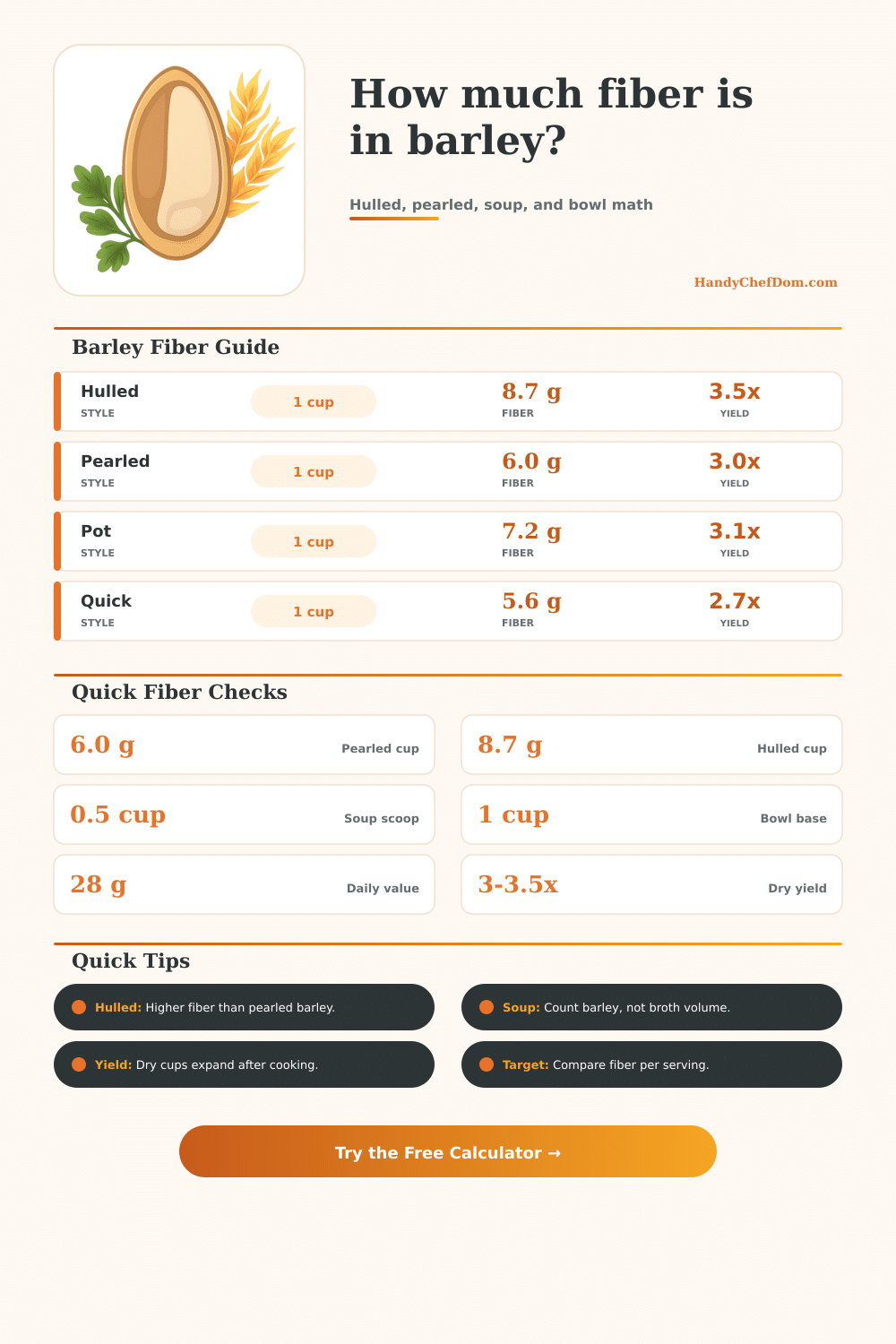
| Hulled barley | 4.7 g | About 8.7 g | About 31.8 g |
| Pearled barley | 3.8 g | About 6.0 g | About 31.2 g |
| Pot barley | 4.1 g | About 7.2 g | About 30.4 g |
| Quick pearled barley | 3.5 g | About 5.6 g | About 28.1 g |
| Black barley | 5.0 g | About 9.0 g | About 33.3 g |
| Rolled barley flakes | 4.0 g prepared | About 6.2 g | About 15.4 g |
| Scotch barley | 3.6 g | About 5.8 g | About 28.5 g |
| Sprouted barley | 4.5 g | About 7.9 g | About 26.5 g |
| Dry barley amount | Dry weight guide | Typical cooked yield | Total fiber range |
|---|---|---|---|
| 1/4 cup dry pearled | About 50 g | 3/4 cup cooked | About 7.5 to 8 g |
| 1/2 cup dry pearled | About 100 g | 1 1/2 cups cooked | About 15 to 16 g |
| 1 cup dry pearled | About 200 g | About 3 cups cooked | About 31 g |
| 1 cup dry hulled | About 184 g | About 3 1/2 cups cooked | About 32 g |
| 500 g dry barley | 500 g | 7 1/2 to 9 1/2 cups | About 74 to 87 g |
| Serving use | Barley per serving | Typical fiber | Planning note |
|---|---|---|---|
| Brothy soup ladle | 1/3 to 1/2 cup cooked barley | About 2 to 4 g | Measure grain, not broth |
| Side dish scoop | 1/2 cup cooked barley | About 3 to 4.5 g | Classic plate portion |
| Cold barley salad | 2/3 cup cooked barley | About 4 to 6 g | Drain before measuring |
| Grain bowl base | 1 cup cooked barley | About 6 to 9 g | Strong fiber foundation |
| Breakfast barley bowl | 3/4 cup cooked barley | About 4.5 to 6.5 g | Often rolled or tender style |
| Meal prep container | 3/4 to 1 cup cooked barley | About 4.5 to 9 g | Split the cooked pot evenly |
| Daily comparison | Target fiber | 1 cup pearled barley | 1 cup hulled barley |
|---|---|---|---|
| FDA daily value | 28 g | About 21% | About 31% |
| Common women target | 25 g | About 24% | About 35% |
| Lower men target | 31 g | About 19% | About 28% |
| Higher men target | 38 g | About 16% | About 23% |
| 10 g meal fiber aim | 10 g | About three fifths | Almost one serving goal |
Barley come in several different forms. Each of these different forms of barley contains a different amount of fiber then the other forms of barley. For example, whole grains that contains the bran layer will have more fiber than those forms of barley that have had the bran layer (and the fiber within that layer) removed.
Thus, barley that contains the bran layer will have more fiber than barley that has had that layer removed (also known as pearled barley). Similarly, barley that has been lightly polished (also known as pot barley), barley that has been processed for quick cooking (quick-cooking barley), barley that has been flattened into flakes (barley flakes), and black barley all contains different amounts of fiber than the other forms of barley. Because each of these forms of barley contain different amount of fiber, it is impossible to use the same rule to measure each type of barley.
How Barley Type and Cooking Affect Fiber
Barley contains a different amount of fiber when it is dry versus when it is cooked. Dry barley is more denser than cooked barley, and contains more fiber per cup of dry barley than cooked barley contains per cup. This is due to the fact that cooked barley contains water, and thus weighs more than dry barley.
Therefore, the cook should measure dry weight of the barley for the most accurate in determining the fiber content, though the volume of the cooked barley can also be measured (if the barley is cooked prior to measuring the volume). The tool allows for the type of barley and the state of the barley to be enter to calculate the amount of fiber that barley will contain. The way that barley is used in a meal can change the amount of fiber that is consumed from that meal.
For instance, if barley is used in a soup, the total volume of the soup may be large, but the amount of barley in that soup may be small. The fiber that is consumed from this soup will come from the barley in the soup, not the liquid portion of the soup. Thus, the cook should measure the amount of barley in the soup rather than the total volume of the soup.
Similarly, if barley is used in a grain bowl, the amount of cooked barley that is consumed will be larger than the amount of barley that is consumed in a portion of soup. Thus, the amount of fiber from a grain bowl will be higher than the amount of fiber from a portion of barley soup. Each individual have different targets for the amount of fiber that should be consumed each day.
However, it is important for each individual to understand the fiber that is contained in barley. Small portions of barley contain small amounts of fiber, but large portions of barley contain large amounts of fiber. For instance, if an individual switches from pearled barley to hulled barley, the fiber content of the same portion of barley will increase.
The estimate-style options can be used for those who would like to account for differences in the fiber content of barley products and who would like to use the higher-bran setting to account for barley that contains many of its outer layer intact. Many individual make mistakes with barley. For instance, an individual may believe that a cup of pearled barley contains the same amount of fiber as a cup of hulled barley, but this isnt true due to the difference in fiber content within each of these types of barley.
Another example of the mistake that many individuals make is in the fact that individuals may measure the total volume of a soup instead of the amount of barley contained within the soup. To avoid these mistakes, you can measure the cooked yield of the barley, as well as the fiber content per serving of the product that will contain the barley. By choosing the correct style of barley and correctly measuring the amount of barley products, individuals will be able to accurately track there fiber consumption throughout the day.