🥫 Food Shelf Life Calculator
Estimate a practical use-by date from food type, storage location, package status, prep date, appliance temperature, packaging, and safety buffer.
This estimator follows common USDA-style storage ranges. It is a planning guide, not a substitute for discard rules when food smells off, looks spoiled, was left out too long, or was kept above safe temperatures.
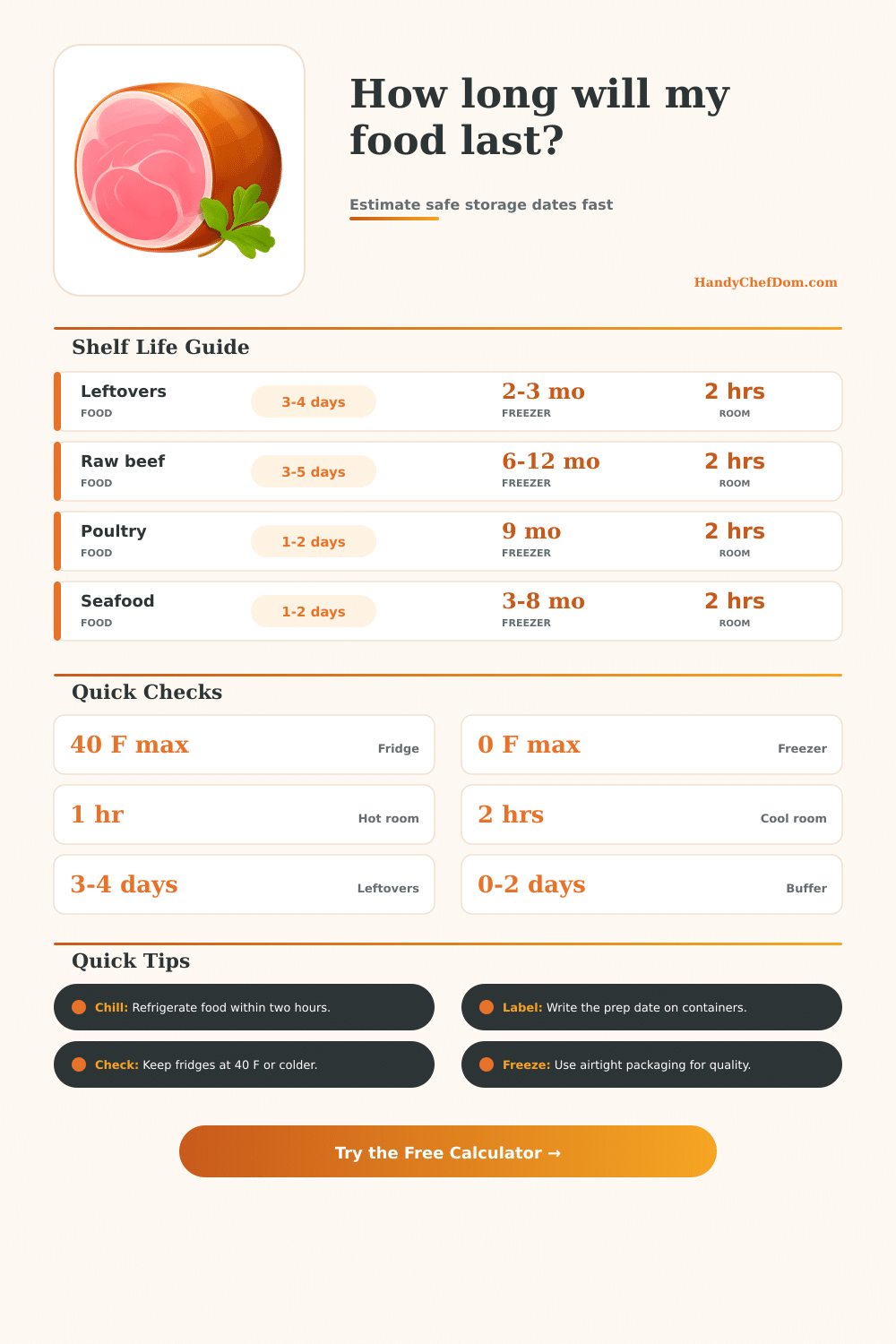
| Food | Refrigerator | Freezer | Storage note |
|---|---|---|---|
| Cooked leftovers | 3 to 4 days | 2 to 3 months | Chill in shallow containers within 2 hours. |
| Cooked poultry | 3 to 4 days | 2 to 6 months | Slice large pieces before chilling for faster cooling. |
| Cooked meat dishes | 3 to 4 days | 2 to 3 months | Reheat only what you plan to serve. |
| Soup or stew | 3 to 4 days | 2 to 3 months | Cool quickly before covering tightly. |
| Cooked rice or pasta | 3 to 4 days | 1 to 2 months | Spread out warm batches so they cool promptly. |
| Cut produce | 3 to 5 days | 8 to 12 months | Keep in clean containers and discard if slimy. |
| Raw animal food | Refrigerator | Freezer | Storage note |
|---|---|---|---|
| Raw poultry pieces | 1 to 2 days | 9 months | Store on a lower shelf to avoid drips. |
| Whole poultry | 1 to 2 days | 1 year | Freeze promptly if not cooking soon. |
| Steaks, chops, roasts | 3 to 5 days | 4 to 12 months | Wrap tightly for freezer storage. |
| Ground meat | 1 to 2 days | 3 to 4 months | Use quickly because grinding increases surface area. |
| Fresh fish | 1 to 2 days | 3 to 8 months | Keep very cold and tightly wrapped. |
| Shellfish | 1 to 2 days | 3 to 6 months | Follow package tags and discard questionable items. |
| Dairy or ready-to-eat | Unopened | Opened | Storage note |
|---|---|---|---|
| Milk | 5 to 7 days | 3 to 5 days | Keep on an interior shelf, not the door. |
| Hard cheese | 3 to 4 weeks | 2 to 3 weeks | Wrap well and trim small dry edges if needed. |
| Soft cheese | 1 week | 3 to 7 days | Discard if mold appears on soft cheese. |
| Deli meat package | 2 weeks | 3 to 5 days | Use the opened date for the shortest window. |
| Shell eggs | 3 to 5 weeks | Not typical | Keep eggs refrigerated in the carton. |
| Opened yogurt | 1 to 2 weeks | 5 to 7 days | Use clean spoons to reduce contamination. |
| Shelf-stable food | Pantry | After opening | Storage note |
|---|---|---|---|
| Dry pasta | 1 to 2 years | 1 year | Keep dry, cool, and sealed. |
| White rice | 2 years | 1 year | Protect from moisture and pests. |
| Canned vegetables | 2 to 5 years | 3 to 4 days | Refrigerate leftovers in another container. |
| Flour | 6 to 12 months | 6 to 8 months | Freeze if keeping longer. |
| Peanut butter | 6 to 9 months | 2 to 3 months | Natural types may need refrigeration. |
| Crackers | 6 to 9 months | 1 to 2 months | Seal tightly for texture. |
Food safety is often difficult for individuals to determine due to the fact that the moment in which food becomes unsafe to eat isnt visually apparent. Many individual use mental rules to determine the safety of the food in there kitchens, but these rules are not always accurate, especially if the food contains leftovers that were mixed with raw meat, or if the food was stored at a different temperature than when it was prepared. A food calculator can help individuals to determine safe eating dates for their food by calculating according to the situation of the individuals food.
The food calculator require that individuals enter specific information regarding the food that they wish to evaluate. For instance, the food calculator will ask for information about the type of food that will be evaluated, where that food will be stored, and for how long the food was sitting at room temperature prior to being refrigerated. These factor are crucial for determining the lifespan of the food to the point of declining quality of the food, and the lifespan of the food to the point of declining safety of the food.
Know When Food Is Safe with a Food Calculator
Food items like steak have different lifespans based off whether the steak is stored in a sealed tray or whether the steak is loosely wrap. The temperature at which the food will be stored is a major factor in the safety and lifespan of the food. For instance, if the refrigerator that will store the food is running at 45 degrees instead of the typical 38 degrees, the food will no longer be able to sit in that refrigerator for as long as if the refrigerator were to reach the safe 38 degrees.
Additionally, whether the food is vacuum-sealed versus loosely wrapped can also impact how quickly the food begins to spoil. The amount of time that food is allowed to sit out at room temperature prior to being refrigerated also has an impact on the food safety. For instance, allowing food to sit out at room temperature for longer than 2 hours is often considered to be an instance in which food could begin to pose a health risk to those who consume it.
Furthermore, the food calculator also allows individuals to enter the amount of minutes that the food was sitting at room temperature prior to being refrigerated. Within the food calculator is reference table that display the amount of time that various types of food can remain safe to eat once stored at different temperatures. These reference tables allow individuals to compare the life of their specific food to that of common foods and there safe eating periods.
Furthermore, these reference tables also allow individuals to more easily make decisions regarding whether the food should be eaten or frozen. In order to manage food in the kitchen, individuals within the kitchen must employ certain habits. Certain habits may include, for instance, the habit of placing labels on containers of food that indicate the date upon which the food was prepared.
By labeling food containers with dates, individuals will no longer have to rely upon their memories to determine how long the food has been stored in the refrigerator. Other habits may include keeping the refrigerator in the kitchen organized. The type of packaging in which the food is stored may impact both the safety and the texture of the food.
For instance, airtight containers prevent the food from contacting with oxygen, which can cause the food to spoil. Additionally, vacuum-sealed packages may help to reduce the instances of freezer burn if the food is stored within the freezer. However, if the same vacuum-sealed packages are used to store food like cheese that remains in the refrigerator, the vacuum-sealed packaging can actualy lead to excess moisture buildup within the product.
These types of packages and their benefits can be entered into the food calculator. Many individuals may believe that the dates that are printed on the packages of food are an indication of the length of time that the food will remain safe to eat. However, these dates are typically only an indication of the quality of the food.
Once the package of food is opened, the food will have a different time limit upon which to consume the food according to the way in which the food is stored after it is opened. When food is stored within the freezer, the quality of the food may decline. While food stored within the freezer will remain safe to eat for extended periods of time, the quality of the food can decline over time.
For instance, food stored in the freezer for 3 months may have different quality than food stored in the freezer for 9 months, though the food in both cases would be safe to eat. Therefore, individuals should of adjusted the expectations of the food that is stored in the freezer for long periods of time. It is also possible for food to become unsafe to eat even if the food is stored within the refrigerator.
For instance, if the refrigerator door was left open for long periods of time while the food was in the refrigerator, or if the food in the refrigerator was exposed to heat from the refrigerator door being opened, the food could become unsafe to eat. Even with these potential threats, however, individuals should always taste the food and smell the food to ensure that it is still safe to eat. The way in which the food was handled prior to reaching the kitchen also has an impact upon the safety of the food.
For instance, if the food sat in a warm car for an hour before being refrigerated, that food has already lost some of its time limit for safety. This amount of time can be entered into the food calculator to make food decisions that factor in the safety of food that was transported in a warm car. The food calculator can provide value to individuals who use it in different scenarios within the kitchen, and who use the food calculator a variety of different times within the same kitchen.
For instance, if individuals use the food calculator a variety of times, they may begin to recognize patterns in the food regarding the impact of certain variables (like temperature or packaging) upon the food. Thus, the food calculator can become a system for individuals to manage food efficiently and reduce food wastes.