🍰 Cake Recipe Calculator
Scale cake recipes by pan area, layers, batter depth, ingredient multiplier, serving style, frosting coverage, and estimated bake time.
Enter the original recipe pan setup and the target cake setup. The calculator scales batter by usable pan area and batter depth, then estimates servings, frosting, and a practical bake window.
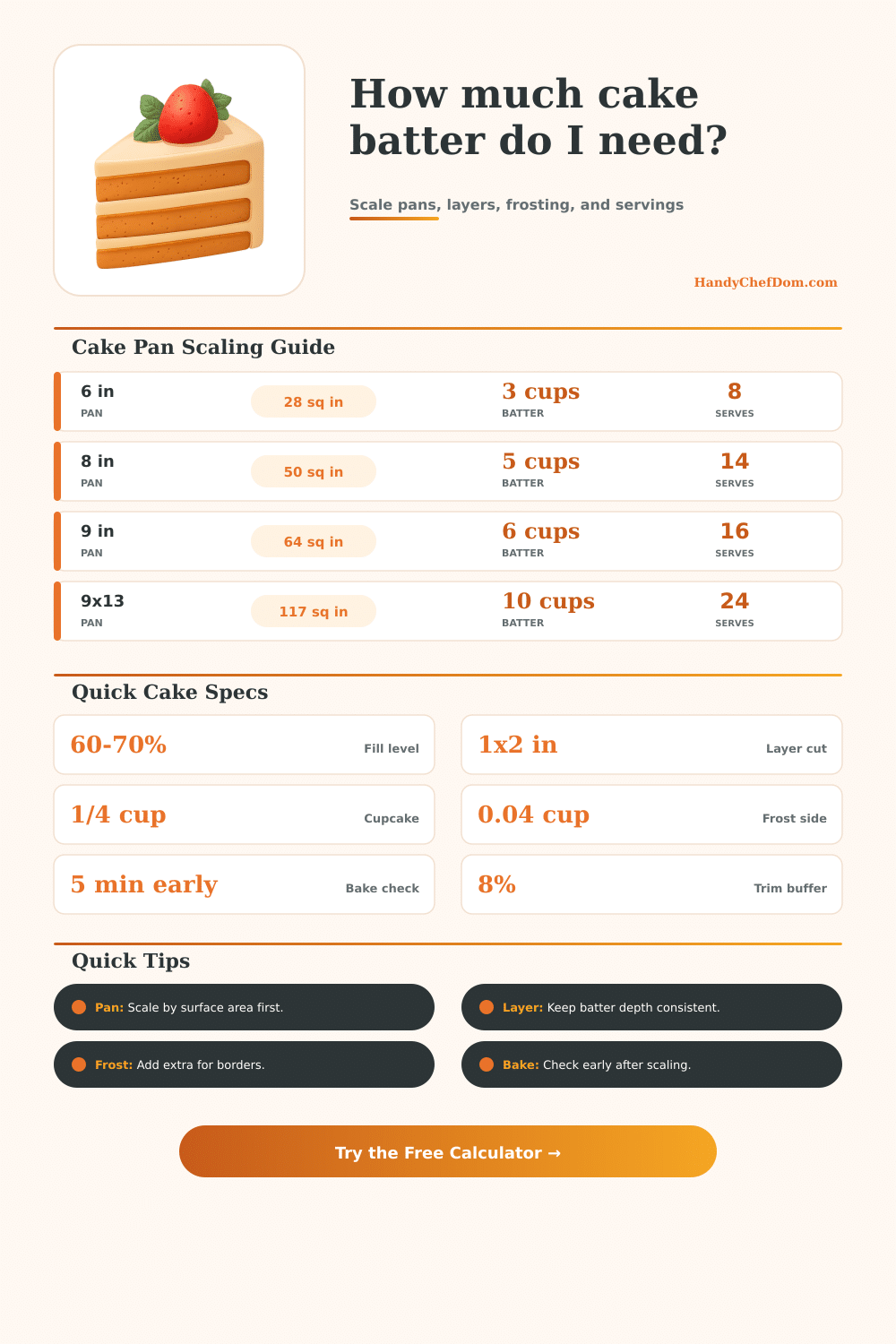
| Common Pan | Area | Typical Batter | Party Servings |
|---|---|---|---|
| 6 in round layer | 28 sq in | 3 cups | 8 to 10 |
| 8 in round layer | 50 sq in | 4 to 5 cups | 12 to 14 |
| 9 in round layer | 64 sq in | 5 to 6 cups | 14 to 16 |
| 8 in square | 64 sq in | 5 to 6 cups | 16 |
| 9 x 13 rectangle | 117 sq in | 8 to 10 cups | 24 to 28 |
| 12 x 18 half sheet | 216 sq in | 14 to 18 cups | 48 to 54 |
| Pan Swap | Multiplier | Depth Note | Bake Effect |
|---|---|---|---|
| 8 in round to 9 in round | 1.27x | Same depth | Similar time |
| 9 in round to 6 in round | 0.44x each | Use more layers | May bake longer |
| Two 8 in rounds to 9 x 13 | 1.16x | Slightly shallow | Check earlier |
| 9 x 13 to two 9 in rounds | 1.09x | Layered cake | Similar time |
| 8 in square to 10 in bundt | 1.40x | Tube center | Longer bake |
| 8 in round to 12 cupcakes | 0.72x | Shallow wells | Much shorter |
| Cake Style | Good Depth | Base Bake Rate | Scaling Caution |
|---|---|---|---|
| Butter layer cake | 1.0 to 1.5 in | 17 min per in | Level domes after cooling |
| Sponge or chiffon | 1.0 to 1.4 in | 14 min per in | Avoid overfilling |
| Pound cake | 1.5 to 2.3 in | 26 min per in | Deep pans need patience |
| Dense chocolate | 1.2 to 1.8 in | 22 min per in | Check center carefully |
| Carrot or fruit cake | 1.2 to 1.8 in | 24 min per in | Moist batter sets slower |
| Cheesecake | 1.5 to 2.5 in | 30 min per in | Servings are richer |
| Frosting Style | Base Use | Best For | Calculator Factor |
|---|---|---|---|
| Naked or skim coat | Light cover | Rustic layers | 0.55x |
| Thin filled and coated | Modest cover | Simple cakes | 0.80x |
| Standard layer cake | Full cover | Most birthdays | 1.00x |
| Thick swirls and borders | Heavy cover | Decorated cakes | 1.35x |
| Buttercream under fondant | Smooth base | Fondant finish | 0.90x |
| Cupcake swirl | Top only | Cupcake trays | 0.12 cup each |
This calculator uses pan geometry and common bakery portions. Real batters rise differently, so use the results as a scaling plan and confirm doneness with your normal cake cues.
When making a cake for many people, it is possible that the standard recipe will produce too little cake for the number of people who will be eating. A standard recipe may only produce enough cake to fill two 8-inch cake pans, but may be needed to feed thirty people at a party. In order to accommodate for the needs of many people, it is first necesary to change the volume of the batter that will be used in the recipe.
The cake volume calculator can be used to change the size of the cake, or even the shape of the cake, while maintaining the same taste and textures of the baked good. The first step in scaling a cake recipe is to determine the area of the pan that will be used to cook the cake. Pan sizes like 9-inch circles will hold more batter than 8-inch circles due to the larger surface area of the pan of the 9-inch circle.
How to Scale a Cake Recipe
The calculator will calculate the area of these pans for the users, and will ask for the dimensions of the pan that will be used to cook the cake and the dimensions of the pan in which the cake should be cooked. The user will also be required to enter the number of layer of cake that the recipe will create, as this will alter the total amount of baking batter that is required. Finally, the depth of the pan is a separate measurement from the area of the pan, and also will change the amount of time that the cake will require to bake and the texture of the baked cake.
It is recommended that cake pans be filled with batter between 60 and 70 percent of the way full. Filling the pan to this range of percentages will allow the cake to rise during the baking process without overflowing the pan with batter. The cake batter volume calculator will also ask for the fill level of the pan, so that the user can ensure the batter will fill the pan to an acceptable level.
If the calculated percentage of batter that will fill the pan is too high, then either the user can reduce the amount of batter, or the user can increase the size of the pan. Conversely, if the amount of batter that will be used to fill the pan is too low, then the cake may bake too quickly within the pan, and the cake may not rise to the desired height. Because frosting is a separate ingredient from cake batter, a different calculation is used to determine how much frosting will be needed.
The amount of frosting required will take into account the number of areas of the cake that will be frosted, such as the top and sides of the cake. For instance, a naked cake will require less frosting than a cake that will be frosted in thick frosting. The type of cake that will be made can also impact the amount of frosting needed, as wedding slices are smaller than party slices, but require the same amount of frosting.
The amount of batter and frosting must be calculated separately from one another. Bake times will change based off the size of the pan in which the cake will be cooked, as well as the depth of the pan. A cake that is baked in a shallow pan will cook in a different amount of time than one baked in a deep pan.
The cake volume calculator will ask for the type of cake that will be prepared, as well as the temperature of the oven in which the cake will be cooked. The bake time that is calculated will be used to cook the cake, but it is also important to check the cake for doneness. You should of checked the cake five minutes before the bake time that the calculator calculates.
Pans of different shapes will require different amounts of cake batter to fill the pan. For instance, it is possible to cook cakes in two 8-inch round pans instead of one 9-by-13 inch pan. Additionally, 8-inch round cake pans can be converted into cupcakes by adding batter into cupcake pans.
The cake batter volume calculator will calculate these types of conversions for the users. Beyond the variables that are accounted for in the cake batter volume calculator, there are some additional variables in baking that the calculator cannot account for. For instance, flour absorbs liquid at different rates, and the altitude at which the cake is baked will impact the rising of the cake.
The oven may not reach the temperatures that the thermostat on the oven range indicates, and pans of different colors will absorb heat at different rates. While the cake batter volume calculator provides a starting point for baking a cake, the baker may need to adjust the baking process based upon the cakes within the oven. In order to scale the recipe to the sized pan, each ingredient must be multiplied by the same number that the calculator determines as the number that will produce the proper amount of batter.
Ingredients like flour, sugar, fat, and eggs will all need to be multiplied by the same number in order to maintain the ratios of the ingredients. Maintaining these ratios will ensure that the texture of the cake remains the same. The chemical leavening agents, like baking powder, may need to be adjusted slightly for very large cakes, as too much baking powder can create an aftertaste to the cake.
In order to avoid this issue, most cooks will multiply each ingredient in the recipe by the same factor that the calculator produced for the batter, and allow for a small margin of error in the recipe. The thickness of the layers of cake will affect both the texture of the cake and the way in which it is served. Thin layers of cake tend to produce a tender texture when baked, but thick layers of cake will retain more moisture and are better suited to cakes that is frosted in heavy frosting.
The depth of the pans should be maintained at the depth of the recipe that is to be created. The cake batter volume calculator will display the depth of the pans to the user, so that the user can determine if they wish to make a cake with taller layers. The style of cake can impact the depth of the pan in which it is baked.
For instance, dense cakes may be baked in deep pans in comparison to cakes that are lighter in texture. The cake batter volume calculator will ask for the type of cake that will be prepared, as the bake time will change based upon the type of cake. For instance, cakes that contain carrots will require more baking time in the oven than cakes that are plain butter cakes.
The number of layers of cake may impact the baking process. For instance, most home ovens may be able to bake two or three layers of cake at a time. The cake batter volume calculator will ask for the number of layers of cake that will be prepared; the total amount of layers will be displayed in the totals for batter and frosting.
The number of layers will allow the baker to easily determine how many cakes may need to be baked in order to have enough cake for all of those who will enjoy the dessert. Beyond baking cakes, the cake batter volume calculator can be used for various other occasions. For instance, each cake recipe can be used for baking sheet cakes, tiered wedding cakes, and cupcakes.
By removing the need to perform the mathematics necessary to scale cakes, the calculator allows for bakers to focus upon other variables for the cake, such as the type of pan for the cake, and the type of frosting.