🍚 Water for Quinoa Calculator
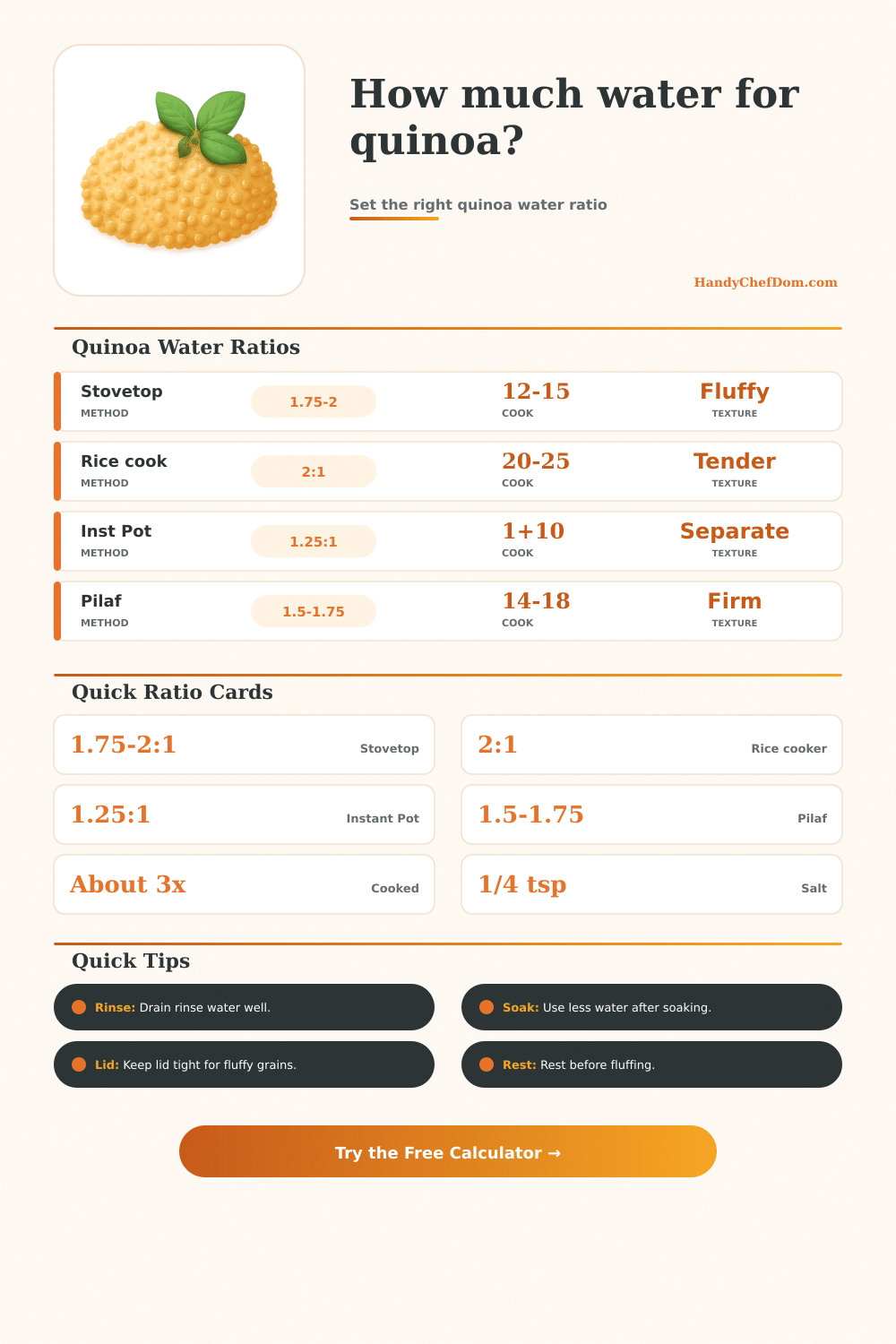
Calculate quinoa water by dry amount, cooking method, texture target, rinse water, lid evaporation, altitude, soaking time, and salt level.
Enter dry quinoa by cups or grams, then refine the added water for your cooker, grain color, target texture, surface moisture, steam loss, altitude, soaking, and salt.
| Method | Base Water | Cook | Rest | Best Texture |
|---|---|---|---|---|
| Stovetop pot | 1.85 cups per cup | 15 min | 5 min | Fluffy |
| Rice cooker | 2.00 cups per cup | 22 min | 10 min | Tender |
| Instant Pot | 1.25 cups per cup | 1 min pressure | 10 min release | Separate |
| Pilaf simmer | 1.65 cups per cup | 16 min | 5 min | Firm |
| Quinoa Type | g Per Cup | Yield Factor | Ratio Change | Time Change |
|---|---|---|---|---|
| White | 170 g | 3.00x | -0.02 | 0 min |
| Red | 175 g | 2.85x | +0.05 | +3 min |
| Black | 175 g | 2.80x | +0.08 | +4 min |
| Tricolor | 172 g | 2.90x | +0.04 | +2 min |
| Sprouted | 160 g | 2.75x | -0.10 | -2 min |
| Pre-rinsed | 168 g | 3.00x | 0.00 | 0 min |
| Royal | 178 g | 3.10x | 0.00 | +1 min |
| Pearl | 165 g | 2.90x | +0.02 | +1 min |
| Texture Or Drain | Water Change | Yield Change | Use When |
|---|---|---|---|
| Separate firm | -0.15 per cup | -0.05x | Salads |
| Fluffy | 0.00 per cup | 0.00x | Everyday bowls |
| Tender | +0.15 per cup | +0.05x | Warm bowls |
| Soft | +0.30 per cup | +0.12x | Breakfast quinoa |
| Rinsed drained | -0.03 per cup | No change | Normal rinse |
| Visibly wet | -0.08 per cup | No change | Quick drain |
| Condition | Water Effect | Time Effect | Calculator Logic |
|---|---|---|---|
| Tight lid | -0.05 per cup | No change | Less steam lost |
| Vented lid | +0.10 per cup | No change | More steam lost |
| Wide pan | +0.18 per cup | No change | More surface area |
| Over 3,000 ft | +1.5% per 1,000 ft | +1 min per 1,000 ft | Lower boiling point |
| 30 min soak | About -0.08 per cup | About -2 min | Hydrated grain |
| 120 min soak | Up to -0.22 per cup | Up to -5 min | Pre-softened grain |
In order to ensure that the quinoa has the proper amount of waters to allow the quinoa to have a fluffy texture, the amount of water that you use to cook the quinoa will determine whether the quinoa will end up as dry or gluey. Many cook attempt to use the same ratio of water to quinoa for every pot of quinoa that they prepares. However, the ratio of water to quinoa can change due to various factor that can impact how the quinoa absorbs water from the cooking pot.
These factors include the type of quinoa that is used, the type of cooking vessel in which the cook cooks the quinoa, and the altitude at which the quinoa is cooked. The texture of the quinoa that you would like will impact the amount of water that you have to adding to the pot of quinoa. For instance, if you would like to make a quinoa salad that you will serve cold, you will have to use less water when cooking the quinoa.
How Much Water to Use for Quinoa
However, if you would like to make a warm quinoa bowl with sauce, you will have to cook the quinoa in such a way that the quinoa become softer, which will require a different amount of water to be added to the pot. The lid that you use will also impact the amount of water that is required to cook the quinoa. If you use a lid that allows the steam that is created while the quinoa is boiling to escape from the pot, then the moisture level within the pot will decrease.
In this case, more water would have of to be added to the pot to compensate for the amount of moisture that has evaporated as steam. Another factor to consider is the step of rinsing the quinoa prior to cooking. As many cooks as to rinse the quinoa to remove the bitter taste from the quinoa.
During this step, the quinoa will naturaly acquire extra moisture on its surface. Due to this extra moisture, slightly less water will have to be added to the pot to avoid the quinoa becoming too wetly. Another factor that will impact the amount of water that should be used in the cooking process is the soaking of the quinoa prior to cooking.
If you have soaked the quinoa in water prior to cooking, then the amount of water that is added while cooking will have to be reduced so that the quinoa will not become soggy. The altitude at which the quinoa is being cooked will also impact the amount of water that is required. At high altitudes, the water will boil at a lower temperature then at low altitudes.
The lower the boiling temperature of the water, the more quick the water will evaporate from the pot. To compensate for the evaporation of the water, more water will have to be added to the pot of quinoa. Additionally, the amount of salt that is added to the water will also impact the cooking of the quinoa.
The salt will help the quinoa to absorb flavor, but if you add too much salt to the water, the texture of the quinoa may change. Depending on the flavor of quinoa that you would like, you can adjust the amount of salt that is added to the pot of water based off the amount of dry quinoa that is to be cooked. After the quinoa has been cooked, it will have to sit covered for a period of time.
During this period, the quinoa will continue to absorb moisture from the steam that is released from the pot of boiling water. When you first remove the quinoa from the heat, it may appear as if it contain some of the liquid that was used during the cooking process. During this resting period for the cooked quinoa, the lid will have to remain on the pot of quinoa so that the steam will continue to cook the quinoa without the addition of more water.
If you dont allow the cooked quinoa to sit covered for the recommended period of time, the texture of the quinoa may not be correct. Following these step for the cooking and resting of the quinoa will ensure that the quinoa is prepared in the correct manner every time that it is prepared.