🥩 Slow Roast Beef Cooking Time Calculator
Estimate a slow roast beef schedule from cut, weight, low oven temperature, target internal temperature, sear plan, rest time, thickness, guests, and carryover heat.
Enter the roast shape and target. The calculator estimates oven time, pull temperature, sear minutes, rest time, serving coverage, and the full ready window.
Best for rosy slices, reverse sear, and a medium rest that lets carryover settle evenly.
Lean and narrow, so thickness and carryover matter more than pounds alone.
Plan thinner slices, a moderate target, and enough rest to keep the center even.
Dense cuts need higher target temperatures when the goal is tender carving texture.
| Cut type | Suggested low oven | Approx min/lb | Carryover range | Best target style |
|---|---|---|---|---|
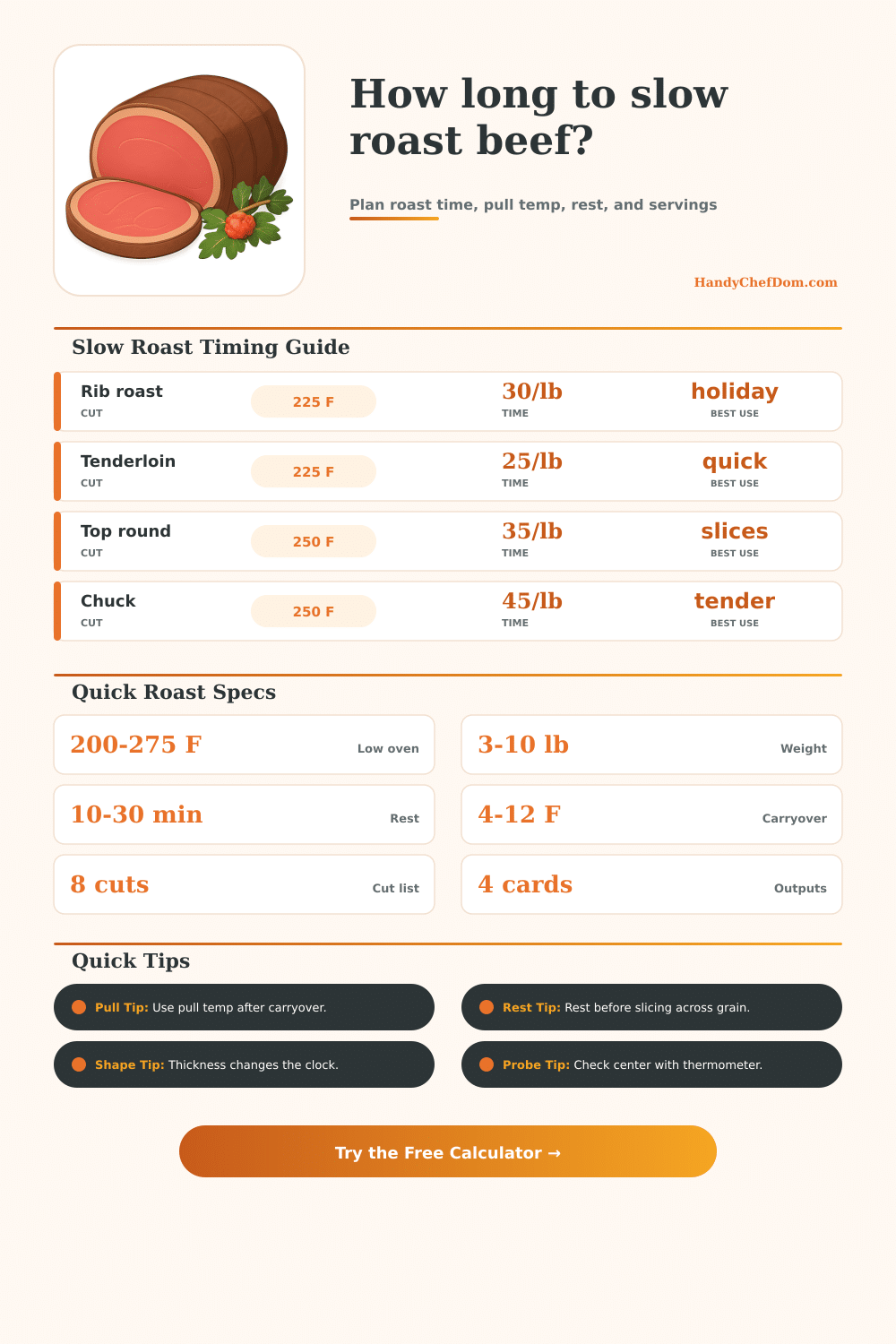
| Prime rib or rib roast | 225°F to 250°F | 28 to 34 | 7°F to 12°F | Medium rare to medium slices |
| Beef tenderloin | 200°F to 225°F | 22 to 28 | 5°F to 10°F | Even rosy center |
| Strip loin roast | 225°F to 250°F | 26 to 32 | 6°F to 10°F | Steakhouse-style slices |
| Top sirloin roast | 225°F to 250°F | 30 to 38 | 5°F to 9°F | Carving roast |
| Tri-tip roast | 225°F to 250°F | 24 to 32 | 5°F to 8°F | Fast slow-roast dinner |
| Rump or top round | 225°F to 250°F | 34 to 42 | 4°F to 8°F | Thin sliced roast beef |
| Chuck roast | 250°F to 275°F | 42 to 58 | 4°F to 7°F | Tender, higher-temp finish |
| Brisket flat | 250°F to 275°F | 50 to 70 | 3°F to 6°F | Sliceable tender finish |
| Target internal temp | Common doneness note | Carryover to enter | Pull temp example | Rest suggestion |
|---|---|---|---|---|
| 125°F | Rare-style center | 6°F to 10°F | 115°F to 119°F | 10 to 20 minutes |
| 130°F to 135°F | Medium-rare style | 7°F to 12°F | 121°F to 128°F | 15 to 25 minutes |
| 140°F to 145°F | Medium style | 5°F to 10°F | 132°F to 140°F | 15 to 30 minutes |
| 150°F to 160°F | Medium-well style | 4°F to 8°F | 144°F to 156°F | 15 to 30 minutes |
| 185°F to 203°F | Tender braise-like finish | 2°F to 6°F | 181°F to 199°F | 20 to 45 minutes |
| Roast weight | Raw serving at 8 oz | Cooked yield at 22% | Typical guest fit | Planning note |
|---|---|---|---|---|
| 2.5 lb | 5 portions | 1.95 lb cooked | 3 to 5 guests | Good for tenderloin, tri-tip, or small sirloin. |
| 4 lb | 8 portions | 3.12 lb cooked | 6 to 8 guests | Common family roast size with leftovers possible. |
| 6 lb | 12 portions | 4.68 lb cooked | 9 to 12 guests | Holiday rib roast or strip roast range. |
| 8 lb | 16 portions | 6.24 lb cooked | 12 to 16 guests | Needs more rest and a deeper thermometer check. |
| 10 lb | 20 portions | 7.80 lb cooked | 16 to 20 guests | Plan a wide ready window for uneven shape. |
| Sear option | Added time | Oven effect | Best match | Calculator behavior |
|---|---|---|---|---|
| No sear | 0 minutes | Full roast time | Delicate crust or covered finish | No sear minutes added |
| Sear before roasting | 8 minutes | Slightly shorter roast | Small roasts and tri-tip | Subtracts a small oven-time credit |
| Reverse sear after roasting | 10 minutes | No early heat boost | Rib, strip, tenderloin | Adds final browning minutes |
| Sear before and after | 14 minutes | Small early heat boost | Very thick roasts | Adds sear time and a small credit |
A slow roast beef dinner require the use of patience from the cook due to the long time in which the roast beef must cooked. There are many factor that relate to the timing of a slow roast beef dinner, including weight of the roast beef, the shape of the roast beef, the temperature of the oven in which the roast beef will cook, and the carryover heat that the roast beef will experience after it is remove from the oven. Each of these factors must be considered in order to guarantee that the roast beef will both slice and eat as the cook has intend.
One of the factors to consider after the cook has removed the slow roast beef from the oven is the carryover heat that the roast beef will experience. Carryover heat is the continued cooking of the roast beef after it have been removed from the oven, which is caused by the roast beefs relatively highly internal temperature. As a result, the internal temperature of the roast beef will continue to rise after removal from the oven.
Slow Roast Beef: Time, Shape, Oven Heat and Rest
The calculator that is provided for roast beef recipe accounts for this carryover heat in that it subtracts the expected carryover heat from the target internal temperature of the roast beef. This allows cook to find the pull point (the point at which the cook will remove the roast beef from the oven) to account for the rest period that they intend to use with the roast beef. Another of the factors to consider in the cooking of a slow roast beef recipe is the shape of the roast beef.
For instance, a roast beef that is in the shape of a long and narrow tenderloins will cook to doneness faster than a squat chuck roast of the same weight. This is due to the way that heat reach the center of the roast beef. The calculator accounts for the shape of the roast beef in that it factor in the thickness of the thickest portion of the roast beef as well as the weight of the roast beef.
Roast beef that is tall and round will require more cooking time than flat roast beef of the same weight. The third of the factors that will impact the cooking time of the roast beef is the temperature to which the roast beef will be cooked. Lower temperatures within the oven will provide more time for error in the cooking process, but will also make the roast beef more sensitive to any difference in the thickness of the roast beef.
Conversely, higher oven temperatures will shorten the cooking time required for the roast beef to reach the target temperature, but will introduce the potential for the exterior of the roast beef to dry out. Reference tables is provided for different types of roast beef that will allow cooks to select the appropriate cooking temperature for there type of roast beef. Rest time is a fourth variable that interact with cooking time and carryover heat.
The longer that roast beef rest after it is removed from the oven, the more carryover heat will cook the roast beef. Additionally, the roast beef will re-distribute its juices during the resting portion of cooking. Rest time should of been accounted for when planning the cooking process, however, as it will extend the total time until the roast beef is ready to be sliced.
The cooking calculator include time for rest in the total cooking window for the roast beef. A sear can be performed either at the beginning of the cooking process or at the end of the cooking process. If a reverse sear method is employed, the roast beef can be seared at the end of cooking to produce a crust without cooking the roast beef any further.
A sear can also be performed at the beginning of cooking, which may shorten the total time that the roast beef need to cook in the oven. The tool accounts for the sear method that the cook employs, as it display the oven time and sear time for the roast beef. This information can assist cooks in determining whether a sear is worth introduce an extra level of coordination for the roast beef to cook.
Finally, the cooking calculator includes estimates of the yield of the roast beef. As the roast beef cooks, some shrinkage and trim loss will occur; the calculator includes typical percentage of shrinkage to allow cooks to determine the total weight of the roast beef after cooking. Cooks can use this information to determine whether the amount of roast beef will be enough for their guests.
If the weight of the roast beef is too low to satisfy the number of guests that will share the meal, the cook can increase the raw weight of the roast beef prior to going into the store to purchase the roast beef. The main purpose of this cooking tool is to allow cooks to consider each of the variables of the roast beef cooking process in order. After cooks enter the information regarding their roast beef and the temperature of their oven, the tool will allow cooks to determine when to start the sear, when to pull the roast beef from the oven, and for how long the roast beef should rest after being removed from the oven.
Though the ovens in each kitchen may be different, and the thermometers may not be of the same accuracy, this calculation will provide cooks with a reliable start to the cooking process. A meat probe may be used to determine whether the roast beef has reached the target temperature within the thickest portion of the roast beef.