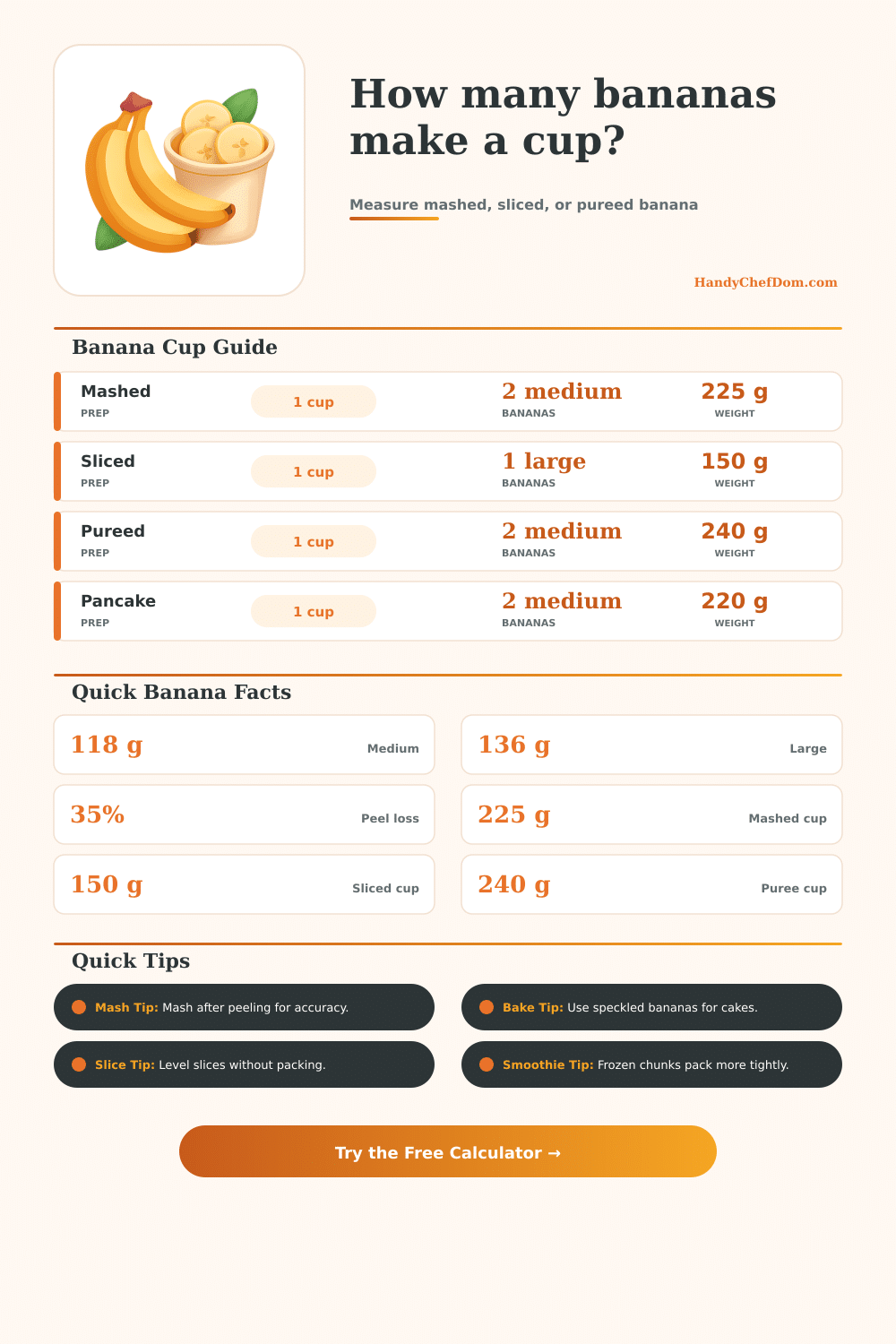
🍌 Bananas Per Cup Calculator
Convert whole bananas into mashed, sliced, or pureed cups for baking, smoothies, pancakes, bowls, and batch prep.
Set the cup amount you need, then match the banana size, ripeness, peel loss, and prep style. The calculator estimates edible weight, whole bananas, and serving yield.
| Prepared Form | Grams per Cup | Approx Bananas | Best Use |
|---|---|---|---|
| Mashed banana | 225 g | About 2 medium | Banana bread, muffins, pancakes |
| Sliced banana | 150 g | About 1 large | Fruit salad, oatmeal, yogurt bowls |
| Pureed banana | 240 g | About 2 medium | Smoothies, baby puree, sauces |
| Loose chunks | 170 g | About 1.5 medium | Blending cups and quick prep bowls |
| Frozen chunks | 160 g | About 1.4 medium | Smoothies and frozen dessert bases |
| Diced banana | 175 g | About 1.5 medium | Muffins, breakfast cups, snack boxes |
| Banana Size | Edible Weight | Whole Weight | Mashed Yield |
|---|---|---|---|
| Mini banana | 70 g | 108 g | 0.31 cup |
| Small banana | 101 g | 155 g | 0.45 cup |
| Medium banana | 118 g | 182 g | 0.52 cup |
| Large banana | 136 g | 209 g | 0.60 cup |
| Extra-large banana | 152 g | 234 g | 0.68 cup |
| Jumbo banana | 170 g | 262 g | 0.76 cup |
| Ripeness | Volume Shift | Texture | Use Note |
|---|---|---|---|
| Firm yellow | Needs 4% more | Holds shape | Best for neat slices and toppings |
| Ripe yellow | Standard | Soft but tidy | Good all-purpose banana measure |
| Speckled ripe | Needs 3% less | Mashes easily | Great for baking and pancakes |
| Very ripe | Needs 6% less | Dense mash | Strong banana flavor for batter |
| Soft overripe | Needs 8% less | Wet puree | Useful when sweetness is desired |
| Frozen ripe | Needs 5% more | Moist after thaw | Drain if thawed liquid separates |
| Kitchen Use | Preferred Form | Cups to Start | Measurement Note |
|---|---|---|---|
| Banana bread | Mashed | 1 to 1.5 cups | Level the cup after mashing |
| Smoothie blend | Pureed or chunks | 0.75 to 1 cup | Frozen pieces pack loosely |
| Pancake batter | Mashed | 0.5 to 1 cup | Use ripe banana for smooth batter |
| Muffin mix | Mashed or diced | 0.75 to 1 cup | Diced banana gives visible pieces |
| Baby puree | Pureed | 0.25 to 0.5 cup | Puree is denser than slices |
| Breakfast bowls | Sliced | 0.25 to 0.5 cup | Do not press slices into the cup |
When you’re trying to convert bananas into CUPS, it never seems to work out exactly the way your gut says it should. For example, three medium banana might not turn into two cups of mashed banana. How can you reliably know when that’s going to be the case? Enter a calculator that figures out the math for you. Simply enter the ripeness and size of your bananas then let the machine tell you what to expect. You won’t have to wonder if yours is too crowded or needs extra piece to reach the goal.
But here’s why estimating won’t work: As the texture of your bananas changes, so do volume and weight. If you’re not aware, a cup of mashed-up bananas isn’t going to take up as much room than a cup of sliced ones (because there’s air trapped in between those slice). Similarly, people tend to think of it as a uniform thing, but the way the fruit is prepared make a huge difference in its density. For example, if you mash up your bananas for a batter that needs some sort of thickening structure, you’ll likely want fewer bananas by weight to get to a cup than if you were slicing them up for oatmeal topping.
Why a Banana Calculator Helps You Bake Better
The device accounts for the kind of preparation you’ve done (whether it’s firm slices), chunky pieces, or something packed like puree; and adjust how much “real” banana will fit into a cup to match. Another thing that changes ripening, something home cooks don’t always factor into their kitchen estimates. Is the nature of fruit itself. Water moves around inside a banana as its cells weaken and eventually break apart. A soft, overripe banana feels heavier in your palm not so much because it has gained weight, but because it has lost its structure.
Mashed up, an overripe fruit will be denser: You won’t use quite as many (by count) to fill a measuring cup as with firm but still yellow bananas, which hold air pockets. The calculator lets you account for this difference in texture, guaranteeing you’ll get a right-sized batch of batter that isn’t too wet or too dry, simply based off how the peel looks.
The peel also matters for baking math. Because the peel is about thirty-five percent of the banana’s overall weight, every time you buy a fruit that weighs two-hundred grams, most of us believe we’re getting two-hundred grams of banana. In fact, all you’re left with is around one-hundred and twenty grams of food once the peel comes off. And if your recipes call for precise hydration ratios, this means you’ll have to buy more whole fruits than you think because you’re not accounting for the weight of the peel. The tool takes that into account automatically, so resulting number of whole bananas will represent what’s actualy needed, no over-optimistic estimates here.
Measurement variances add a new twist to the batch-cooking dynamic because they adds up fast (a 1/2-ounce difference is small in one pancake, but noticeable when multiplied by four-dozen muffins). Baby Purees and Banana Bread are examples of presets that help control variables so that consistency you’re looking for on Friday will be the same as what you achieved on Tuesday.
If you know how fruits relate to each other, volume, shape, size, you don’t have to weigh them all. For instance, a mid-ripe banana is your friend (a sure bet). Nature never offers us perfectly consistent produce: some bananas are fat and some are thin. The calculator closes that distance and allow you to pick the actual size of the fruit you have in front of you. It converts that real-world difference into practical kitchen terms.
It’s a lesson in density: When it comes to baking with fruit, precise doesn’t mean exact. It means knowing that your recipe calls for two cups of mashed banana, not necessarily less or more, knowing that mashing compresses the fruit so it takes up less space than slices. Know that more-ripe fruit weighs more per cup than under-ripe, and know that mashing something makes it denser and takes up less space. You should of gotten this stuff down, and those numbers will begin to fall into place.
Instead of making an educated guess on whether there’s enough fruit on that pile, you’ll trust the math of the mash. You’ll know just where your ingredient lies on the scale of predictability, which is precisely what good baking needs.