🥩 Top Round Roast Cooking Time Calculator
Estimate top round roast oven time from roast weight, thickness, oven temperature, target doneness, sear style, marinade state, rest time, slicing plan, and guest count.
Use the thickest part of the top round roast for the thickness field. The calculator gives a time window, an early thermometer check, a pull temperature estimate, and a service yield based on your slicing plan.
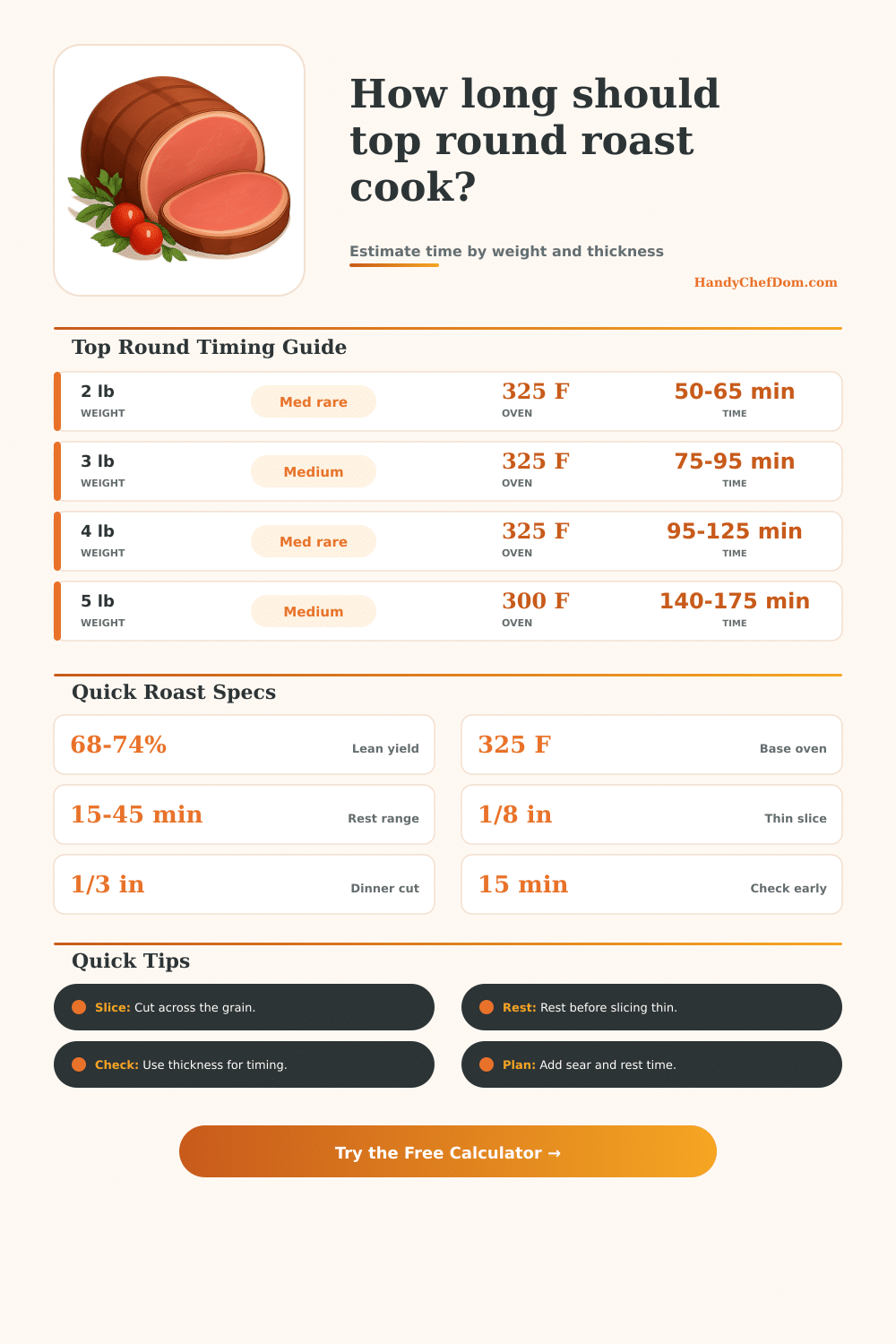
| Raw Weight | Typical Thickness | 325 F Medium Rare Window | Best Use |
|---|---|---|---|
| 2 to 2.5 lb | 2.3 to 2.8 in | 45 to 65 minutes | Small dinner roast |
| 3 to 3.5 lb | 3.0 to 3.6 in | 70 to 95 minutes | Family roast |
| 4 to 4.5 lb | 3.5 to 4.2 in | 95 to 125 minutes | Holiday platter |
| 5 to 6 lb | 4.0 to 5.0 in | 125 to 165 minutes | Buffet slicing |
| 7 to 8 lb | 4.8 to 5.8 in | 165 to 215 minutes | Large gathering |
| Target Doneness | Final Center Goal | Base Pace At 325 F | Slice Result |
|---|---|---|---|
| Rare | 125 F | 17 to 19 min per lb | Very rosy center |
| Medium rare | 135 F | 20 to 22 min per lb | Rosy and juicy |
| Medium | 145 F | 23 to 26 min per lb | Light pink center |
| Medium well | 155 F | 27 to 30 min per lb | Faint pink center |
| Well done | 165 F | 31 to 35 min per lb | Fully cooked through |
| Oven And Sear Plan | Timing Effect | Use When | Planning Note |
|---|---|---|---|
| No separate sear | Baseline oven time | Simple roast schedule | Add rest time after oven |
| Pan sear first | Shorter oven time, more active time | You want browned edges | Add about 10 active minutes |
| High heat oven start | Faster surface heat | Larger roasts with dry exterior | Count the hot start in total time |
| Reverse sear after rest | Gentler oven estimate | Thin slicing and even center | Add sear after the rest |
| Lower oven roasting | Longer but steadier | Lean top round texture control | Start checking before the window |
| Slicing Plan | Slice Thickness | Cooked Portion | Good For |
|---|---|---|---|
| Dinner slices | About 1/3 inch | 5.5 oz per guest | Standard plated meal |
| Thin platter | About 1/4 inch | 4.5 oz per guest | Buffet or mixed sides |
| Shaved sandwich | About 1/8 inch | 3.5 oz per guest | Sandwiches and wraps |
| Thick carving | About 1/2 inch | 7 oz per guest | Hearty roast plates |
| Meal prep portions | Thin packed slices | 4 oz per portion | Lunch bowls or salads |
Calculator estimates are planning guides for top round roast timing. Oven behavior, roast shape, starting temperature, and thermometer placement can change the final cooking window.
Top round roast are a lean cut of beef. Because top round roast is lean, top round roast will cook more faster than a rib roast or a chuck roast. However, because top round roast is lean, the top round roast have the potential to become dry very easyy if it is cooked for too long.
You will need to adjust the cooking time, the oven temperature, and the way that you slice the top round roast to the weight and the shape of the cut of beef that you purchases. The weight of the top round roast will help you to determining the cooking time. However, the thickness of the roast will play a bigger role in determining the cooking time.
How to Cook a Top Round Roast
For example, a three-pound top round roast that is four inch tall will take longer to cook than a three pound top round roast that is relatively flatly. A cooking time calculator will help you to determine the cooking time for your top round roast because it can account for the thickness of the roast. The oven temperature will also play a key role in the cooking processes.
A temperature of 325 degrees are common in the home. However, 300 degrees is recommended if you are worried about the edges of the roast drying out. Finally, a temperature of 375 degrees will sear the top round roast quick so the exterior will be browned, thus reducing the cooking time needed to cook the roast to your desire doneness.
The doneness of the roast is critical important because there is very little marbling on this cut of beef. Marbling is the fat inside the roast that help to keep the roast moist. If you cook the top round roast to medium rare the center will be pink and tender.
If you cook the roast to medium the center will be pink towards the edge of the roast and the roast will be firmer to the touch. A cooking calculator will help you to determine the temperature to which you should pull the roast from the oven. This temperature account for the carryover cooking that will occur after the roast is pulled from the oven.
You can sear the roast before cooking it in the oven or you can cook it in the oven to searing the roast. The starting temperature of the roast will alter the cooking time for the roast. If you remove the roast from the refrigerator it will take longer to cook than if you let the roast sit out on the counter for one hours.
Additionally, you should allow the roast to rest after cooking. Fifteen minutes of resting will allow the muscle fibers of the roast to relax. However, to allow the juices to remain in the roast you should let the roast rest for thirty to forty five minutes after cooking.
The way that you will slice the roast will determine how many people will eat the roast. Thinly slice roasts are tender and will allow one serving of roast to feed more people. Thickly sliced roasts will feed one person but will use up the roast quick.
Additionally, you should cut against the grain of the roast. The grain indicate the direction of the muscle fibers of the roast. If you cut with the grain of the roast the roast will be difficult to chewing.
Many cook make mistakes when preparing a top round roast. For example, some people will use a very hot oven temperature and leave the roast in the oven alone. This will result in the edges of the roast drying out.
Additionally, people often forget to let the roast rest after cooking which will make the roast lose it’s juices when it is cut. To avoid these mistake you can measure the thickness of the roast, use the correct oven temperature for the size of the roast, and allow the roast to rest for the proper length of time. Following these steps will result in a tender roast that is easy to slice.