🥩 Top Sirloin Roast Cooking Time Calculator
Estimate roast time, pull temperature, carryover rise, resting minutes, and slice count for top sirloin roasts from weeknight dinners to holiday platters.
Enter the roast size and target finish. The calculator estimates oven minutes, pull temperature, carryover, rest time, cooked yield, and serving slices.
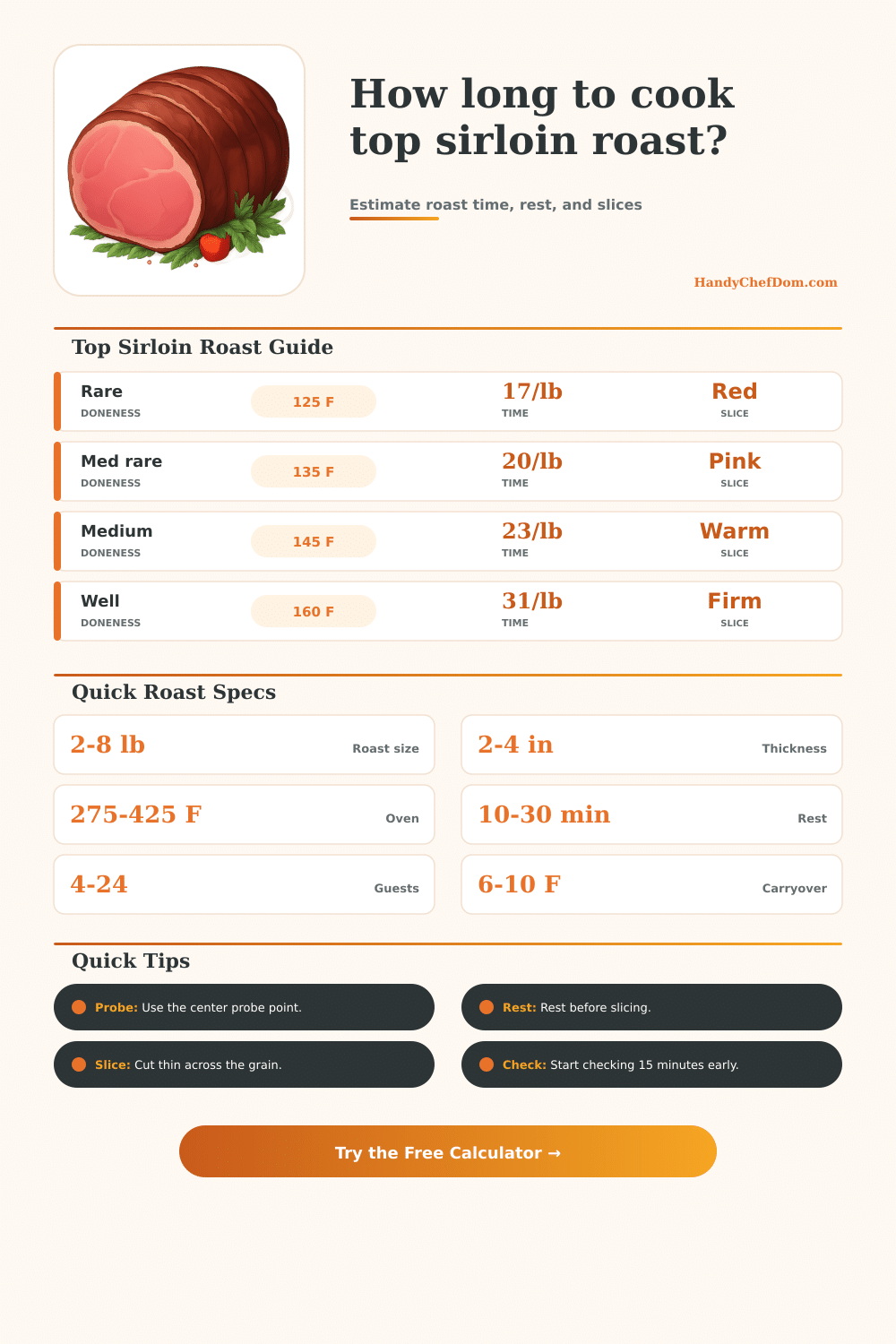
| Doneness | Finish Target | Pull With 8 F Rise | Base Time At 325 F |
|---|---|---|---|
| Rare | 125 F | 117 F | 17 min/lb |
| Medium rare | 135 F | 127 F | 20 min/lb |
| Medium | 145 F | 137 F | 23 min/lb |
| Medium well | 150 F | 142 F | 26 min/lb |
| Well done | 160 F | 152 F | 31 min/lb |
| Oven Setting | Best Fit | Timing Effect | Calculator Use |
|---|---|---|---|
| 275 F | Reverse sear | Slower | More even center |
| 300 F | Large roast | Moderate slow | Good for thick cuts |
| 325 F | Classic roast | Baseline | Default estimate |
| 350 F | Weeknight roast | Faster | Good for 2-4 lb |
| 375 F | High heat | Fast | Check earlier |
| 425 F | Short blast | Very fast | Use with care |
| Guests | Raw Roast | Cooked Yield | Slice Plan |
|---|---|---|---|
| 2-3 | 2 lb | 24 oz | 4-6 slices |
| 4-5 | 3 lb | 36 oz | 8-10 slices |
| 6-8 | 4.5 lb | 53 oz | 12-16 slices |
| 9-12 | 6.5 lb | 77 oz | 18-24 slices |
| 13-16 | 8 lb | 95 oz | 26-32 slices |
| Roast Shape | Thickness | Time Change | Yield Note |
|---|---|---|---|
| Low, wide roast | 2 in | About 10% less | Fast center heat |
| Average roast | 3 in | Baseline | Standard estimate |
| Thick roast | 4 in | About 12% more | Check center point |
| Tied even roast | 3 in | About 5% less | Even slices |
| Fat cap left | 3 in | Baseline | Lower carved yield |
Top sirloin roast are a cut of meat that falls somewhere in between tender meat and tough meat. Because top sirloin roast is a cut of meat that is in between tender and tough meats, it is difficult to determine the cooking timing for an top sirloin roast roast. Many people selects a top sirloin roast roast because it contain flavor, as well as because it is less expensive than roasts like ribeye or tenderloin roasts.
In order to enjoy the benefit of a top sirloin roast roast, however, it is important to cook the roast in such a way that the slices of meat remains juicy and easy chewable. The timing for roasting a top sirloin roast roast can include several different factors, such as the size of the roast, the thickness of the roast, and the starting temperature of the roast. Carryover rise is the continued rise in the internal temperature of the roast after it has been removed from the roasting oven.
How to Cook a Top Sirloin Roast
Carryover rise occur in roasts because the heat that is stored in the roast will continue to cook the roast’s center after the roast has been removed from the oven. Carryover rise is an especially important concept to understand with lean roasts like top sirloin roast roasts, as those roasts contains less fat than many other roasts. Less fat mean that there is less meat that help to retain the heat of the roast.
Therefore, small roasts will experience a significant drop in temperature after they are removed from the oven, leading to a small carryover rise. However, large roasts will retain more heat, leading to a larger rise in the roast’s center after it is remove. The thickness of the roast will impact the cooking time for that roast.
A wide and low roast that is two inches thick will require a shorter cooking time than a tall and narrow roast of the same weight. This is due to the shorter distance that the heat must travel to the center of the meat. Additionally, the temperature of the oven will impact the cooking time.
A lower oven temperature will allow roasts to be cooked more slow so that they are less likely to overcook the outside of the roast. Higher oven temperatures will decrease the cooking time. In high oven temperatures, though, the cook will require more frequent check to ensure it does not cook beyond the target temperature.
The starting temperature of the roast will also impact the cooking time. A roast that is taken directly out of the refrigerator will require more cooking time than a roast that has been at room temperature for an hour. While the difference in cooking time for a two-pound roast is small, the difference is significant for roasts that weighs more than four or five pounds.
Another choice to make before cooking is whether to pre-sear the roast. A pre-sear will sear the roast prior to roasting, adding both browning to the roast and heat to the roast prior to roasting. A reverse sear will sear the roast only after it has been cooked, though, meaning that the initial sear will be the last of the roast’s cooking process.
Each of these method will impact the total cooking time for the top sirloin roast. The yield of the roast is the weight of the top sirloin roast after roasting. Because top sirloin roast is a lean roast, the roast will drop in weight more than a cut of roast that contain more fat.
Additionally, the trimming of the roast will impact the roast’s total yield. If a fat cap is left on the roast, the fat cap will protect the roast from the outside world. However, the fat cap will reduce the amount of usable roast that can be carved from the roast.
If lean trim is used, however, there will be more usable roast after it is carved. Many cook make mistakes when roasting top sirloin roasts. For instance, they may use the same amount of time per pound for a three-pound roast and a six-pound roast.
Furthermore, many cooks will skip the resting period for the roast. During the resting period, the juices will have time to settle within the roast. Additionally, the roast will have time for its carryover rise to fully complete when the roast is removed from the oven.
If it is not allowed to rest, the juices will release on the cutting board. Finally, there are a few other factors to consider prior to roasting a top sirloin roast. The first is in how many slices of roast you would like to serve to your guest.
Thinly sliced roasts will allow you to feed more people than thick sliced roasts. Several factors impact cooking time for a top sirloin roast roast. These factor include the weight of the top sirloin roast, the thickness of the roast, and the temperature of the oven in which the roast is cooked.