🍪 Brown Sugar Cup Weight Converter
Convert brown sugar cups into grams, ounces, pounds, tablespoons, and scaled baking amounts with packed versus loose cups, light versus dark sugar, and moisture adjustments.
Choose how the cup is filled, then scale it for the actual batch. A firmly packed cup should release as a shaped mound; a loose cup is spooned in without pressing.
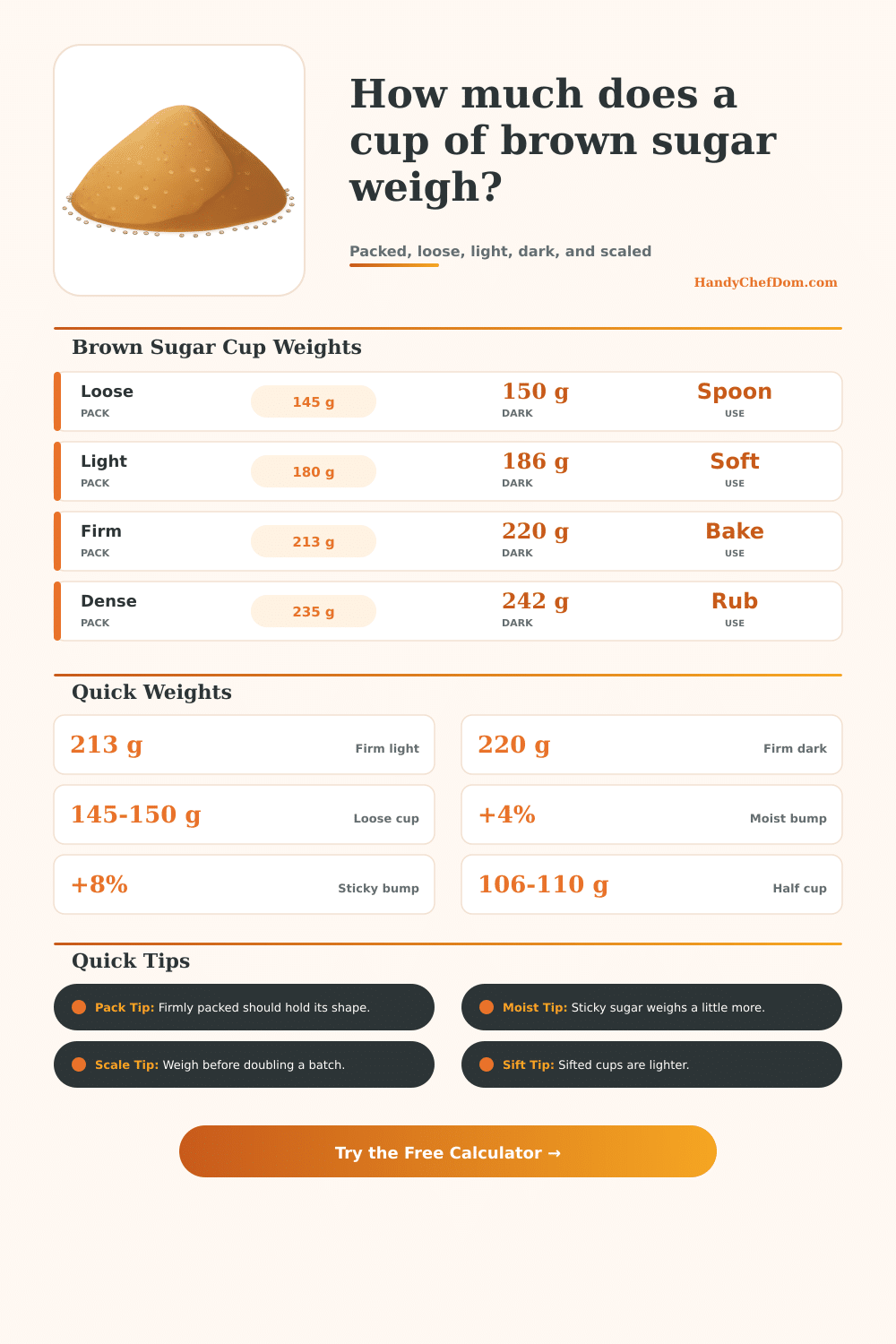
| Packing style | Light brown | Dark brown | Best use |
|---|---|---|---|
| Loose spooned cup | 145 g / 5.1 oz | 150 g / 5.3 oz | Spoon-only measures |
| Lightly packed cup | 180 g / 6.3 oz | 186 g / 6.6 oz | Soft fill notes |
| Firmly packed cup | 213 g / 7.5 oz | 220 g / 7.8 oz | Most baking formulas |
| Very firmly packed cup | 235 g / 8.3 oz | 242 g / 8.5 oz | Dense rubs or clumps |
| Sugar type | Firm cup | Moisture note | Flavor weight cue |
|---|---|---|---|
| Light brown sugar | 213 g | Moderate molasses | Standard cookies |
| Dark brown sugar | 220 g | More molasses | Chewier bakes |
| Light muscovado | 225 g | Fine and damp | Deep caramel |
| Dark muscovado | 235 g | Very sticky | Molasses-forward |
| Golden brown sugar | 205 g | Lighter crystals | Milder sweetness |
| Homemade molasses sugar | 218 g | Varies by mix | Check by scale |
| Recipe scale | 1 cup firm light | 1 cup firm dark | Tablespoons |
|---|---|---|---|
| Half batch, 0.5x | 106.5 g | 110 g | 8 tbsp |
| Standard, 1x | 213 g | 220 g | 16 tbsp |
| One and half, 1.5x | 319.5 g | 330 g | 24 tbsp |
| Double batch, 2x | 426 g | 440 g | 32 tbsp |
| Triple batch, 3x | 639 g | 660 g | 48 tbsp |
| Common amount | Firm light | Firm dark | Kitchen note |
|---|---|---|---|
| 1 tablespoon | 13.3 g | 13.8 g | Level after packing |
| 1/4 cup | 53 g | 55 g | Small batch |
| 1/3 cup | 71 g | 73 g | Bar cookies |
| 1/2 cup | 106.5 g | 110 g | Many toppings |
| 3/4 cup | 160 g | 165 g | Cake layers |
| 2 cups | 426 g | 440 g | Large trays |
Cup weights are practical kitchen estimates for brown sugar conversion. For exact baking tests, weigh the sugar after measuring once and reuse that gram target.
That’s because baking with brown sugar is as much physics as it is chemistry. That’s the part most people miss.
Maybe you’ve measured each cup carefully, but ended up with dense gingerbread or dry cookies. Chances are, it isn’t the oven temperature. Rather, it’s the sticky crystals of sugar, and all the air trapped among them.
Why You Should Weigh Brown Sugar
Brown sugar is more than simply sugar. It is sugar coated with molasses. This makes it behave different than sugar when measured on a scale or in a cup. A lightly spooned cup of sugar can contain maybe 145 grams. A tightly packed cup can weigh around 213 grams, nearly half again as much as a loose one. That’s almost half again as much sugar in the same space.
So if you’re dipping and sweeping instead of pressing it down hard, don’t expect a recipe that calls for a tight pack to work out right. When we press our sugar down, molasses works as glue, and helps hold those grains together tightly. But if you leave your sugar in open bag and let it dry out, it won’t stick together so tightly, and regardless of how much you try to stuff it into the measuring cup it will remain lightweight and airy.
That is why you’ll often see recipes calling for “firmly packed” brown sugar. They don’t want a cloud; they want a brick.
You also need to know what kind of sugar you’re working with. If it’s dark brown sugar, there’s more molasses in there than there is in light. That means it weigh a little more per cup. It also has more moisture, but we’ll get back to that later. After you enter the type of sugar you’re using, and choose your packing style, the calculator does all the math for you so you don’t have to guess if your slightly darker sugar is going to mess up the ratio or not.
It takes into account how it feels as well. Is your sugar fresh, moist, soft, still in its bag? Or is it dry, crumbly, already out of its bag and been on the counter for weeks? You can take that variation into account with the tool and get a target weight that aligns with your real-life sugar situation instead of some perfect textbook standard.
Then there’s the issue of scaling. When you double the recipe, you don’t double the cups; you double the mass. Use twice as much light brown sugar. Triple? Forget it. Measuring by volume when trying to make a triple batch of bars leads to compaction errors gone wild. Precision comes from weighing.
A firmly packed cup of light brown sugar weigh 213 grams. So when I want to make three batches, I can just multiply that value by three: 639 grams total. Pour in until the scale stops beeping. You don’t have to shake, press, or guess whether the second cup is as tight as the first.
The silent force in all of this is moisture. Wet sugar weigh more and will be clumpier and stickier compared to dry granules. That little extra moisture cushion makes the difference between a crunchy cookie and a mushy cookie. And the chart on that page spells it out nicely with the density/firmness/lightness levels compared to each other. This is good if you just want to quickly check something without running the full calculation process.
Where it really shines, though, is repeatability. Learn what your starting weight is (with the packer and brand of sugar you use), and you’ll get the same result again and again. The cup got you this far. Now trust the gram.
The gram is the ingredient, and the cup is the container. And once you switch to weighing, you’ll start baking with your ingredients; not just air pockets you fight with every time. This may seem like a minor change in habit, but it changes everything. Not only will your next batch look better, it will taste exactly like you remember it should of tasted. You finally measured the thing that matters, not the thing that fits.