🍗 Chicken Breast Cooking Time Calculator
Estimate chicken breast cooking time from breast weight, thickest point, boneless or bone-in style, cooking method, target temperature, brine, rest time, serving plan, and batch size.
Use the thickest part of the breast for timing. The calculator scales time by method heat, individual breast size, thickness, bone-in style, brining, batch crowding, rest time, and finish temperature.
Best for batches, bone-in breasts, and hands-off timing with a wider finish window.
Best for thin or pounded breasts; turn once and use a short rest before slicing.
Works well for 1 to 4 breasts with hot circulating air and compact batches.
Fast direct heat for boneless breasts; thicker bone-in pieces need a cooler zone.
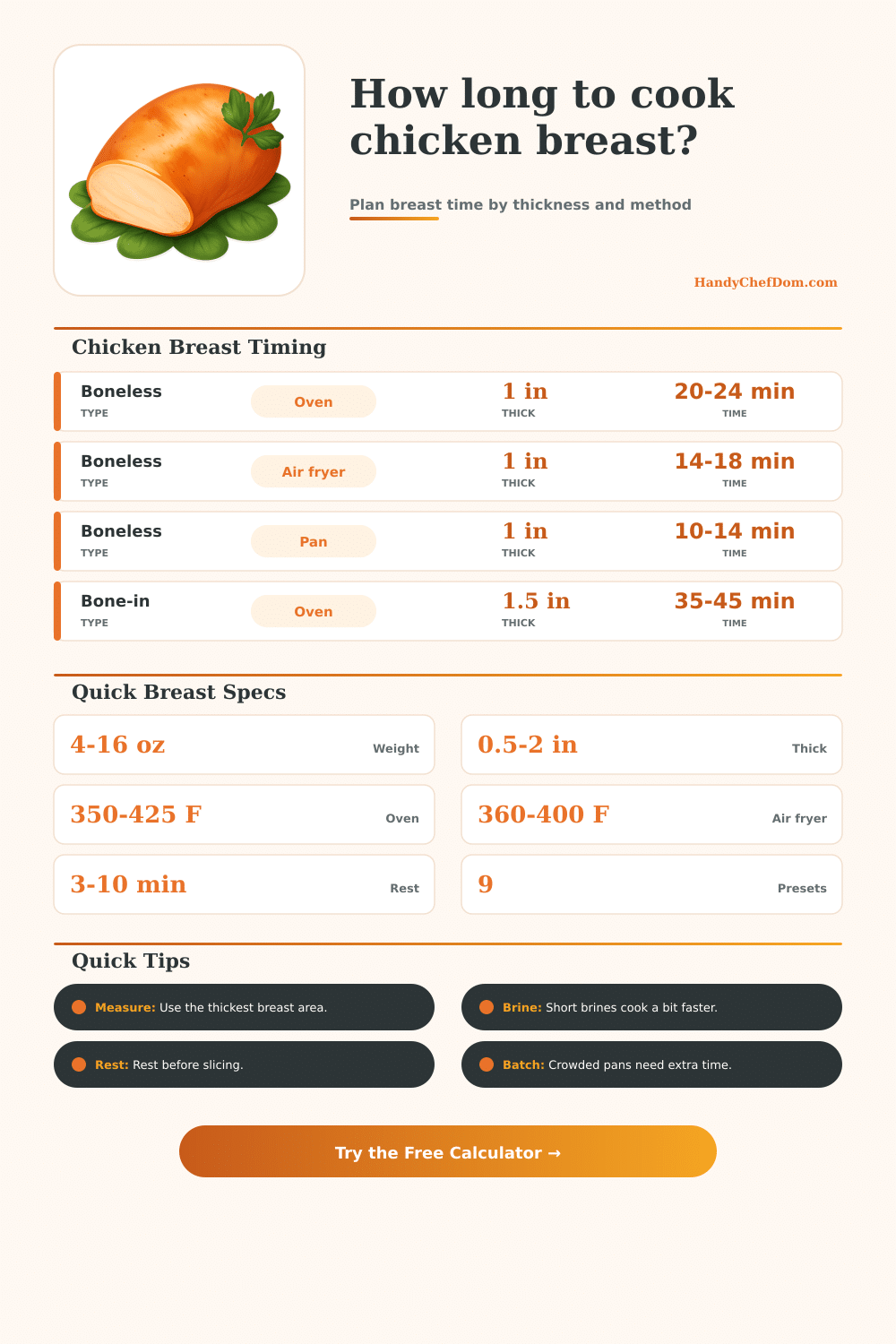
| Thickness | Typical weight each | Oven 400 F | Air fryer 380 F | Pan or grill |
|---|---|---|---|---|
| 1/2 inch | 4 to 5 oz | 12 to 16 minutes | 9 to 12 minutes | 6 to 9 minutes |
| 3/4 inch | 5 to 7 oz | 16 to 20 minutes | 12 to 15 minutes | 8 to 11 minutes |
| 1 inch | 7 to 9 oz | 20 to 24 minutes | 14 to 18 minutes | 10 to 14 minutes |
| 1 1/4 inch | 9 to 12 oz | 24 to 30 minutes | 17 to 22 minutes | 13 to 17 minutes |
| 1 1/2 inch | 12 to 16 oz | 30 to 36 minutes | 21 to 27 minutes | 16 to 22 minutes |
| Breast style | Thickness | Oven range | Grill range | Timing note |
|---|---|---|---|---|
| Bone-in split breast | 1 1/4 to 1 1/2 in | 35 to 45 minutes at 375 F | 28 to 40 minutes indirect | Bone side slows center heating |
| Bone-in large breast | 1 1/2 to 2 in | 42 to 55 minutes at 375 F | 38 to 52 minutes indirect | Start checking early near the bone |
| Stuffed breast | 1 1/4 to 1 3/4 in | 28 to 42 minutes at 375 F | Not ideal for direct grill | Filling adds thermal mass |
| Skin-on boneless | 1 to 1 1/2 in | 22 to 34 minutes at 400 F | 14 to 22 minutes direct | Skin helps protect surface |
| Target finish | Common pull temp | Rest window | Carryover used | Best fit |
|---|---|---|---|---|
| 155 F finish | 151 to 153 F | 6 to 8 minutes | 2 to 4 F | Juicy brined breasts |
| 160 F finish | 156 to 158 F | 5 to 7 minutes | 2 to 4 F | Standard dinner slices |
| 165 F finish | 161 to 163 F | 4 to 6 minutes | 2 to 4 F | Default thermometer target |
| 170 F finish | 167 to 169 F | 3 to 5 minutes | 1 to 3 F | Bone-in or sauced pieces |
| Scenario | Adjustment | Cooked yield | Serving estimate | Calculator cue |
|---|---|---|---|---|
| Dry brined boneless | Cook 3% faster | About 76% | 5 to 6 oz dinner | Set brine to dry |
| Wet brined boneless | Cook 5% faster | About 78% | 5 to 6 oz dinner | Set brine to wet |
| Crowded air fryer | Add 6% to 14% | About 74% | 4 to 5 oz lunch | Use actual breast count |
| Meal prep batch | Add rest and slicing time | About 74% | 4 oz portions | Choose meal prep portions |
Chicken breast timing is an estimate for planning. Use the calculator window as a check schedule and rely on your thermometer reading for the final pull point.
Cooking chicken breast requires consider several different variables. Chicken breast change texture based off the variables you use in the cooking process. For example, if the chicken breast is cooked for too long, the chicken breast will become dryly and stringy.
However, if the cook remove the chicken breast from the heat source too early, the chicken breast will remain undercooked. Several variables needs to be considered prior to cooking the chicken breast, including the thickness of the chicken breast, whether the chicken breast contain a bone, the starting temperature of the chicken breast, and how you will cook the chicken breast. The thickness of the chicken breast is one of the primary factors in how long it take for the chicken breast to cook.
How to Cook Chicken Breast
If the piece of chicken breast is thin, it will cook relatively quick since the heat will easily reach the center of the chicken breast. Conversely, if the piece of chicken breast is thick, it will take longer for the heat to reach the center of the chicken breast to ensure that it reach the target temperature. In these cases, the cook should measure the chicken breast for temperature at the thickest part of the chicken breast.
Another variable to consider is whether the chicken breast contain a bone. Because the bone will naturaly absorb some of the heat that is cooking the chicken breast, the chicken breast with the bone will take longer to cook than one without a bone. Thus, the cooking time for a chicken breast with a bone cannot be the same as one without a bone.
Another factor is the starting temperature of the chicken breast. Because the starting temperature of the chicken breast will impact how long it take to reach the target temperature, a chicken breast that starts at a cooler temperature (like out of the refrigerator) will require more time to cook than one that begins at room temperature. Thus, allowing the chicken breast to sit out on the counter for some period prior to cooking will reduce the cooking time.
The cooking method will change the way that the chicken breast react to heat. Ovens provide even heat to the chicken breast, and ovens allow for many piece of chicken breast to be cooked at the same time. Pan or grill heat the chicken breast to the surface only, as the high heat can cause the surface of the chicken breast to brown before the center of the chicken breast is cooked.
Air fryers use heat to cook the chicken breast, but the heat may dry out the surface of the chicken breast if the pieces of chicken breast are too close together. Brining change the way the chicken breast retains moisture and cooks. Brining with water will slightly increase the rate of heat transfer into the chicken breast.
Using salt on the surface of the chicken breast (dry brining) allows the chicken breast to hold more juices. Using brine also reduce the cooking time of the chicken breast, so the cook will need to adjust the cooking method if the chicken breast is brined. After cooking the chicken breast, it must be allowed to rest.
Even after the cook remove the chicken breast from the heat source, the heat within the chicken breast will continue to even the temperature of the chicken breast. If the chicken breast is removed from the heat source before it reaches the proper internal temperature, the carryover heat will heat the chicken breast to the correct temperature. Allowing the chicken breast to rest also prevents the chicken breast from lose its moisture.
Finally, another important aspect of cooking chicken breast is considering the cooked yield. When chicken breast is cooked, some of the moisture evaporates from the chicken breast, causing the chicken breast to lose some of its weight. If the chicken breast is being prepared for meal prep, the weight loss should of been considered.
By considering the thickness of the chicken breast, the weight of the bone, the cooking temperature, the use of a brine, the cooking method, and the resting period of the chicken breast, the cook can prepare the chicken breast in a manner that assure that each batch of chicken breast is cooked the same way.